
Pale-headed Rosella Identification Guide
An Australian parrot with a pale creamy-yellow head, blue cheeks, and a scalloped black-and-buff back, found across northeastern Australia.
Read the full Pale-headed Rosella encyclopedia entry →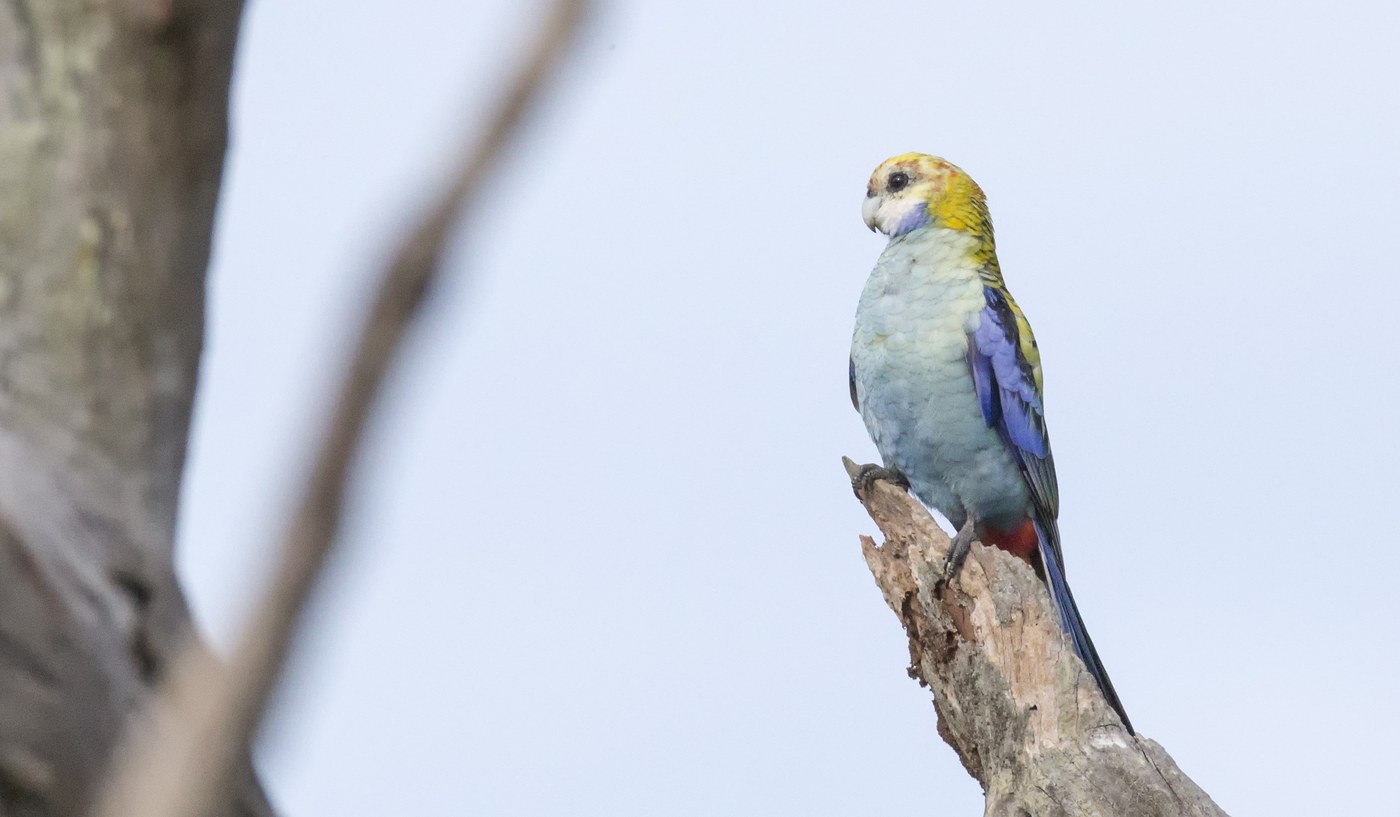
Key Field Marks
- Size & shape: A medium-sized parrot around 30 cm long, with the typical rosella build — a fairly long tail and stocky body.
- Head: Pale creamy-yellow to whitish crown and face, unlike the red heads of most other rosella species.
- Face pattern: Prominent pale blue-white cheek patch bordered by a thin blue edge.
- Body: Deep blue underparts and rump; back and wings are black with each feather broadly edged pale buff-yellow, creating a scalloped pattern. Vent and undertail area show scarlet-red.
- Behavior: Usually seen in pairs or small flocks feeding on seeds, blossoms, and fruit in open woodland and along tree-lined farmland; flight is undulating with audible wingbeats.
Separating It from Similar Species
- Eastern Rosella: Has a bright red head and breast rather than pale yellow-white; ranges approach in parts of southeastern Queensland and northern New South Wales, where hybrids with intermediate (dull orange-red) head color occur.
- Northern Rosella: Black head rather than pale, found further north and west (Top End/Kimberley); ranges do not overlap with Pale-headed Rosella.
- Hybrid birds: Look for a head color intermediate between pale yellow and red, indicating Eastern x Pale-headed intergrades in the contact zone.
Where & When to See It
- Range: Endemic to northeastern Australia, from Cape York Peninsula in Queensland south through to northern New South Wales.
- Habitat: Open eucalypt woodland, farmland with scattered trees, roadside vegetation, and increasingly parks and gardens in towns.
- Season: Resident year-round; no significant migration.
Voice
A metallic, bell-like "kwik-kwik" or "pink-pink" contact call given in flight, along with softer chattering notes when feeding in groups.
Frequently asked questions
How is a Pale-headed Rosella different from an Eastern Rosella?
Pale-headed Rosella has a pale creamy-yellow head, while Eastern Rosella has a bright red head; their ranges overlap slightly, producing occasional hybrids with intermediate head color.
Do Pale-headed Rosellas migrate?
No, they are non-migratory residents throughout their northeastern Australian range.
What habitat do Pale-headed Rosellas prefer?
Open woodland, farmland edges, and increasingly suburban parks and gardens with mature trees.
What color is a Pale-headed Rosella's vent?
Scarlet red, contrasting with the blue underparts and pale head.