
Pale Chanting Goshawk Identification Guide
A pale gray southern African raptor with long red-orange legs and a black-and-white banded tail, often seen perched on roadside poles.
Read the full Pale Chanting Goshawk encyclopedia entry →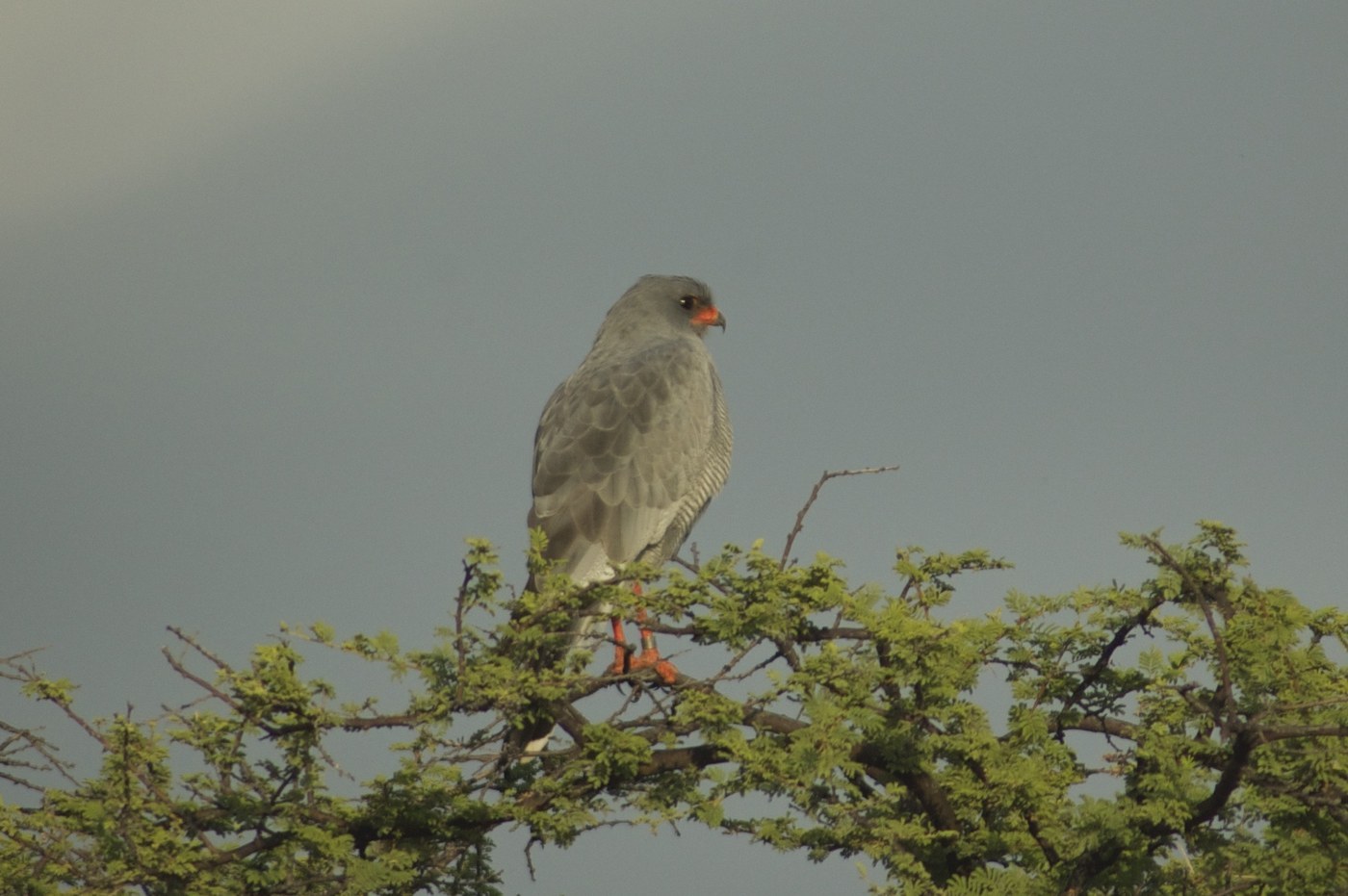
Key Field Marks
- Size & shape: A medium-large raptor, about 50–56 cm long, with a fairly slim build, long wings, and notably long legs for a hawk.
- Plumage: Pale blue-gray head, breast, and upperparts; the belly and flanks are finely barred gray-and-white. In flight the wings show pale gray coverts contrasting with blackish flight feathers.
- Tail: Black tail with bold white barring, obvious both perched and in flight, and a white rump patch visible when flying away from the observer.
- Bare parts: Bright red-orange legs and a matching red-orange cere (base of the bill) stand out even at a distance.
- Behavior: Frequently perches conspicuously on fence posts, utility poles, or the tops of small trees in open country, scanning for prey. Often walks on the ground chasing prey, including flushing insects with wing-flicking, and reptiles/small mammals.
Separating It from Similar Species
- Dark Chanting Goshawk: Overall darker slate-gray with a shorter tail-to-wing projection at rest and orange (not red) legs; ranges overlap in parts of Namibia and Botswana, so check overall tone — Pale Chanting is noticeably paler on the head and breast.
- Eastern Chanting Goshawk: East African, essentially allopatric with Pale Chanting Goshawk, similar but slightly different structure; range separates them.
- Gabar Goshawk: Much smaller and shorter-legged, with a plain gray hood and no barring extending as far down the belly.
Where & When to See It
- Range: Southern Africa, including Namibia, Botswana, South Africa, and southern Angola.
- Habitat: Arid and semi-arid savanna, Karoo scrub, and semi-desert with scattered trees or poles for perching.
- Season: Resident year-round; most easily found along quiet roads through open farmland or reserves where poles provide regular perches.
Voice
The name comes from its melodious, far-carrying "chanting" song — a series of clear, piping whistled notes, most often given at dawn during the breeding season, sometimes in duet between pairs.
Frequently asked questions
What color are a Pale Chanting Goshawk's legs?
Bright red-orange, a key field mark that helps separate it from the similar Dark Chanting Goshawk, which has orange (less red) legs.
How do I tell Pale from Dark Chanting Goshawk?
Pale Chanting Goshawk has a distinctly paler gray head and breast; Dark Chanting Goshawk is overall darker slate-gray, and their ranges only narrowly overlap.
Why is it called a 'chanting' goshawk?
Breeding birds give a melodious series of piping whistles described as a song or chant, unusual among hawks, especially heard at dawn.
Where do Pale Chanting Goshawks like to perch?
Prominent open perches such as utility poles, fence posts, and isolated trees in arid savanna and scrub country.