
Painted Stork Identification Guide
A large South and Southeast Asian wetland stork told by its pink-tinged tertials, black breast band, and long yellow-orange decurved bill.
Read the full Painted Stork encyclopedia entry →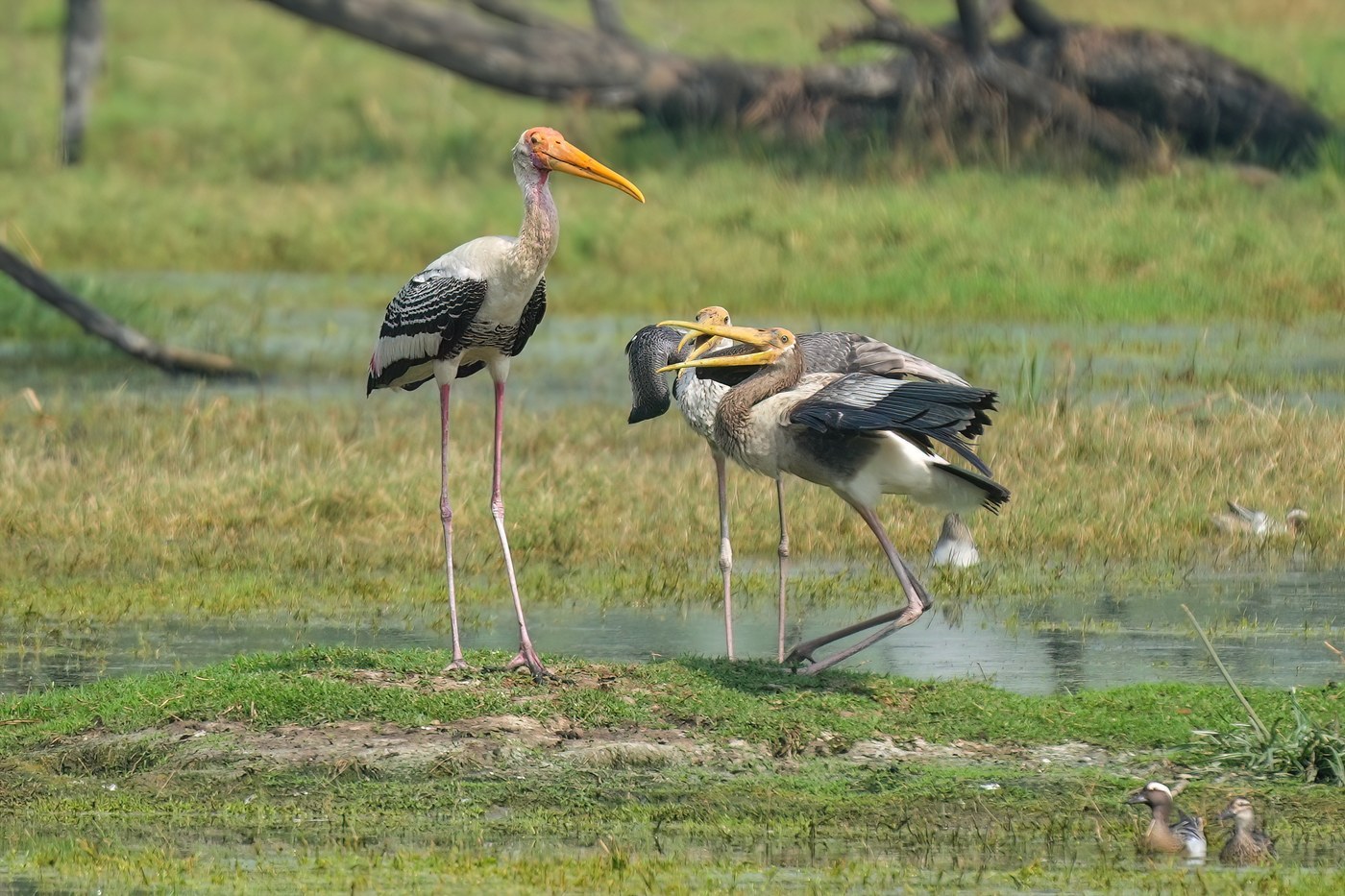
Key Field Marks
- Size & shape: A very large wading bird, roughly 93–100 cm tall, with a long neck, long orange-yellow legs, and a heavy, long, downward-curved bill.
- Plumage: Mostly white body with a bold black band across the upper breast. The inner wing (tertial) feathers are tinged pale pink, giving the "painted" look that gives the species its name. Flight feathers and tail are glossy black.
- Bare parts: The face is bare and yellow-orange, and the long bill is yellow with a slight downward curve toward the tip. Legs are pink to pale red.
- Behavior: Forages by wading slowly through shallow water, sweeping its partly open bill side to side to detect fish and other prey by touch ("tactile feeding"). Often stands motionless for long periods. Highly social — feeds, roosts, and nests in large colonies alongside other storks, herons, and ibises.
Separating It from Similar Species
- Asian Openbill: Much smaller, all grayish-white to blackish, with a gap between the mandibles (hence "openbill"); lacks the pink tertials and black breast band.
- White Stork: Straight, dagger-like red bill (not decurved) and lacks the black breast band and pink wing tinge.
- Yellow-billed Stork (Africa, allopatric): Very similar shape and pink-tinged wings, but ranges do not overlap — Yellow-billed is African, Painted Stork is Asian, so range alone separates them.
- Milky Stork (Southeast Asia): Lacks the black breast band and has an all-white body except black flight feathers; bill is paler and less orange.
Where & When to See It
- Range: Resident and locally migratory across the Indian subcontinent, Sri Lanka, and parts of Southeast Asia (Cambodia, Myanmar, Thailand, Vietnam).
- Habitat: Freshwater wetlands, marshes, flooded agricultural fields, reservoirs, and lake margins. Famous protected colonies occur at sites such as Keoladeo (Bharatpur) National Park in India.
- Season: Present year-round in core range; breeding colonies are most active and visible during and just after the monsoon season when wetlands are flooded.
Voice
Largely silent away from the nest. At breeding colonies, adults communicate with loud bill-clattering displays rather than vocal calls, typical of true storks.
Frequently asked questions
What makes the Painted Stork's wings look pink?
The tertial (inner wing) feathers are tinged with a soft pink wash, most visible on breeding adults and giving the species its painted appearance.
How do I tell a Painted Stork from a White Stork?
Painted Stork has a decurved yellow-orange bill and a black breast band, while White Stork has a straight red bill and no breast band.
Where is the best place to see Painted Storks?
Large wetland reserves in India and Sri Lanka, such as Keoladeo National Park, host major nesting colonies, especially after monsoon rains flood the marshes.
Do Painted Storks migrate?
They are mostly resident but make local and seasonal movements tracking water levels and food availability rather than long-distance migration.