
Painted Redstart Identification Guide
A striking black warbler with a bold white wing patch and bright red belly, easily recognized by its habit of constantly fanning its tail and spreading its wings while foraging.
Read the full Painted Redstart encyclopedia entry →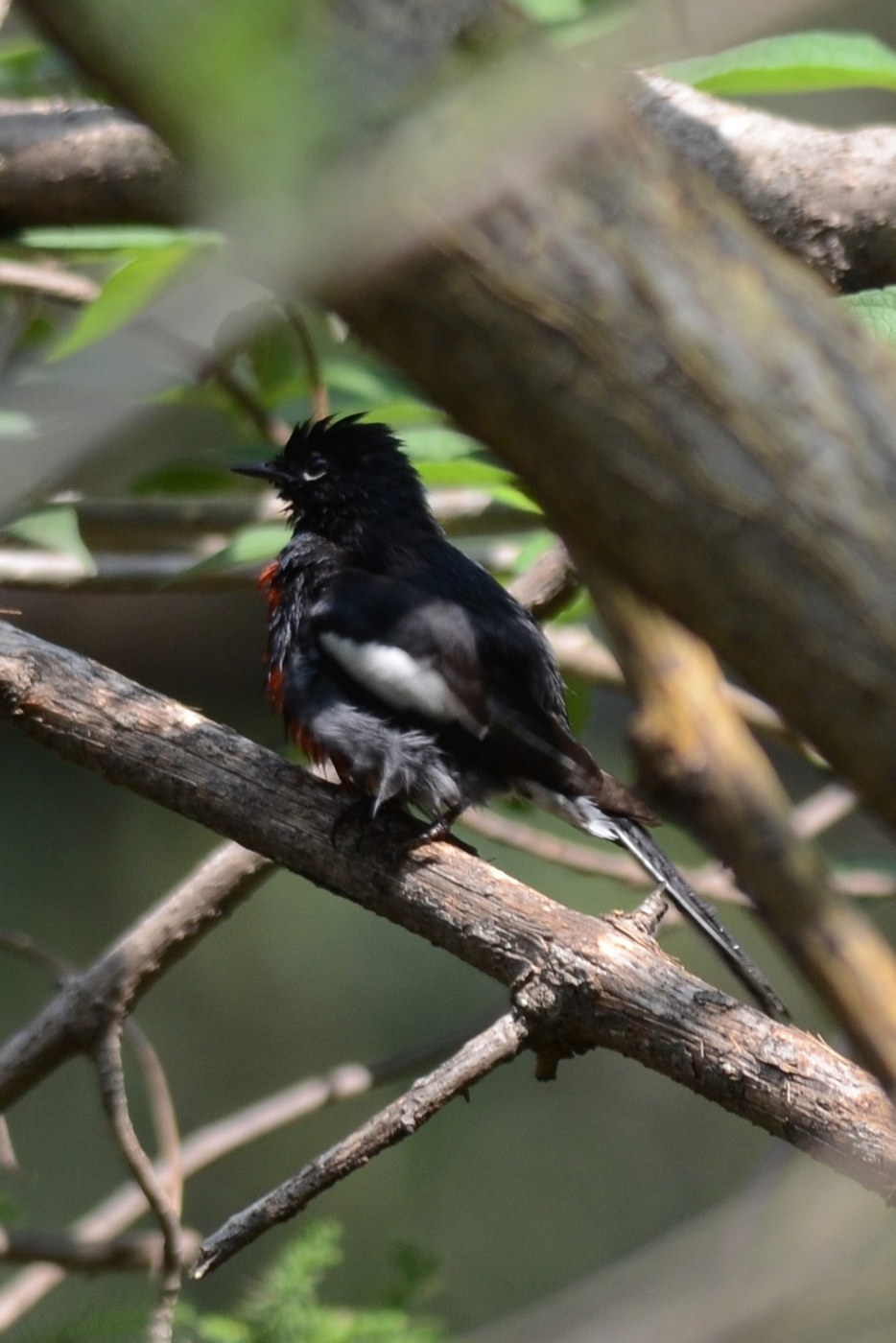
Key Field Marks
- Slender warbler (about 13 cm) with a mostly black head, throat, and upperparts.
- Bold white patch on the folded wing, conspicuous even at rest.
- Bright red to crimson lower breast and belly, sharply set off against the black upperparts.
- White outer tail feathers, flashed prominently when the tail is fanned.
- Small white crescent below the eye on an otherwise black face.
Similar Species
- Slate-throated Redstart (rare stray into the same region): lacks the bold white wing patch, and shows a grayer/slate-toned body rather than solid black upperparts, with dusky (not white) lores.
- American Redstart: patterned in black and orange rather than black and red/white, and is essentially unrelated in range within Painted Redstart's core southwestern habitat.
- The combination of a solid white wing patch and red belly on a black-bodied warbler is unique within its range, making Painted Redstart one of the more distinctive and easily identified warblers once seen.
Habitat, Range & Season
- Found in oak and pine-oak woodland, especially shaded, sycamore-lined canyons in the "sky island" mountain ranges of southeastern Arizona and southwestern New Mexico, south through the mountains of Mexico to Central America.
- Largely resident/permanent across much of its range, with some local elevational movement in winter.
- Popular and reliable in well-known birding canyons such as Madera Canyon and Cave Creek Canyon in Arizona.
Voice
- Song is a rich, cheerful warbling phrase, often rendered as "wheeta wheeta wheeta wheet."
- Call is a distinctive rising, slurred "wheet" or sharp "chip," frequently given while foraging.
Behavior Notes
- Constantly fans its tail and droops or spreads its wings while foraging, flashing the white tail feathers and wing patch to flush insects — a highly active and characteristic display that aids identification even in poor light.
- Often joins mixed-species foraging flocks and is generally tame and approachable, especially in popular canyon birding locations.
Frequently asked questions
What is the most distinctive feature of a Painted Redstart?
A solid black body with a bold white wing patch and a bright red lower breast and belly, combined with a constant habit of fanning the tail and spreading the wings while foraging.
How do you tell Painted Redstart from Slate-throated Redstart?
Painted Redstart has a bold white wing patch and solid black upperparts, while Slate-throated Redstart lacks the white wing patch and shows grayer, slate-toned upperparts with dusky lores.
Where is the best place to see a Painted Redstart?
Shaded oak and pine-oak canyons in the sky island mountains of southeastern Arizona and southwestern New Mexico, such as Madera Canyon, where it is often present year-round.
Why does a Painted Redstart fan its tail so much?
It flashes its white outer tail feathers and spreads its wings to startle and flush hidden insects out of foliage, a foraging technique that also makes the bird easy to spot in motion.
What does a Painted Redstart sound like?
A rich, cheerful warbling song often written as 'wheeta wheeta wheeta wheet,' along with a rising, slurred 'wheet' call.