Painted Bunting Identification Guide
One of North America's most colorful songbirds, with males showing an unmistakable combination of a blue head, red underparts, and green back, while females are a plain, uniform yellow-green.
Read the full Painted Bunting encyclopedia entry →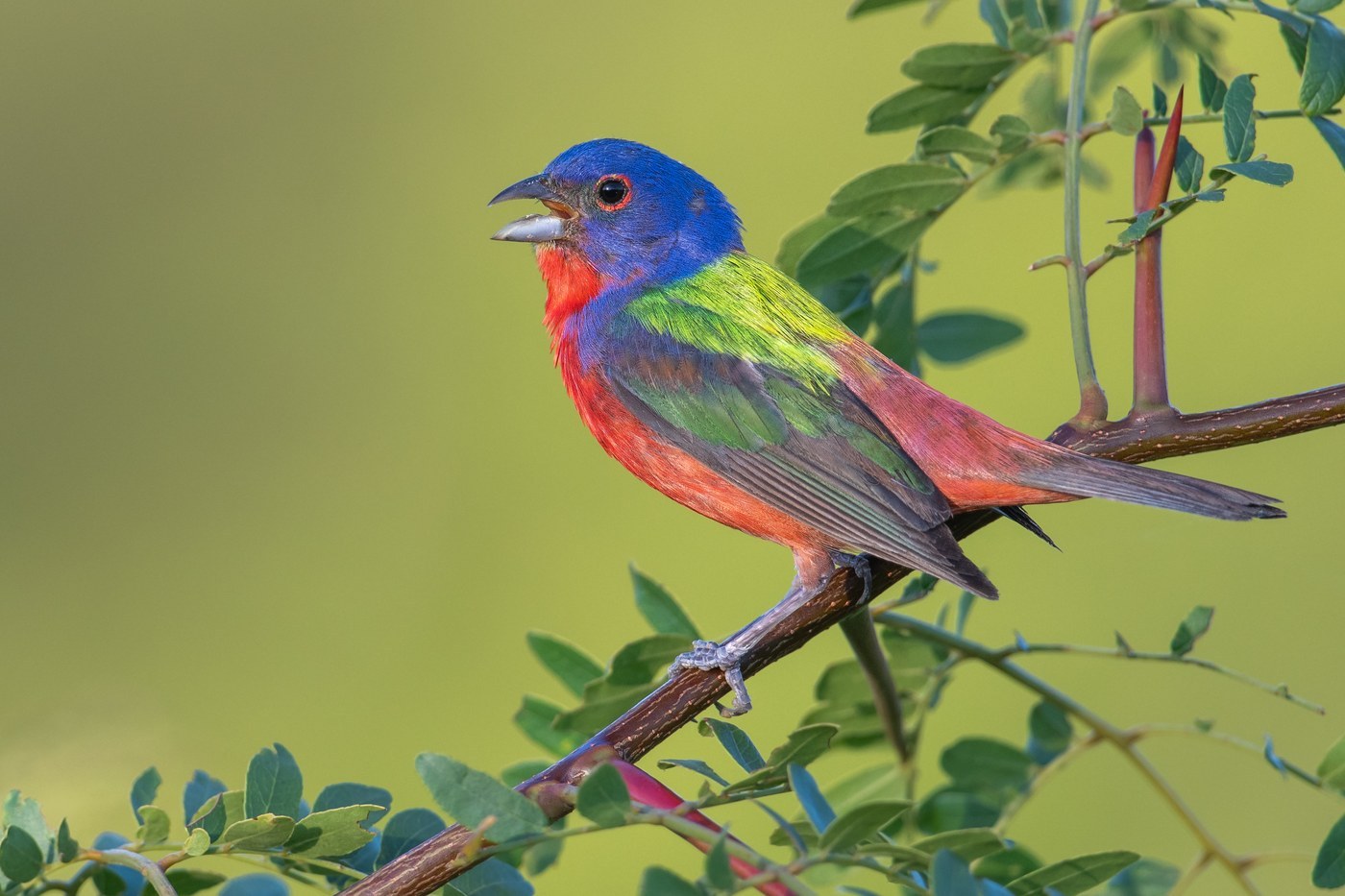
Key Field Marks
- Small, finch-like bunting (about 13 cm) with a stout, conical bill.
- Male: unmistakable — violet-blue head, red eye-ring, bright green back, and vivid red rump and underparts, often described as the most colorful songbird in North America.
- Female/immature: uniform bright yellow-green above and paler yellow-green below, with no streaking and no wing bars — a plain, evenly colored finch-like bird.
- The female's plain, uniformly green-yellow plumage combined with a conical bill is diagnostic within its range, since no other North American bunting is plain green.
Similar Species
- Female/immature Painted Buntings can superficially suggest female tanagers or vireos, but the combination of a stout, conical (bunting-type) bill, uniform green-yellow color with no wing bars or streaking, and typical dense scrub habitat separates it from those groups.
- No other North American bunting shows a plain green body, making females fairly straightforward to identify once the bill shape and uniform coloring are noted.
Habitat, Range & Season
- Breeds in two disjunct populations: one across south-central states (from Texas and Oklahoma east to Louisiana and Mississippi) in brushy scrub, hedgerows, and woodland edges; the other along the Atlantic coast of the southeastern United States (Carolinas to Florida) in coastal thickets and maritime scrub.
- Winters in Florida, the Caribbean, Mexico, and Central America.
- Favors dense, brushy cover and is often surprisingly hard to see despite the male's bright plumage.
Voice
- Song is a sweet, high-pitched, warbling series of paired phrases, often described as cheerful and musical.
- Call is a sharp, distinctive "chip" or "plik" note.
Behavior Notes
- Despite the male's brilliant colors, the species is shy and tends to stay low and hidden in dense vegetation.
- Readily visits seed feeders that are placed near dense cover, which is often the best way to get a good look.
Frequently asked questions
How do you identify a male Painted Bunting?
Males are unmistakable, with a violet-blue head, red eye-ring, bright green back, and vivid red underparts and rump — no other North American songbird looks like this.
What does a female Painted Bunting look like?
Females and immatures are a plain, uniform yellow-green overall with no streaking or wing bars, distinguished from similar-looking birds by their stout, conical bunting bill.
Where can I find a Painted Bunting?
Look in brushy scrub, hedgerows, and woodland edges in two separate breeding areas: south-central states from Texas to Mississippi, and coastal thickets from the Carolinas to Florida; in winter, look in Florida, the Caribbean, Mexico, and Central America.
Why are Painted Buntings hard to see despite their bright colors?
They are shy birds that tend to stay low and hidden within dense vegetation, so even brightly colored males can be easy to miss without patience or a feeder set up near cover.
What does a Painted Bunting sound like?
A sweet, high, warbling song delivered in paired phrases, along with a sharp 'chip' or 'plik' call note.
Painted Bunting identified by the community
Recent Painted Bunting sightings identified with Bird Identifier.