
Pacific Loon Identification Guide
A slender, medium-sized loon best known for its clean grey crown and hindneck sharply set off from a white face and throat in nonbreeding plumage.
Read the full Pacific Loon encyclopedia entry →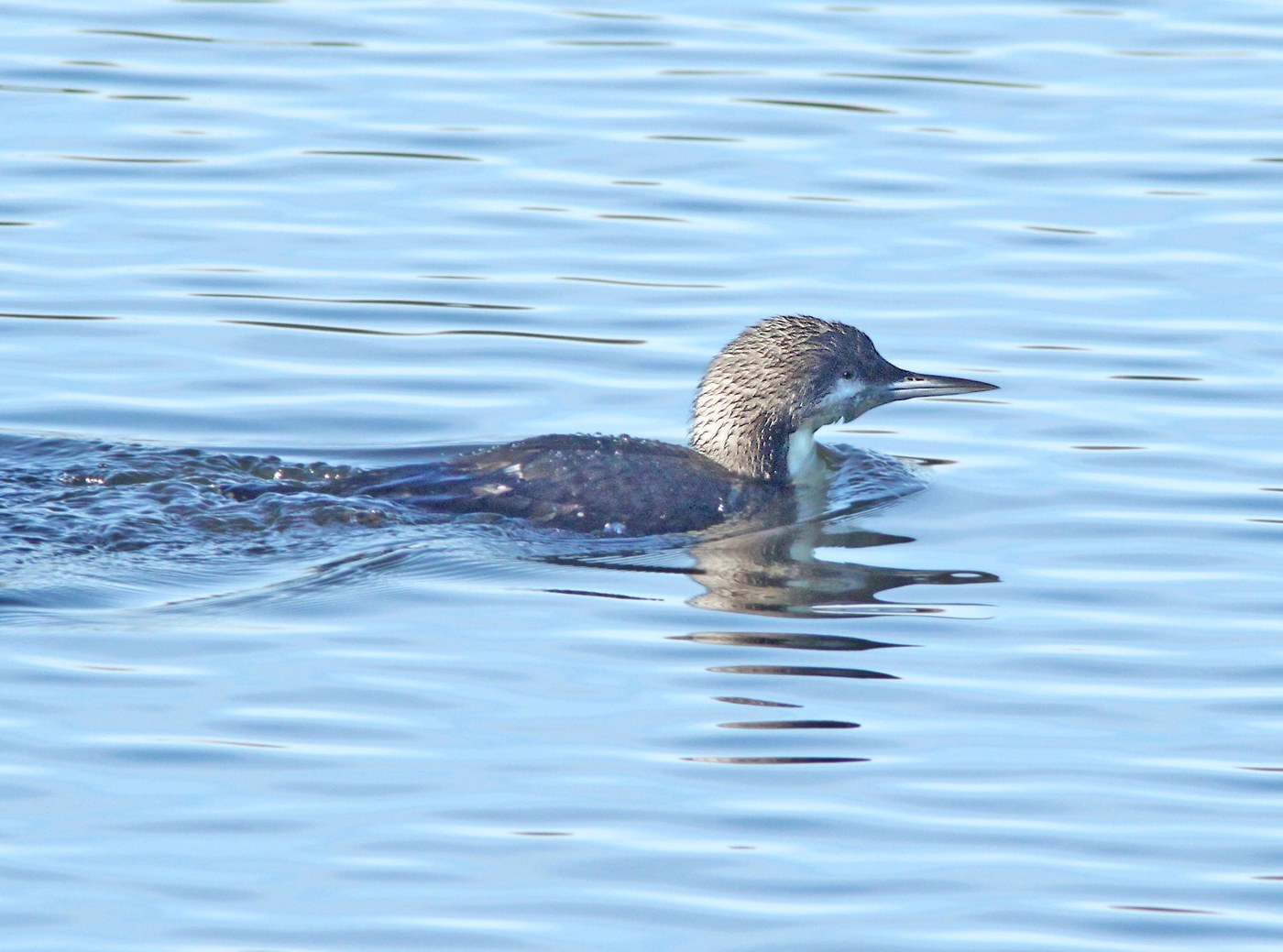
Key Field Marks
- Medium-sized loon (about 58-74 cm), noticeably slimmer and smaller-billed than a Common Loon.
- Breeding plumage: pale silvery-grey crown and hindneck, glossy black throat (with a purplish or greenish sheen), fine black-and-white vertical striping on the sides of the neck, and a checkered black-and-white back; the thin, straight, dark bill is typically held horizontally.
- Nonbreeding plumage: dark grey to blackish crown and hindneck sharply demarcated from the clean white face, throat, and foreneck — this crisp division is a key field mark; a partial dark "chinstrap" or necklace band is sometimes visible across the foreneck.
Similar Species
- Common Loon (nonbreeding): larger and heavier-billed, often held slightly uptilted, with a messier, less sharply demarcated head pattern and a more obvious white eye-ring.
- Red-throated Loon (nonbreeding): paler overall with a thinner, distinctly uptilted bill and more white on the face extending around the eye, lacking the Pacific Loon's crisp grey-white boundary on the neck.
- Arctic Loon (rare, very similar): shows a white flank patch visible above the waterline and slightly less contrast between crown and face; separation from Pacific Loon can be difficult and often requires careful, prolonged views.
Habitat, Range & Season
- Breeds on tundra and taiga lakes across northern Alaska and Arctic Canada.
- Migrates along the Pacific coast, often in large numbers, and winters in nearshore ocean waters, bays, and estuaries from southern Alaska south to Mexico.
- Frequently encountered in flocks or loose rafts during migration, unlike most loon species, which are typically solitary.
Voice
- Largely silent away from the breeding grounds; breeding-season vocalizations include wailing and croaking calls typical of loons.
Behavior Notes
- Dives for fish and other aquatic prey, often foraging cooperatively in loose groups during migration and winter.
- Migrates in flocks, sometimes numbering in the hundreds or thousands, along favored coastal routes — a notable exception to the typically solitary habits of loons.
Frequently asked questions
What is the best way to identify a nonbreeding Pacific Loon?
Look for a dark grey crown and hindneck that is sharply, cleanly demarcated from the white face and foreneck — a crisper boundary than in Common or Red-throated Loon.
How do you tell Pacific Loon from Common Loon?
Pacific Loon is smaller and slimmer-billed, holds its bill horizontally, and shows a cleaner, sharper division between the dark crown and white face than the bulkier, heavier-billed Common Loon.
Where and when is the best time to see Pacific Loons?
Look along the Pacific coast during migration, when they often form large flocks or rafts, and in winter in nearshore ocean waters and bays from Alaska to Mexico; they breed on Arctic tundra lakes in summer.
Do Pacific Loons migrate in groups?
Yes — unlike most loon species, which travel alone, Pacific Loons often migrate along the Pacific coast in substantial flocks.