
Pacific Golden-Plover Identification Guide
A slim, long-legged migratory shorebird with gold-and-black spangled upperparts, best separated from American Golden-Plover by its white undertail coverts and shorter wing projection.
Read the full Pacific Golden-Plover encyclopedia entry →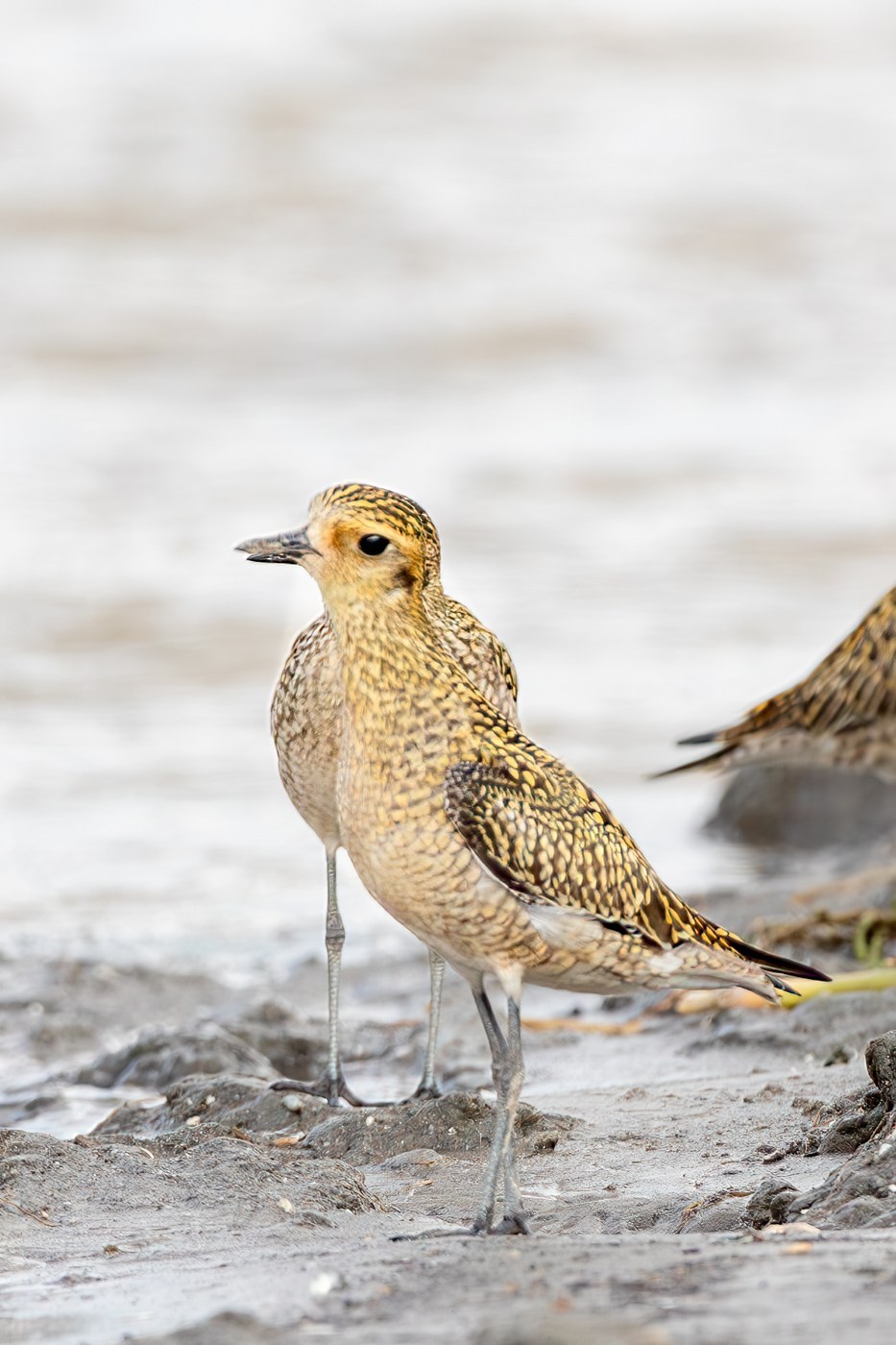
Key Field Marks
- Medium-sized plover (about 23-26 cm) with a slim build, fairly long neck, and long legs compared to other plovers.
- Breeding plumage: upperparts densely spangled gold and black; face, throat, breast, and belly solid black, bordered by a broad white stripe running from the forehead down the side of the neck to the flanks; undertail coverts are white.
- Nonbreeding/juvenile plumage: golden-brown, spangled upperparts, a buffy eyebrow stripe, mottled breast, and plain buffy-white underparts.
- Wingtips (primary projection) typically fall short of or barely reach the tail tip, giving a less attenuated look than American Golden-Plover.
Similar Species
- American Golden-Plover: in breeding plumage shows black (not white) undertail coverts — the key distinguishing feature; also appears grayer overall in nonbreeding plumage and has noticeably longer wings extending well past the tail tip at rest.
- Black-bellied Plover (Grey Plover): larger and stockier with a heavier bill, black axillaries ("wingpits") visible in flight, and a white rump/uppertail — features lacking in Pacific Golden-Plover.
- Structure (leg and neck length, primary projection) combined with undertail covert color are the most reliable ways to separate the two golden-plover species.
Habitat, Range & Season
- Breeds on Arctic tundra of Siberia and western Alaska.
- Winters on mudflats, beaches, grasslands, athletic fields, and agricultural land across the Pacific islands (including Hawaii, where it is a well-known and conspicuous winter resident), Australia, South and Southeast Asia, and parts of East Africa.
- A long-distance migrant, present on wintering grounds from fall through spring, with birds departing for the Arctic in late spring.
Voice
- Flight and contact call is a whistled, often disyllabic "chu-wheet" or "tlee-u-lee," distinct from the more mournful, drawn-out "pee-oo-wee" of Black-bellied Plover.
Behavior Notes
- Forages with a characteristic run-stop-peck action typical of plovers, on open mudflats, beaches, and short grass.
- Often seen singly or in loose, scattered groups rather than tight flocks; on wintering grounds such as Hawaii it readily uses lawns, parks, and golf courses.
Frequently asked questions
How do you tell Pacific Golden-Plover from American Golden-Plover?
In breeding plumage, check the undertail coverts: white in Pacific Golden-Plover, black in American Golden-Plover. Structurally, American Golden-Plover has longer wings that extend well past the tail, while Pacific Golden-Plover's wingtips barely reach the tail.
Where can I see a Pacific Golden-Plover?
On wintering grounds, look on mudflats, beaches, grasslands, and even lawns and golf courses across the Pacific islands (notably Hawaii), Australia, and South/Southeast Asia; it breeds on Arctic tundra in Siberia and western Alaska.
What does a Pacific Golden-Plover sound like?
A whistled, often two-syllable call rendered as 'chu-wheet' or 'tlee-u-lee,' distinct from the longer, more mournful call of the larger Black-bellied Plover.
What does a nonbreeding Pacific Golden-Plover look like?
Golden-brown, spangled upperparts, a buffy eyebrow stripe, a mottled breast, and plain buffy-white underparts, lacking the bold black face and belly of breeding birds.