
Pacific Black Duck Identification Guide
A dark dabbling duck of Australasia and the Pacific islands, identified by its bold facial stripes and green speculum on an otherwise uniformly dark brown body.
Read the full Pacific Black Duck encyclopedia entry →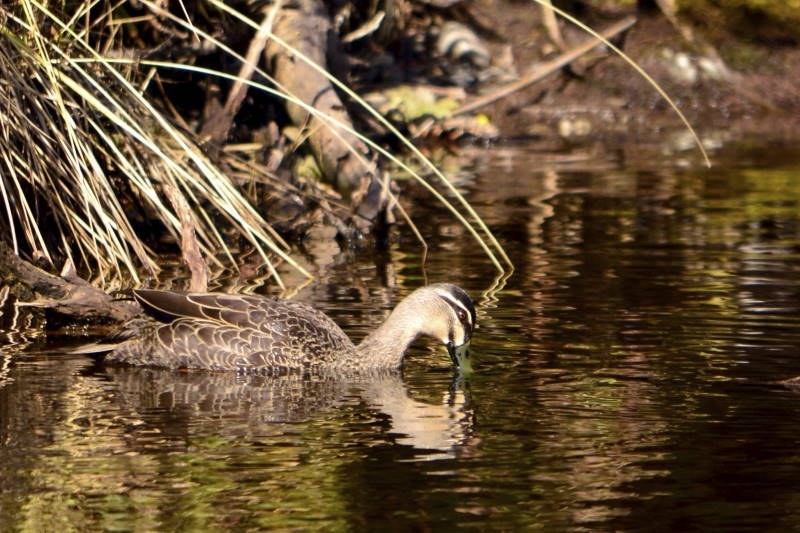
Key Field Marks
- Medium-sized dabbling duck, similar in size and shape to a Mallard, with an overall dark brown body.
- Pale buffy-cream face and throat crossed by two bold dark stripes: one through the eye and another below it — the most reliable field mark.
- Iridescent green (occasionally purplish) speculum bordered with black and white, visible at rest and conspicuous in flight.
- Bill is blue-grey to slate with a black tip (the "nail") and black culmen ridge; legs and feet are dull orange to orange-red.
- Sexes look alike, unlike most ducks — both males and females show the same plumage pattern.
Similar Species
- Mallard (female): Pacific Black Duck is darker overall with much bolder facial striping and a grey (not orange) bill; the two species hybridize readily where introduced Mallards occur (notably in New Zealand and parts of Australia), so look carefully for intermediate features such as partial orange on the bill or paler body tones, which indicate a hybrid.
- Other dabbling ducks in the region generally show much paler heads or different bill colors, making the strong facial striping and dark body a useful combination.
Habitat, Range & Season
- Found on a wide range of wetlands: lakes, rivers, swamps, estuaries, and mangroves across Australia, New Zealand, New Guinea, and many Pacific islands.
- Largely resident, with some local movements in response to water availability rather than true long-distance migration.
- Often the default "wild duck" seen on park lakes and wetlands throughout its range, frequently alongside introduced Mallards.
Voice
- Females give a loud, Mallard-like series of quacks, often descending in volume.
- Males produce a quieter, softer rasping or wheezy call.
Behavior Notes
- Dabbles and upends in shallow water to feed on aquatic plants, seeds, and invertebrates; also grazes on land.
- Hybridization with introduced Mallards is a significant conservation concern in parts of its range, particularly New Zealand.
Frequently asked questions
What is the easiest way to identify a Pacific Black Duck?
Look for a dark brown body with a pale buffy face crossed by two bold dark stripes (through and below the eye), a slate-grey bill with a black tip, and a green speculum.
How do you separate Pacific Black Duck from a female Mallard?
Pacific Black Duck is darker overall, has much bolder facial stripes, and a grey bill rather than an orange one. Watch for hybrids showing intermediate features like partial orange bill color where introduced Mallards overlap.
Where is the Pacific Black Duck found?
It occurs on wetlands, lakes, rivers, and estuaries across Australia, New Zealand, New Guinea, and many Pacific islands, and is largely a year-round resident.
Do male and female Pacific Black Ducks look different?
No — unlike most ducks, males and females share essentially the same plumage pattern, though females tend to give louder, more Mallard-like quacks.