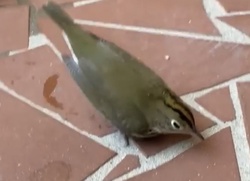
Ovenbird Identification Guide
A ground-dwelling New World warbler told by its orange crown stripe, bold white eye-ring, and thrush-like streaked underparts as it walks across the forest floor.
Read the full Ovenbird encyclopedia entry →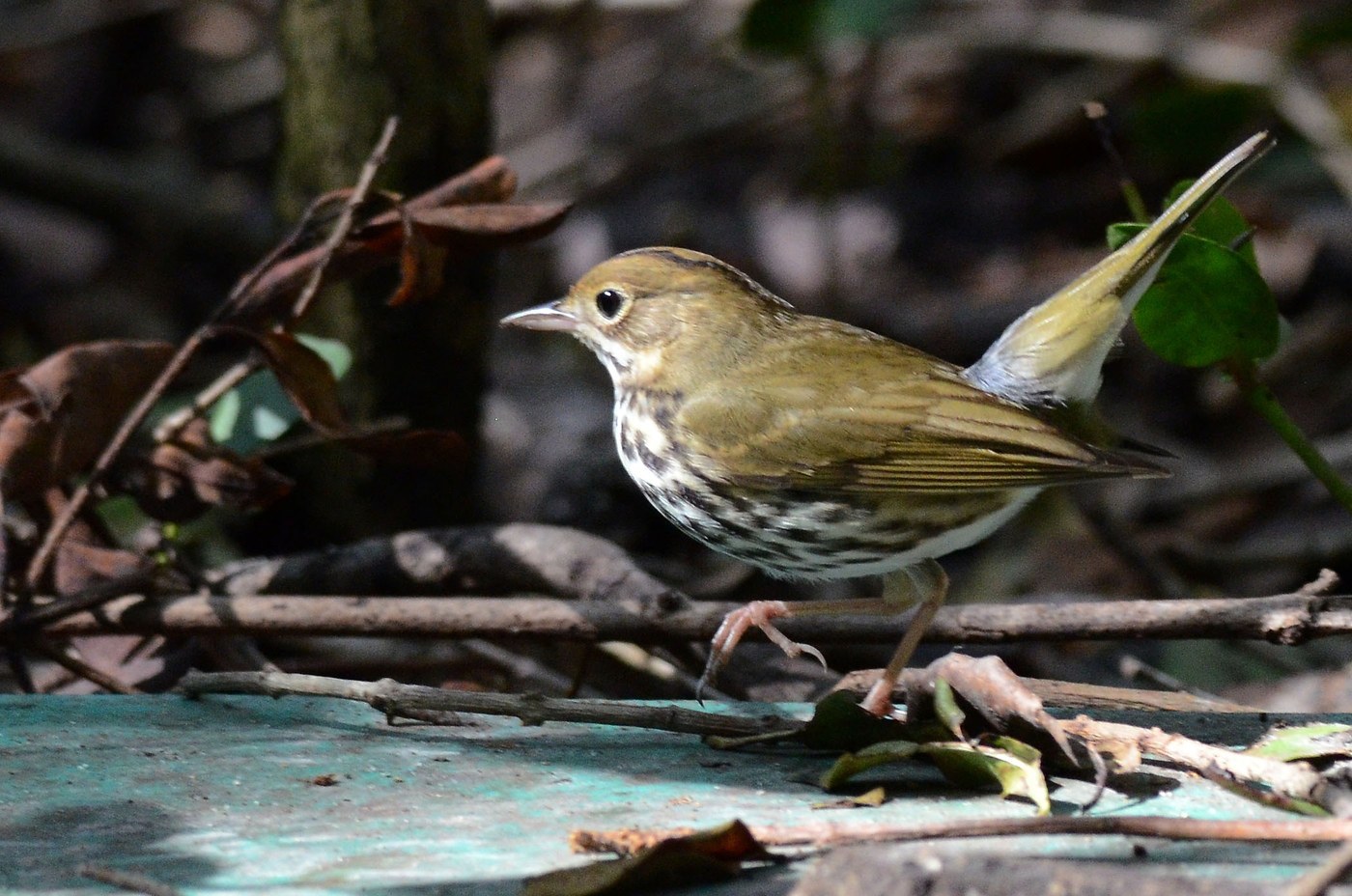
Key Field Marks
- Chunky, thrush-shaped warbler (about 14-15 cm) with olive-brown upperparts and heavily streaked white underparts.
- Bright orange crown stripe bordered on each side by black lateral stripes — the single most useful field mark.
- Bold white eye-ring on an otherwise plain olive-brown face.
- Pink legs; walks deliberately across the ground rather than hopping, often with the tail cocked up.
- Sexes look alike.
Similar Species
- Northern Waterthrush and Louisiana Waterthrush: also streaked below and walk on the ground with a bobbing tail, but both lack the Ovenbird's orange crown stripe and instead show a pale supercilium (eyebrow stripe) rather than a white eye-ring; waterthrushes are usually found near water.
- Wood Thrush and other spotted thrushes: larger, lack the black-bordered orange crown stripe, and have a different overall shape and bill.
- The Ovenbird's combination of crown pattern, eye-ring, and ground-walking gait separates it from all other North American warblers.
Habitat, Range & Season
- Breeds in mature deciduous and mixed forest with a closed canopy and relatively open understory across Canada and the eastern and north-central United States.
- Winters in Florida, the Caribbean, Mexico, and Central America; also a common migrant throughout the eastern half of North America.
- Nests on the ground in a domed structure resembling a small Dutch oven, which gives the species its name.
Voice
- Song is a loud, ringing, crescendoing "teacher-TEACHER-TEACHER-TEACHER," often heard well before the bird is seen.
- Also gives a distinctive, complex flight song at dusk during the breeding season.
- Call note is a sharp, hard "chip."
Behavior Notes
- Forages almost entirely on the forest floor, walking and flipping leaf litter in search of invertebrates.
- Often the most frequently heard, if not seen, bird in mature eastern forests during the breeding season.
Frequently asked questions
What is the best field mark for identifying an Ovenbird?
Look for the bright orange crown stripe bordered by black lines on the head, combined with a bold white eye-ring and heavily streaked underparts on a bird walking on the forest floor.
How do you tell an Ovenbird from a waterthrush?
Both walk on the ground and are streaked below, but Ovenbird has an orange crown stripe and a white eye-ring, while waterthrushes lack the crown stripe and instead show a pale eyebrow stripe; waterthrushes also favor streamside or wetland habitat.
Where and when can I find an Ovenbird?
Look and listen in mature deciduous or mixed forest with a shaded understory across eastern and north-central North America during the breeding season (spring through summer); in winter, look in Florida, the Caribbean, Mexico, and Central America.
What does an Ovenbird sound like?
A loud, ringing song that gets louder toward the end, commonly rendered as 'teacher-TEACHER-TEACHER-TEACHER.'
Why is it called an Ovenbird?
The name comes from its domed, oven-shaped ground nest built from leaves and grass, not from any behavior related to cooking or food.
Ovenbird identified by the community
Recent Ovenbird sightings identified with Bird Identifier.