
Ostrich Identification Guide
The world's largest living bird, identified by its towering height, bare long neck and legs, and the male's bold black-and-white plumage.
Read the full Ostrich encyclopedia entry →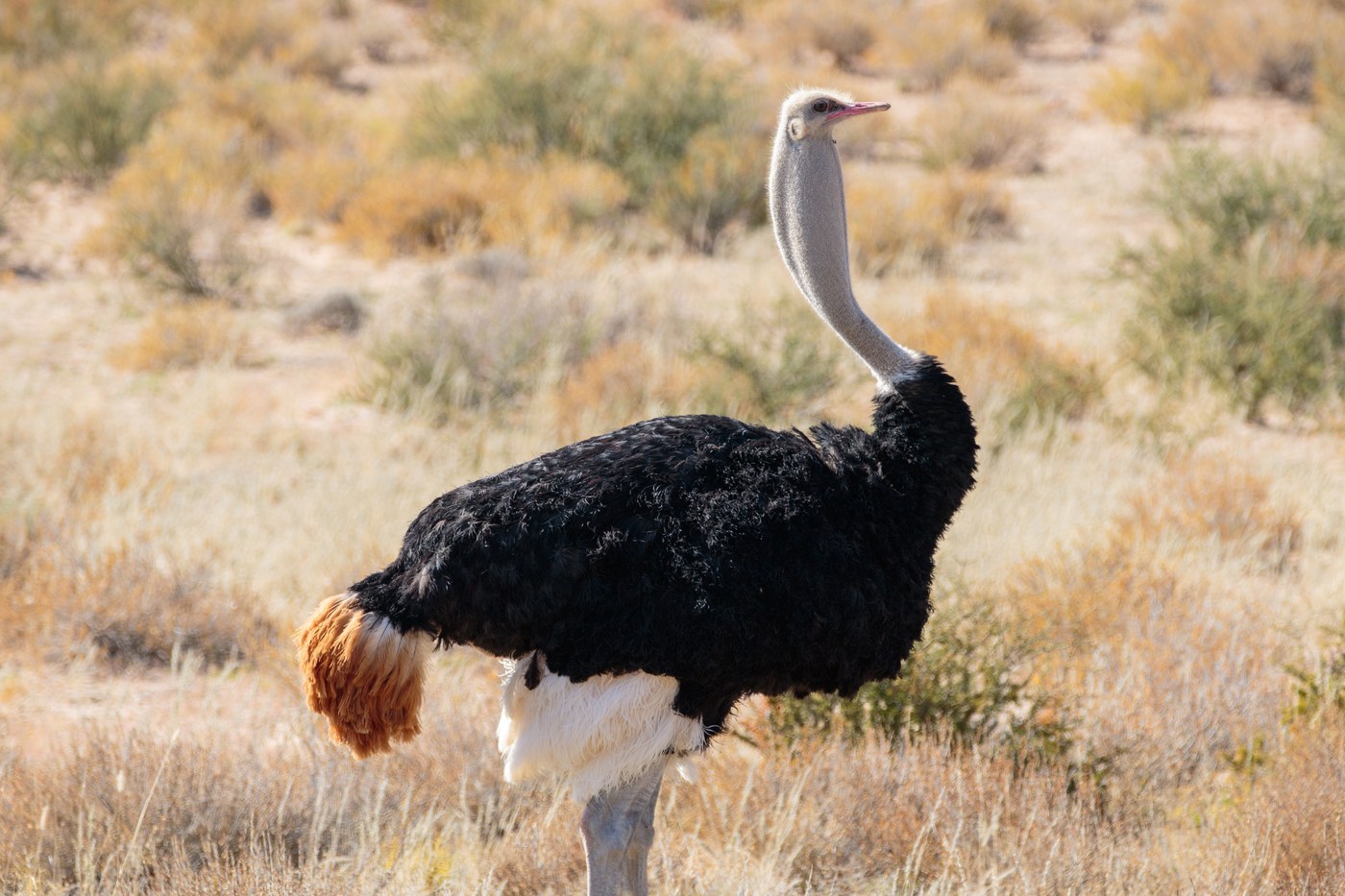
Key Field Marks
- Enormous flightless bird standing up to 2.7 m tall, with a tiny head, large dark eyes, and a broad, flattened bill.
- Long, bare neck and long, powerful legs; each foot has just two toes, an adaptation for fast running.
- Male: glossy black body plumage contrasting sharply with white flight feathers and a white tail.
- Female and immatures: overall grey-brown, duller plumage that provides camouflage while incubating eggs on the open ground.
- Neck and leg skin color varies by subspecies and season, ranging from pinkish to blue-grey, and can flush brighter during breeding display.
Similar Species
- Emu (Australia): smaller, with shaggy, loose grey-brown feathers overall (no black-and-white male pattern), a feathered neck, and three toes per foot; ranges do not overlap with Ostrich.
- Rhea (South America): smaller and uniformly grey-brown, also three-toed, and restricted to the Americas.
- No other bird approaches the Ostrich's combination of size, bare neck, and two-toed feet, making confusion unlikely once size and structure are noted.
Habitat, Range & Season
- Native to open savanna, semi-desert, and arid plains across sub-Saharan Africa.
- Highly social outside the breeding season, often forming mixed herds with grazing mammals such as zebra and antelope.
- Farmed and occasionally escaped birds occur outside the native range, but genuinely wild populations are restricted to Africa.
Voice
- Generally quiet, but breeding males produce a deep, resonant booming or roaring sound that can carry long distances.
- Hisses and grunts when alarmed or defending a nest.
Behavior Notes
- Flightless but an extremely fast runner, capable of sustained speeds around 60-70 km/h, using its long legs and two-toed feet for traction.
- Feeds mainly on plants, seeds, and small invertebrates while walking slowly across open ground.
Frequently asked questions
How can you tell a male Ostrich from a female?
Males have glossy black body plumage with white flight feathers and tail, while females and young birds are a duller, camouflaging grey-brown all over.
What is the difference between an Ostrich and an Emu?
Ostriches are larger, have bare necks, two toes per foot, and (in males) bold black-and-white plumage; Emus are smaller, have feathered necks, three toes per foot, and uniform shaggy grey-brown plumage. Their ranges also do not overlap — Ostrich is African, Emu is Australian.
Where do wild Ostriches live?
Wild Ostriches are found in open savanna, semi-desert, and arid plains across sub-Saharan Africa; birds seen elsewhere are typically farmed or escaped individuals.
What sound does an Ostrich make?
Breeding males give a deep, booming roar-like call; otherwise Ostriches are mostly silent apart from hisses and grunts when alarmed.