Osprey Identification Guide
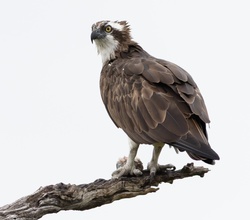
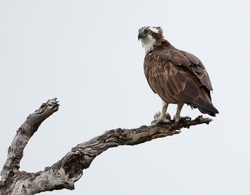
A large, fish-eating raptor found near water almost worldwide, best identified by its white head with a dark eye-mask and long, bowed wings held in flight.
Read the full Osprey encyclopedia entry →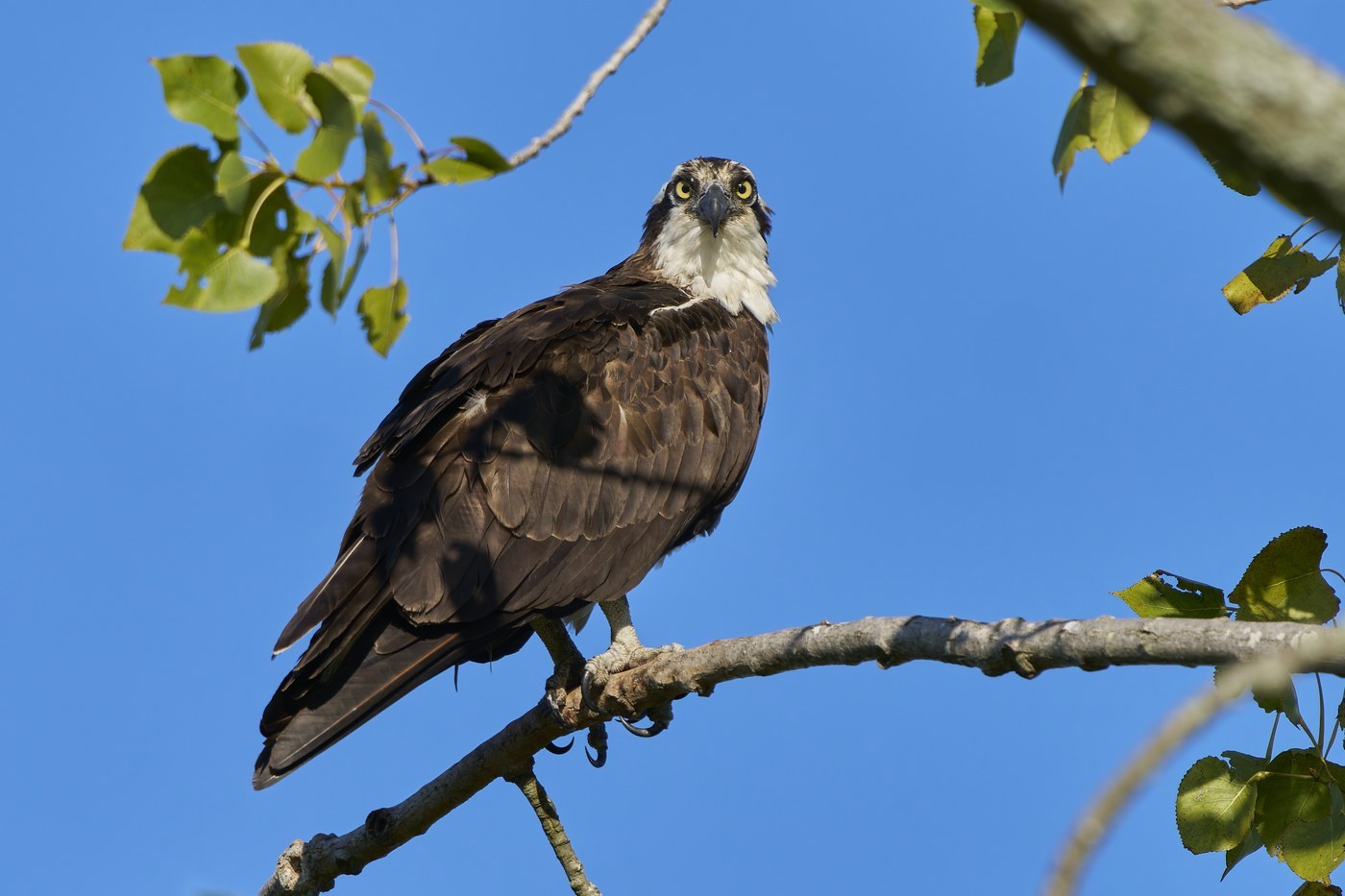
Key Field Marks
- Large raptor with a wingspan of roughly 1.5-1.8 m; noticeably slimmer and longer-winged than a Bald Eagle.
- White head crossed by a bold dark brown stripe through the eye, giving a "masked" look.
- Dark brown upperparts and mostly white underparts, with a variable dark brown breast band (typically bolder and more complete on females, faint or absent on many males).
- Dark carpal (wrist) patches visible on the underwing in flight; long, narrow wings often held with a distinct crook or bow, gull-like in shape.
- Black, strongly hooked bill; bright yellow eyes; long legs with a reversible outer toe and spiny foot pads adapted for gripping fish.
Similar Species
- Bald Eagle (adult): entirely white head and tail with no dark eye-mask, much broader wings held flat, larger overall body.
- Immature Bald Eagle: bulkier, more uniformly mottled brown-and-white plumage, broader wings, and lacks the Osprey's clean white underparts and wrist patches.
- In flight, the Osprey's angled, bowed wing profile and habit of hovering over water before plunging feet-first are strong clues even at a distance.
Habitat, Range & Season
- Almost always found near water — lakes, rivers, reservoirs, estuaries, and coastlines — where it hunts for fish.
- Breeds across much of North America, Europe, and Asia, as well as Australia; northern populations are strongly migratory, wintering in the tropics and subtropics of Central and South America, Africa, and southern Asia.
- Nests on platforms, channel markers, dead trees, or utility poles close to water; readily uses artificial nesting platforms.
- Look for it in summer on breeding lakes and rivers in temperate regions, and year-round in warmer coastal areas.
Voice
- Gives a series of sharp, whistled "cheep-cheep-cheep" notes, often rising in urgency near the nest.
- Also produces a piercing alarm call when a potential predator or intruder approaches the nest site.
Behavior Notes
- Hunts by hovering or circling over water, then diving feet-first to snatch fish near the surface.
- Uniquely among raptors, carries captured fish head-first and aligned with its body of flight for reduced drag.
Frequently asked questions
What is the fastest way to tell an Osprey from a Bald Eagle?
Check the head: an Osprey has a white head with a bold dark stripe through the eye, while an adult Bald Eagle has an entirely white head with no eye-mask. Ospreys also look slimmer with narrower, bowed wings in flight.
Where is the best place to look for an Osprey?
Almost always near water — lakes, rivers, reservoirs, or coastlines — since it feeds almost exclusively on fish. Check tall dead trees, channel markers, and nesting platforms nearby.
How can you recognize an Osprey in flight?
Look for long, narrow wings held with a distinct bend or crook (a gull-like, M-shaped silhouette), dark patches at the wrists, and hovering behavior over water before a feet-first dive.
Do male and female Ospreys look different?
They are similar, but females typically show a more complete, darker breast band ('necklace') than males, which often have little or no breast band.
Osprey identified by the community
Recent Osprey sightings identified with Bird Identifier.