
Ortolan Bunting Identification Guide
A small Old World bunting known for its grey-green head, yellow throat, and bold pale eye-ring, breeding in open farmland from Europe to Central Asia.
Read the full Ortolan Bunting encyclopedia entry →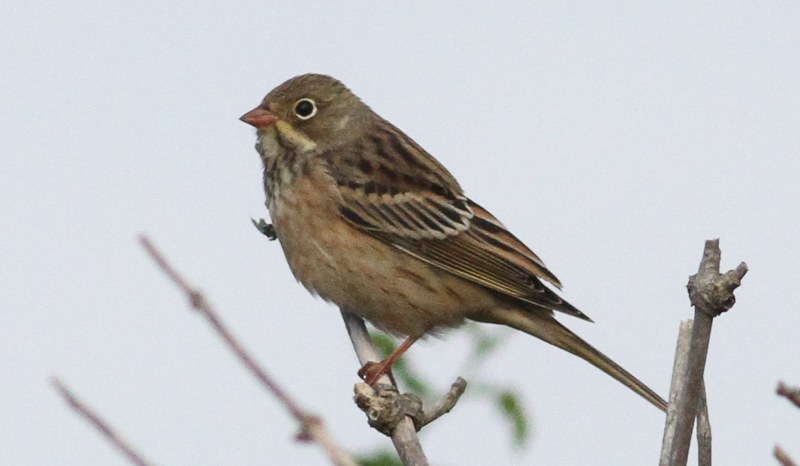
Key Field Marks
- Small, sparrow-sized bunting (about 16 cm) with a conical pale pink bill and pink legs.
- Male: grey-green head and breast, bright yellow throat and thin yellow eye-ring, cinnamon-buff underparts, and a streaked olive-brown back.
- Female/immature: duller and more streaked version of the male pattern — greyish-buff head with fine dark streaking, paler yellow throat, buffier underparts.
- The combination of a pink bill, yellow throat, and pale eye-ring on an otherwise grey-brown bunting is distinctive.
- Fairly upright posture; often perches on wires, bushes, or clods of earth in open fields.
Similar Species
- Cretzschmar's Bunting: very similar but has a blue-grey (not yellow) throat and a rustier, more orange head and underparts; ranges overlap only marginally in the eastern Mediterranean.
- Yellowhammer: much more extensively yellow on the head and underparts, with a chestnut rump — lacks the Ortolan's grey head and pink bill.
- Female/immature buntings can be confusing; focus on the pink bill and pale eye-ring, which most similar species lack.
Habitat, Range & Season
- Breeds in open, sunny farmland, vineyards, orchards, and dry grassy slopes with scattered trees or hedgerows across Europe into western and central Asia.
- A long-distance migrant that winters in the Sahel zone of sub-Saharan Africa, arriving on breeding grounds in late spring.
- A scarce but regular passage migrant in parts of western Europe outside the core breeding range, and a very rare vagrant further afield.
Voice
- Song is a simple, slightly melancholy series of similar notes, often rendered "zee-zee-zee-zee-zeeoo," dropping in pitch toward the end.
- Call is a soft, quiet "plit" or "slee," easy to overlook.
- Usually sings from an exposed perch such as a wire, bush top, or fence post.
Frequently asked questions
What is the easiest way to identify an Ortolan Bunting?
Look for a grey-green head, bright yellow throat, pale pink bill, and pink legs on a streaked, cinnamon-buff-bodied bunting, usually seen perched in open farmland.
How is Ortolan Bunting told apart from Cretzschmar's Bunting?
Throat color is the key: Ortolan Bunting has a yellow throat, while Cretzschmar's Bunting has a blue-grey throat and a rustier orange head and underparts.
Where and when should I look for Ortolan Buntings?
Search sunny farmland, vineyards, and open grassy slopes with scattered trees or bushes across Europe and western/central Asia during the breeding season (late spring through summer); they winter in the African Sahel.
What does an Ortolan Bunting sound like?
A simple, slightly mournful song of repeated similar notes that descends in pitch at the end, often written as 'zee-zee-zee-zee-zeeoo.'