
Ornate Hawk-Eagle Identification Guide
A powerful, crested tropical forest raptor with a bold rufous throat band and boldly barred underparts, one of the most striking eagles of the Neotropics.
Read the full Ornate Hawk-Eagle encyclopedia entry →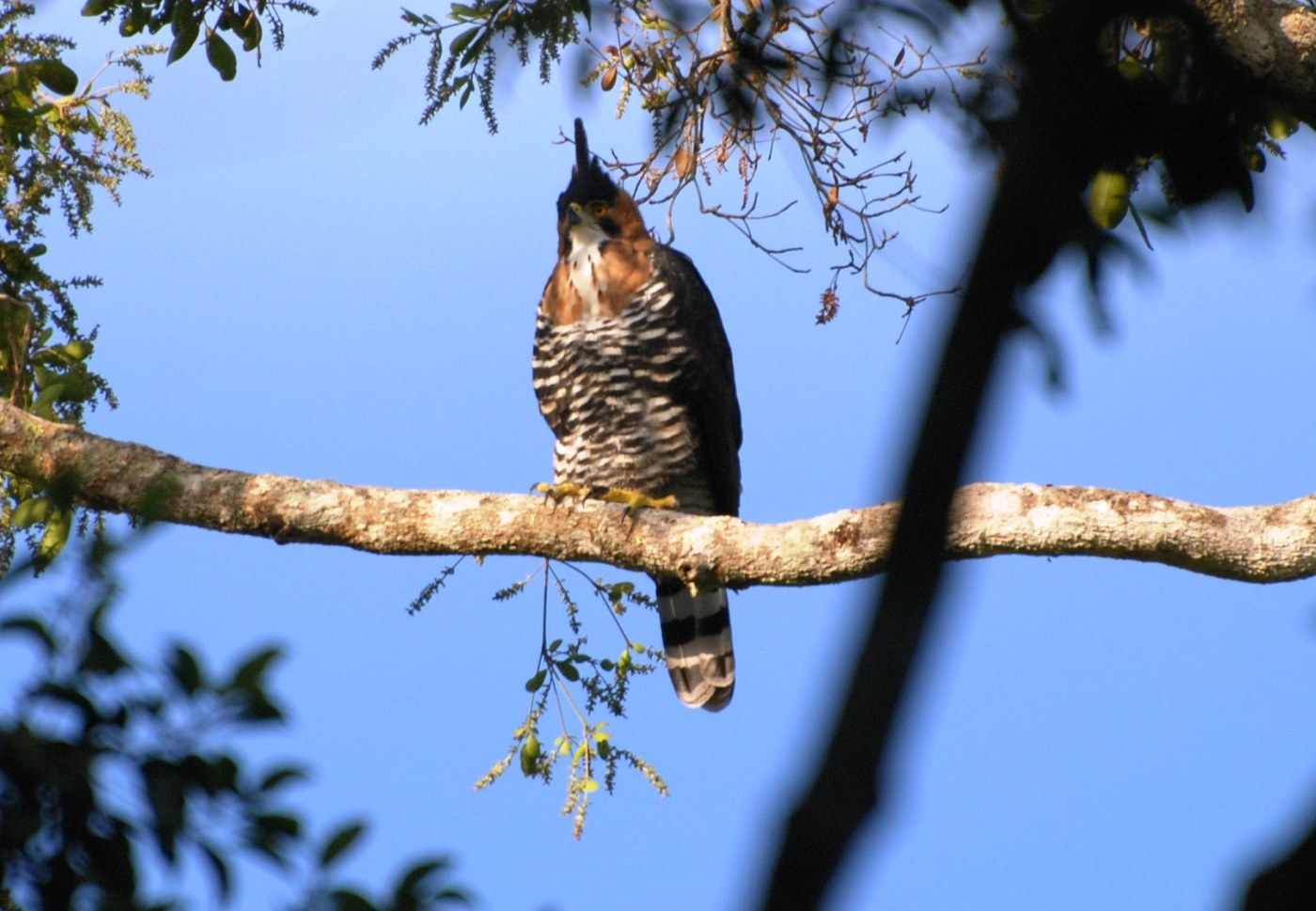
Key Field Marks
- Size & shape: A medium-large, powerfully built forest eagle (58–68 cm / 23–27 in) with broad, rounded wings, a long tail, and a prominent, erectile black crest on the head — one of the most distinctive raptors in its range.
- Plumage (adult): Black crown and crest, a bold rufous-orange band across the upper breast/throat sides, a white throat, and densely black-barred white underparts and thighs, creating a dramatic, high-contrast pattern unlike any similar species.
- Plumage (juvenile): Much paler overall, with a white head, largely white or lightly marked underparts, and a smaller, less obvious crest, taking several years to acquire full adult plumage.
- Legs: Feathered legs down to the feet (typical of booted eagles), with heavily barred thighs contributing to the "trousered" look.
- Behavior: A powerful, agile hunter of forest canopy and edge, capable of taking substantial prey such as birds and mid-sized mammals; often perches motionless for long periods within the canopy, then soars on broad wings above the forest, especially in mid-morning thermals, when the crest and barred underparts are easiest to see.
Separating It From Similar Species
- Black Hawk-Eagle: Overall much darker/blackish below with fine barring rather than the Ornate's bold rufous breast band and heavy black-and-white barring; also has a less prominent crest.
- Black-and-white Hawk-Eagle: Smaller, with a cleaner white body lacking any rufous breast band, and a different, more contrastingly pied head pattern.
- Juvenile birds can be confused with juveniles of other hawk-eagles, but the combination of a mostly clean white head, pale underparts, and gradually developing crest, together with typical Ornate Hawk-Eagle structure (broad wings, long banded tail), usually allows separation with good views.
- In flight, look for the combination of broad rounded wings, a long, strongly banded tail, and (in adults) the rufous breast band visible even at a distance.
Habitat & Range
Found from Mexico south through Central America and into South America as far as northern Argentina, inhabiting lowland and foothill tropical forest, including both humid rainforest and, to a lesser extent, drier forest types. It requires large tracts of relatively intact forest and is considered a good indicator of forest health; deforestation has caused declines in parts of its range. It is generally non-migratory, with resident pairs holding large forest territories.
Voice
Gives loud, high-pitched, whistled calls, often a series of rising notes, given especially during territorial and courtship flights above the canopy; birds are often located first by these far-carrying whistles before being seen soaring above the trees.
Frequently asked questions
What is the most distinctive feature of an adult Ornate Hawk-Eagle?
A prominent black crest, a bold rufous-orange band across the upper breast, and heavily black-and-white barred underparts — a combination not shared by other Neotropical raptors.
How do juvenile Ornate Hawk-Eagles differ from adults?
Juveniles are much paler, with a mostly white head and lightly marked underparts, and a smaller crest; they take several years to develop the bold adult breast band and barring.
How can you separate it from the Black Hawk-Eagle?
Black Hawk-Eagle is much darker overall below with fine barring and no bold rufous breast band, and has a less prominent crest than the Ornate Hawk-Eagle.
Where is the best habitat to find an Ornate Hawk-Eagle?
Large tracts of intact lowland and foothill tropical forest from Mexico through Central America into South America, where it typically forages within the canopy or soars above the trees.