
Oriental Turtle Dove Identification Guide
A stocky, richly patterned Asian dove with a scaly chestnut back and a black-and-white striped neck patch, often found in wooded farmland and gardens.
Read the full Oriental Turtle Dove encyclopedia entry →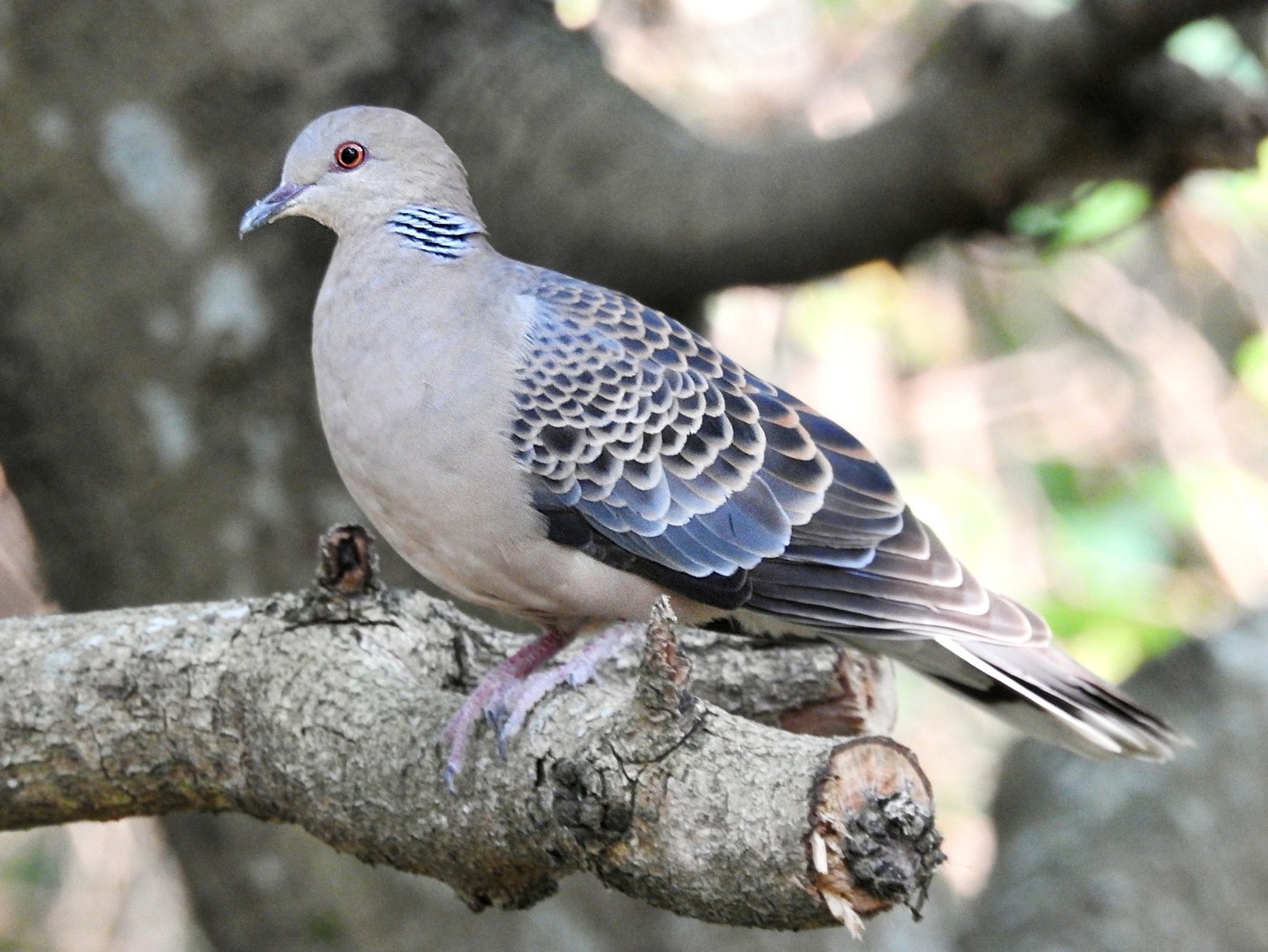
Key Field Marks
- Size & shape: A plump, medium-sized dove (about 33–35 cm / 13 in) with a small head, full chest, and a relatively short, squared tail compared to some other doves.
- Plumage: Upperparts show a distinctive scaly pattern of chestnut-and-black-fringed feathers on the back and wing coverts, giving a "scalloped" or tortoiseshell appearance unlike the more uniform plumage of many other doves.
- Neck patch: A patch of black feathers barred with white or bluish-grey on the sides of the neck is a key field mark, similar in concept to the neck patch of the European Turtle Dove but typically bolder and more contrasting.
- Underparts: Pinkish-grey breast fading to paler grey on the belly, with a bluish-grey panel often visible on the closed wing.
- Behavior: Often seen singly or in pairs, foraging on the ground in fields, farmland, or forest clearings; flight is strong and direct, and perched birds often sit motionless on wires or bare branches for long periods.
Separating It From Similar Species
- European Turtle Dove: Similar scaly back pattern but generally shows a more contrasting rufous-and-black scalloping, a whiter belly, and a different, more limited range (mostly not overlapping); the Oriental Turtle Dove is typically bulkier with a duller, greyer overall tone.
- Eurasian Collared-Dove: Much plainer sandy-grey overall with a thin black half-collar edged in white, lacking the Oriental Turtle Dove's heavily scaled chestnut back.
- Spotted Dove: Shows a black-and-white spotted (not barred) neck patch and a plainer, unscaled brownish-grey back, distinct from the Oriental Turtle Dove's scalloped upperparts.
- The bold, heavily scalloped chestnut-and-black back combined with the barred (not spotted) neck patch is the most reliable combination for identification.
Habitat & Range
Breeds across a broad swath of Asia from the Ural Mountains east through Siberia, Mongolia, China, Korea, and Japan, south to the Himalayas and parts of Southeast Asia. Northern populations are migratory, wintering further south in China, Korea, Japan, South Asia, and Southeast Asia, while southern populations are largely resident. It occurs in a range of semi-open habitats including farmland, forest edges, parks, and gardens, and is a well-known rare vagrant to western Europe and North America (particularly Alaska and the Pacific coast).
Voice
A deep, rhythmic, somewhat mournful cooing, often rendered as a four- or five-note "coo-COO-coo-coo" or similar rolling phrase, lower-pitched and more resonant than the calls of the smaller Eurasian Collared-Dove.
Frequently asked questions
What is the best field mark for identifying an Oriental Turtle Dove?
A heavily scaled chestnut-and-black back combined with a black neck patch barred with white or bluish-grey, giving it a distinctly patterned, scalloped upperside compared to plainer doves.
How does it differ from a Eurasian Collared-Dove?
The Eurasian Collared-Dove is plain sandy-grey with a thin black half-collar, while the Oriental Turtle Dove has a much bolder, scaly chestnut-patterned back and a broader barred neck patch.
Where does the Oriental Turtle Dove live?
It breeds across a wide swath of Asia from the Urals through Siberia, China, Korea, and Japan, wintering further south into South and Southeast Asia; it occurs as a rare vagrant in western North America and Europe.
Does the Oriental Turtle Dove migrate?
Northern and Siberian populations are strongly migratory, heading south for winter, while populations in milder southern parts of the range tend to be resident year-round.