
Orange-crowned Warbler Identification Guide
One of North America's plainest warblers, identified more by its lack of strong markings than by any single bold field mark, plus a rarely-seen orange crown patch.
Read the full Orange-crowned Warbler encyclopedia entry →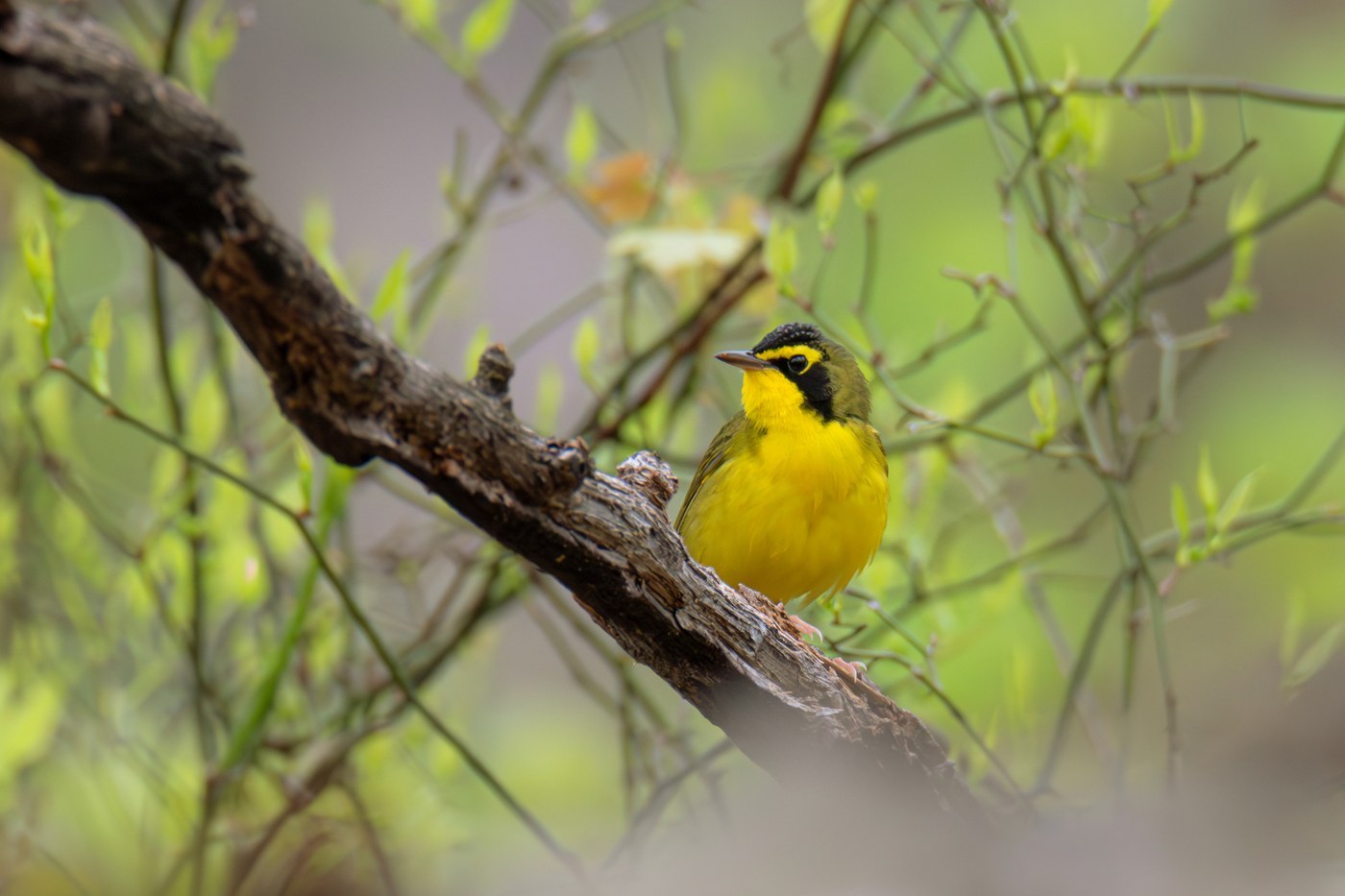
Key Field Marks
- Size & shape: A small, slim warbler (about 12–13 cm / 5 in) with a thin, sharply pointed bill and a fairly long tail that it often pumps or flicks while foraging.
- Plumage: Overall dull olive-yellow to greyish-olive with no wing bars, no strong facial pattern, and only faint, blurry breast streaking — its plainness is itself the best clue among North American warblers.
- Crown patch: The namesake orange crown patch is a small rusty patch on the crown, usually concealed under the olive feathers and only visible when the bird is agitated and raises its crown feathers; it is rarely a reliable field mark.
- Face: A faint, broken white eye-ring and a thin, indistinct pale eyebrow (supercilium) are the closest things to a facial pattern.
- Undertail coverts: Yellow undertail coverts contrast somewhat with a duller belly, a helpful supporting mark.
- Behavior: Actively gleans low in shrubs, thickets, and low tree branches, often hanging upside-down from leaf clusters and habitually flicking its tail — more active and lower-foraging than many co-occurring warblers.
Separating It From Similar Species
- Tennessee Warbler: Cleaner white (not yellow) undertail coverts and a crisper, more contrasting face pattern with a bolder white eyebrow, versus the Orange-crowned's overall dingier, more uniform look.
- Female/immature Yellow Warbler: Shows yellow edges on the wing feathers (yellow "wing bars"/edging) and a more uniformly yellow body, while Orange-crowned Warbler lacks yellow in the wings and looks duller overall.
- Nashville Warbler: Has a complete white eye-ring and a grey hood contrasting with a yellow body, features the Orange-crowned lacks (its eye-ring is broken, and it shows no grey hood).
- Regional subspecies vary from quite grey (western interior/Rocky Mountain birds) to bright yellow-olive (Pacific coast birds), so overall color saturation varies — always check the diagnostic combination of faint streaking, broken eye-ring, and yellow undertail coverts rather than color alone.
Habitat & Range
Breeds across a broad swath of North America from Alaska and northern Canada south through the western mountains and Pacific coast, in shrubby second growth, forest edges, willow thickets, and chaparral. It winters across the southern U.S., Mexico, and Central America, and is one of the earliest warblers to arrive in spring and among the latest and hardiest to linger in fall — it is also one of the few warblers that regularly winters well north into the U.S., including in brushy backyard habitat.
Voice
Song is a loose, dry trill that often changes pitch or speed partway through, sometimes described as a "stuttering" trill, distinguishing it from the tighter, more even trill of a Chipping Sparrow or Dark-eyed Junco. The call note is a sharp, husky tsik.
Frequently asked questions
Why is the Orange-crowned Warbler considered hard to identify?
It lacks bold field marks such as wing bars or a strong face pattern — birders learn it largely by process of elimination, using its overall dull, faintly-streaked plainness plus faint eye-ring and yellow undertail coverts.
Can you actually see the orange crown patch in the field?
Rarely. The rusty crown patch is usually hidden beneath the surrounding olive feathers and is visible only when the bird raises its crown feathers, such as during agitation or singing.
How do you distinguish it from a Tennessee Warbler?
Tennessee Warbler has clean white undertail coverts and a crisper face pattern, while Orange-crowned Warbler shows yellow undertail coverts, a duller overall look, and faint blurry breast streaking.
Does the Orange-crowned Warbler's appearance vary by region?
Yes, subspecies range from grey and dull in the interior/Rocky Mountain population to brighter yellow-olive along the Pacific coast, so overall tone is not a reliable standalone mark.