
Olive Sparrow Identification Guide
A plain, olive-brown, ground-loving sparrow of South Texas brush country, more often heard rattling from dense cover than seen in the open.
Read the full Olive Sparrow encyclopedia entry →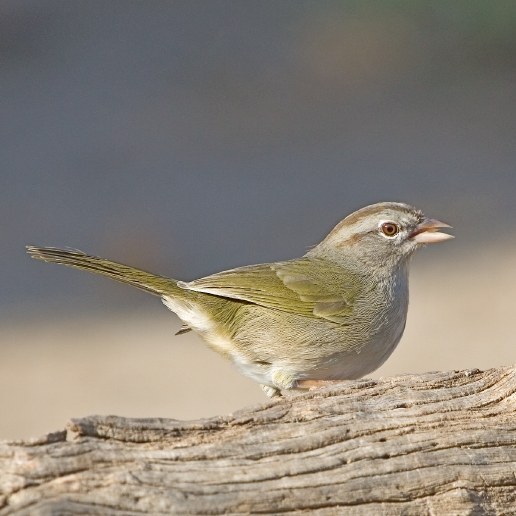
Key Field Marks
- Size & shape: A medium-large, long-tailed sparrow (about 15 cm / 6 in) with a fairly plain, chunky build and a stout, conical bill.
- Plumage: Overall olive-brown above and buffy-grey below, with almost no streaking anywhere on the body — one of the plainest sparrows in North America.
- Head pattern: The best mark is on the head: two dark brown lateral crown stripes bordering a paler grey central crown stripe, giving a striped-cap look, along with a faint dark line through the eye.
- Bill & legs: Pale, pinkish conical bill; pinkish legs.
- Behavior: Skulking and secretive, spending most of its time on or near the ground under dense thorn-scrub, hopping and scratching through leaf litter; it rarely comes into the open and is detected far more often by voice than by sight.
Separating It From Similar Species
- Canyon Towhee / Abert's Towhee: Larger, with proportionally longer tails and different, drier ranges; both lack the Olive Sparrow's striped crown pattern.
- Green-tailed Towhee: Shows a rufous cap and white throat, quite different from the Olive Sparrow's grey-and-brown striped crown and unmarked underparts.
- Within its limited range, the plain unstreaked body combined with the dark-bordered grey crown stripe is essentially unique among regularly occurring sparrows, making confusion unlikely once the bird is seen well.
Habitat & Range
A bird of dense, thorny brushland (chaparral/monte) of South Texas and eastern Mexico south to Honduras and Nicaragua. In the U.S. it is essentially confined to the Lower Rio Grande Valley and nearby brush country, where it is a year-round resident that rarely wanders from thick cover. It favors tangled mesquite, huisache, and other thorn-scrub with a dense understory.
Voice
The song is a distinctive accelerating series of dry "clink" notes that speeds into a rattling trill, sometimes likened to a bouncing ping-pong ball or a marble spinning to a stop. The call is a sharp, metallic chink or tsip, often the first (and only) clue to a bird buried deep in the brush.
Frequently asked questions
What makes the Olive Sparrow hard to see?
It is a skulking, ground-dwelling bird that stays deep inside dense thorn-scrub and rarely perches in the open, so it is usually detected by its distinctive rattling song rather than by sight.
What is the key field mark on an Olive Sparrow?
A plain, unstreaked olive-brown body combined with a head pattern of dark lateral crown stripes bordering a paler grey central stripe.
Where in the United States can you find Olive Sparrows?
They are essentially restricted to South Texas, especially the Lower Rio Grande Valley brush country, where they are year-round residents.
How does the Olive Sparrow's song help identify it?
Its song is an accelerating series of dry clinking notes that speeds into a rattle, often compared to a bouncing ping-pong ball, which is quite distinctive even when the bird itself is hidden.