
Olive-backed Oriole Identification Guide
A slim, olive-and-yellow Australasian oriole best known for its rich, fluting whistle delivered from the leafy canopy.
Read the full Olive-backed Oriole encyclopedia entry →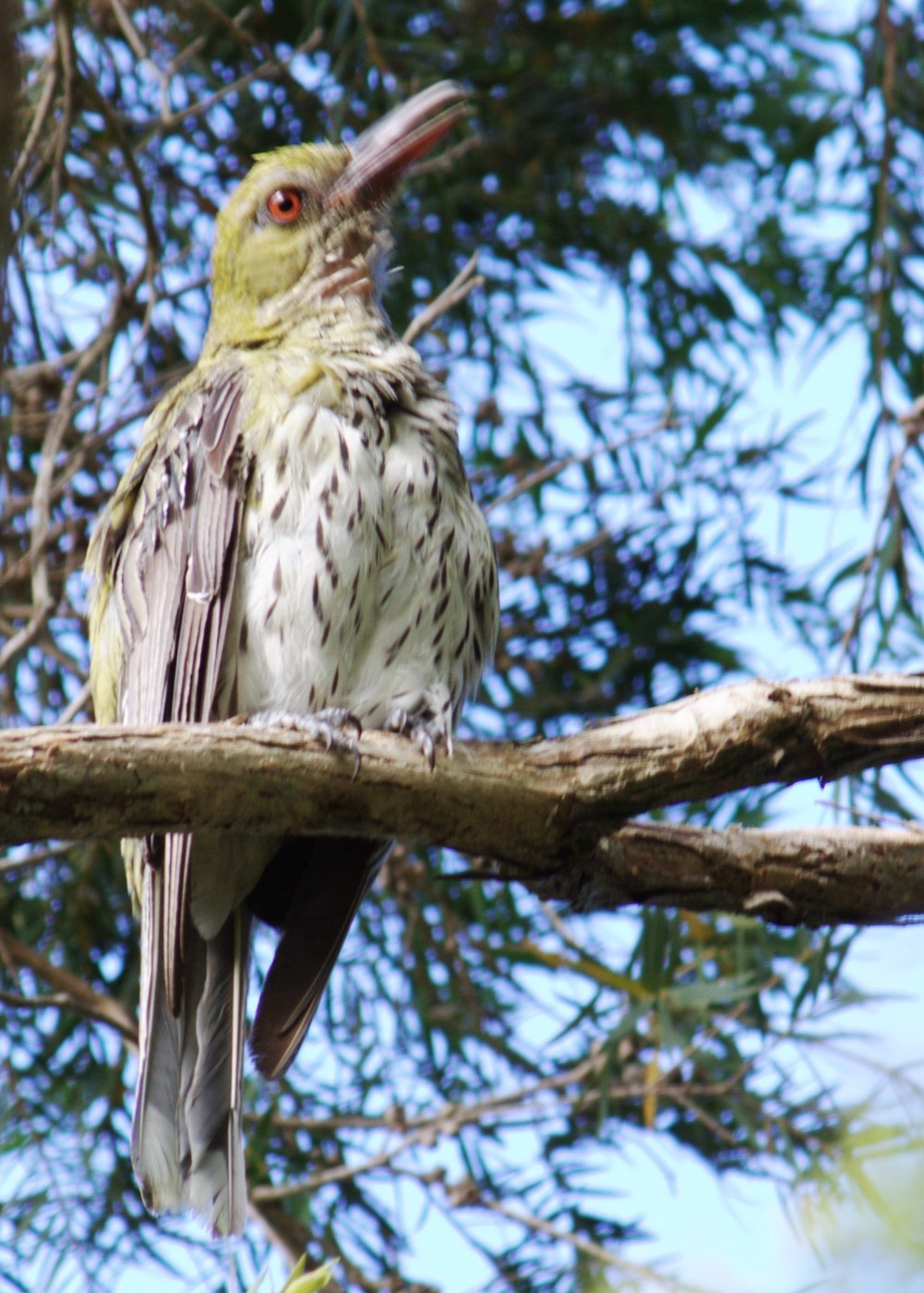
Key Field Marks
- Size & shape: A slender, long-tailed songbird about 26–28 cm (10–11 in) long, roughly the size of a large honeyeater but more elongated, with a longish tail and a fairly heavy, slightly downcurved bill.
- Plumage: Olive-green to olive-brown upperparts with a streaked, pale yellowish-white underside; the streaking (rather than solid yellow) is a key giveaway that separates it from true "golden" orioles at a glance.
- Bill & eye: Thick, pinkish-red to coral bill and a striking red or red-orange eye that stands out against the muted plumage.
- Legs: Grey to bluish-grey legs, unremarkable in the field.
- Behavior: Forages methodically and rather sluggishly in the outer canopy and mid-story, gleaning fruit and insects; often located by voice long before it is seen, sitting motionless among leaves.
Separating It From Similar Species
- Figbird (Sphecotheres vieilloti): Overlaps in range and habitat and is often confused with the oriole. Figbirds have a bare, dark eye-patch (skin around the eye) rather than a red iris, a shorter tail, and males often show grey heads or olive backs without the oriole's fine streaking below.
- Yellow Oriole (Oriolus flavocinctus): Found in northern Australia; has cleaner, more solidly yellow underparts with less obvious streaking and a duskier face patch around the eye, versus the Olive-backed Oriole's clear red eye on a plain olive face.
- Juvenile and female Olive-backed Orioles are duller and more heavily streaked than adult males, which can look confusingly similar to female figbirds — focus on eye colour and bill shape to confirm.
Habitat & Range
Found through eastern and northern Australia (from Cape York south to around Victoria) and into southern New Guinea and nearby islands, where several subspecies occur. It favours rainforest edges, eucalypt woodland, mangroves, parks, and well-treed gardens, especially where fruiting figs or berries are present. Northern populations are largely resident; some southern Australian birds are partial migrants, moving north in the austral winter.
Voice
A rich, far-carrying, fluty whistle, often rendered as "orry-ole" or a rolling series of liquid notes; song is more melodious and varied than the harsher, more nasal calls of the figbird, and is frequently the first clue to the bird's presence in dense foliage.
Frequently asked questions
What is the easiest way to tell an Olive-backed Oriole from a Figbird?
Check the eye and face: the oriole has a plain olive face with a bright red iris, while the figbird has a patch of bare dark skin around the eye. Underparts streaking (oriole) versus more solid colour (figbird) also helps.
Is the Olive-backed Oriole yellow like other orioles?
Only faintly — its underparts are pale and heavily streaked rather than the bold solid yellow seen in many other oriole species, which is one of its most distinctive features.
Where is the best place to look for one?
Scan the leafy canopy of rainforest edges, eucalypt woodland, or fruiting fig trees in eastern and northern Australia or southern New Guinea; you'll often hear its fluty whistle before spotting it.
Does the Olive-backed Oriole migrate?
Northern tropical populations are largely sedentary, while birds in the cooler southern part of the range shift northward outside the breeding season.