
Oilbird Identification Guide
A bizarre nocturnal cave-dwelling bird — the world's only nocturnal flying fruit-eater — identified by its hawk-like reddish-brown plumage, white wing spots, and echolocating clicks in total darkness.
Read the full Oilbird encyclopedia entry →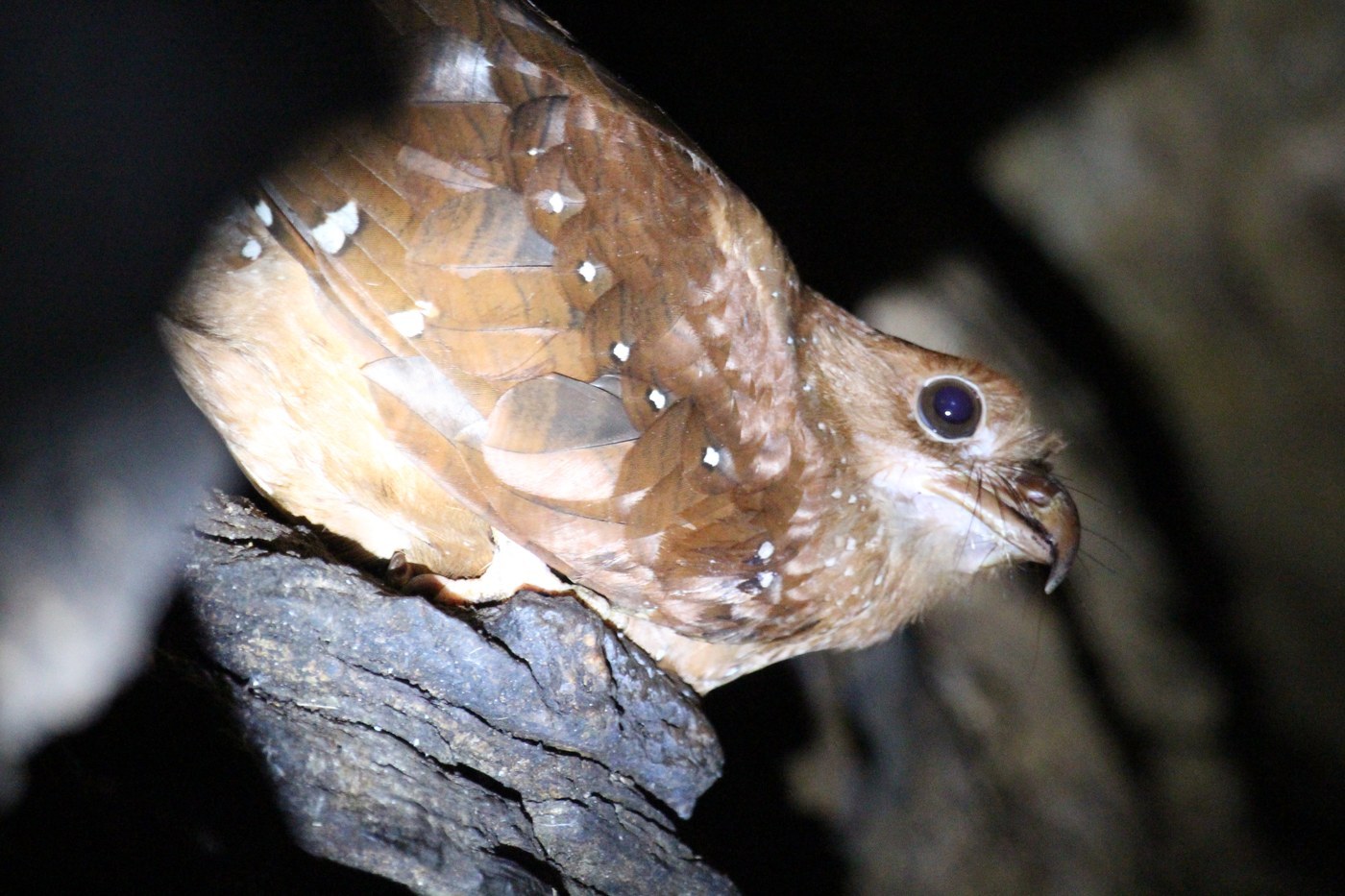
Key Field Marks
- Size & shape: Large for a nightbird (about 40–49 cm / 16–19 in) with long, broad, rounded wings and a long tail, giving a hawk-like silhouette in flight quite unlike any owl or nightjar.
- Plumage: Rich reddish-brown to chestnut overall, densely marked with small white spots edged in black on the wings, back, and tail, creating a soft spangled pattern.
- Head: Large dark eyes adapted for low light, and a strongly hooked, sharp-edged bill fringed with stiff bristles used for plucking fruit in flight.
- Flight: Strong, direct, and agile despite the bird's size, aided by echolocation for navigating pitch-black cave interiors.
Separating It From Similar Species
- Nightjars (e.g., Pauraque, potoos): Smaller, with cryptic gray-brown mottled plumage adapted for ground or branch camouflage rather than the Oilbird's reddish, spotted plumage and hooked bill; nightjars also lack the Oilbird's colonial cave-roosting habit and fruit-eating diet.
- Potoos: Sit upright and motionless on exposed perches mimicking a broken branch, entirely unlike the Oilbird's cave-roosting, flocking behavior and hooked bill.
- In practice, the Oilbird is unmistakable once seen or heard — no other bird in its range combines a hawk-like silhouette, echolocating clicks, and a diet of whole fruit swallowed in flight.
Behavior Clues
- The world's only known nocturnal, echolocating, fruit-eating bird: it emits sharp audible clicks to navigate the total darkness of cave roosts, in addition to using vision in dim light outside.
- Roosts and breeds colonially in caves by day, sometimes in colonies of hundreds to thousands, and flies out at dusk to forage, often traveling long distances each night.
- Feeds exclusively on fruit, especially oil-rich palm and laurel family fruits, plucked on the wing while hovering briefly — unique among nightbirds, which are otherwise insectivorous or carnivorous.
Where & When to Look
- Habitat: Roosts and nests in caves, rocky canyons, and deep ravines within or near humid forest; forages over surrounding forest canopy at night.
- Range: Northern South America and Trinidad, including Venezuela, Colombia, Ecuador, Peru, Guyana, and Trinidad's famous Dunston Cave (Asa Wright Nature Centre).
- Season: Resident year-round at breeding caves; best observed at dusk as birds emerge from cave mouths, or inside accessible show caves with guided tours.
Voice
- Produces a remarkable range of harsh sounds inside caves: sharp, rapid echolocation clicks used for navigation in darkness, along with loud screams, snarls, and grating calls that can be startling in the enclosed cave environment.
Frequently asked questions
What makes the Oilbird unique among birds?
It is the world's only known nocturnal bird that both echolocates (using audible clicks to navigate dark caves) and feeds exclusively on fruit, a combination found in no other bird species.
Where can you see an Oilbird?
In and around caves in northern South America and Trinidad, including well-known accessible sites such as Dunston Cave at the Asa Wright Nature Centre in Trinidad, or at dusk as colonies emerge to forage.
What does an Oilbird eat?
It eats fruit exclusively, especially oil-rich fruits of palms and trees in the laurel family, which it plucks in flight by briefly hovering near fruiting branches.
Why does the Oilbird click while flying in caves?
It produces audible echolocation clicks, similar in principle to bat sonar, to navigate safely through the total darkness of its cave roosts.