
Oak Titmouse Identification Guide
A plain, gray-brown, crested little songbird of California oak woodlands whose lack of distinctive markings is itself the best field mark.
Read the full Oak Titmouse encyclopedia entry →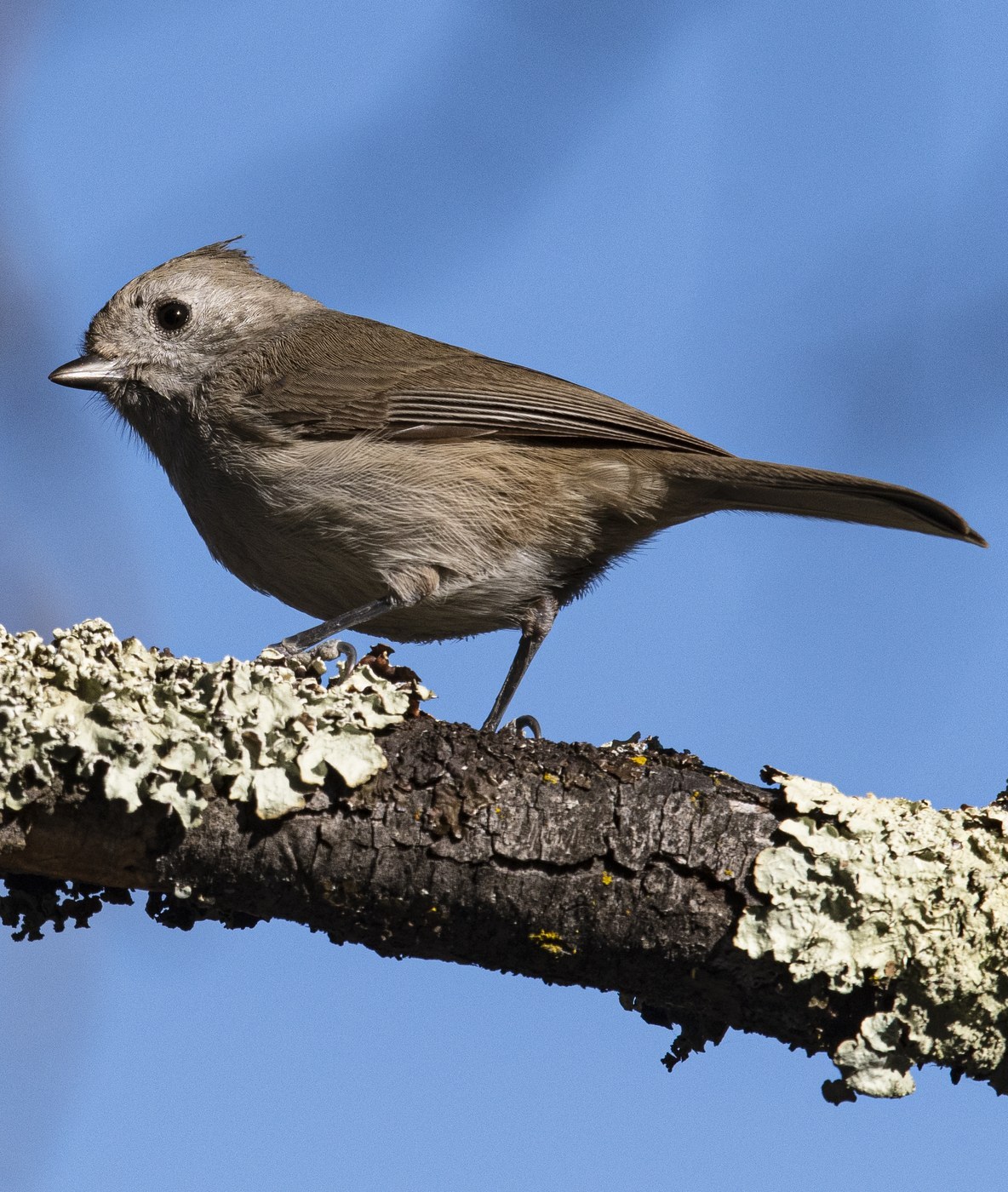
Key Field Marks
- Size & shape: Small (about 13–14 cm / 5 in) with a small pointed gray crest, a fairly large head, and a short, stout bill.
- Plumage: Uniformly plain grayish-brown above and slightly paler grayish-buff below, with no wing bars, no eye markings, and no other bold pattern — the overall plainness is diagnostic.
- Face: Featureless aside from a dark eye; no mask, eyebrow, or eyering stand out.
- Behavior: Active and acrobatic, often hangs upside down while foraging in oak foliage, frequently in pairs.
Separating It From Similar Species
- Juniper Titmouse: Nearly identical in plumage and structure; the two were once considered one species ("Plain Titmouse") before being split. They are best separated by range and habitat — Oak Titmouse occupies oak woodlands west of the Sierra Nevada/Cascades crest (California and southern Oregon), while Juniper Titmouse occupies pinyon-juniper woodlands of the interior Great Basin and Southwest, with essentially no range overlap. Voice differences (see below) can help where ranges approach each other.
- Bushtit: Much smaller and slimmer with a long tail and tiny bill, lacks any crest, and travels in larger, more constantly twittering flocks.
- Black-capped/Mountain Chickadee: Both show a bold black cap and bib contrasting with white cheeks, quite unlike the titmouse's uniformly plain head.
Where & When to Look
- Habitat: Strongly associated with oak woodlands and oak-conifer mix at low to middle elevations; also found in oak-dominated suburban yards and parks.
- Range: Endemic to California and a small part of southwestern Oregon, occupying the Central Valley foothills and Coast Ranges.
- Season: Non-migratory resident year-round; pairs typically remain on the same territory throughout the year.
Voice
- Song is a rapid, repetitive whistled phrase such as "peter-peter-peter" or "chiwit-chiwit-chiwit," similar in cadence to Tufted Titmouse but harsher and drier.
- Calls include a scratchy, chickadee-like "tsick-a-dee" and various harsh scolding notes.
Frequently asked questions
What is the best way to identify an Oak Titmouse?
Look for a small, uniformly plain gray-brown bird with a small pointed crest and no bold facial or wing markings — its overall plainness, combined with oak woodland habitat in California, is the best identifier.
How do I tell Oak Titmouse from Juniper Titmouse?
They look nearly identical; the most reliable way is range and habitat, since Oak Titmouse lives in oak woodlands west of the Sierra Nevada/Cascades in California and southern Oregon while Juniper Titmouse lives in pinyon-juniper habitat of the interior Great Basin and Southwest, with virtually no overlap.
Is the Oak Titmouse found outside California?
Only marginally — its range is almost entirely confined to California, with a small extension into adjacent southwestern Oregon.
Do Oak Titmice migrate?
No, they are non-migratory and typically remain on the same territory year-round as mated pairs.