
Nuttall's Woodpecker Identification Guide
A small black-and-white barred woodpecker nearly endemic to California's oak woodlands, distinguished from the similar Ladder-backed Woodpecker mainly by facial pattern and habitat.
Read the full Nuttall's Woodpecker encyclopedia entry →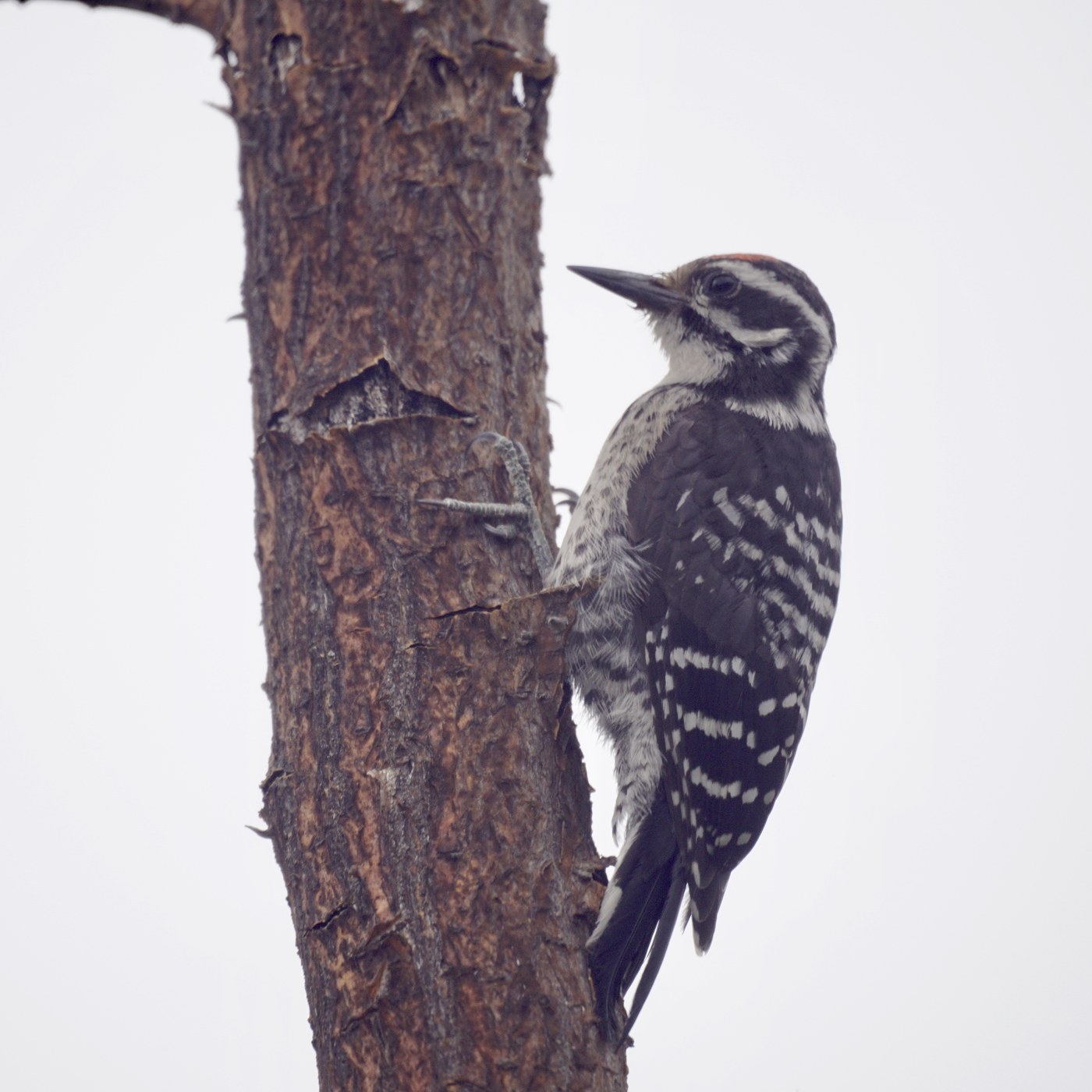
Key Field Marks
- Size & shape: A small woodpecker (about 18 cm / 7 in), similar in size and shape to Downy or Ladder-backed Woodpecker.
- Back pattern: Black-and-white horizontally barred ("ladder-backed") pattern across the back and wings.
- Face: Black face with a bold white stripe below the eye and another above, and a black bar or "necklace" connecting through the cheek toward the breast, giving a more heavily marked, blacker-faced look than similar species.
- Crown: Males show red confined to the rear crown/nape only; females have an entirely black crown with no red.
- Underparts: Whitish, lightly spotted or streaked with black on the flanks.
Separating It From Similar Species
- Ladder-backed Woodpecker: Very similar barred-back pattern, but Ladder-backed has a plainer face with less black extending onto the cheek, more spotting (versus barring) on the flanks, and occupies drier desert scrub and mesquite habitat farther east and south, with only limited range overlap with Nuttall's in southeastern California.
- Downy Woodpecker: Has a plain white (unbarred) back stripe down the center rather than horizontal barring, a shorter bill, and males show a red patch on the back of the head rather than confined lower on the nape.
- Hairy Woodpecker: Larger overall with a notably longer, more robust bill and a plain white back, not barred.
Where & When to Look
- Habitat: Strongly tied to oak woodlands, foothill riparian corridors, and mixed oak-chaparral habitat, generally avoiding pure conifer forest or open desert.
- Range: Largely endemic to California (foothills and coastal ranges) with a small extension into northwestern Baja California, Mexico — one of the most range-restricted North American woodpeckers.
- Season: Resident year-round throughout its range; does not typically migrate.
Voice
- Gives a sharp, dry "pitit" or "pik" call note.
- Also produces a descending, rattling trill — "prrrrrt" — reminiscent of but distinct from the calls of Downy and Ladder-backed Woodpeckers, often the first clue to its presence in dense oak canopy.
Frequently asked questions
How can I tell Nuttall's Woodpecker from Ladder-backed Woodpecker?
Nuttall's has a blacker face with a bold black bar connecting through the cheek toward the breast and more barring on the flanks, while Ladder-backed has a plainer face and more spotted flanks; habitat is also a strong clue, as Nuttall's favors oak woodlands and Ladder-backed favors desert scrub, with only narrow overlap in southeastern California.
Where is Nuttall's Woodpecker found?
It is nearly endemic to California, found mainly in oak woodlands and foothill riparian areas throughout the state's interior and coastal ranges, with a small range extension into northwestern Baja California.
How do male and female Nuttall's Woodpeckers differ?
Males show a red patch confined to the rear crown and nape, while females have an entirely black crown with no red.
Does Nuttall's Woodpecker migrate?
No, it is a non-migratory year-round resident throughout its range.