
Northern Waterthrush Identification Guide
A warbler disguised as a thrush, walking along water's edge with a constant tail-bob, streaked below with a buffy eyebrow — most reliably told from Louisiana Waterthrush by its throat pattern and habitat.
Read the full Northern Waterthrush encyclopedia entry →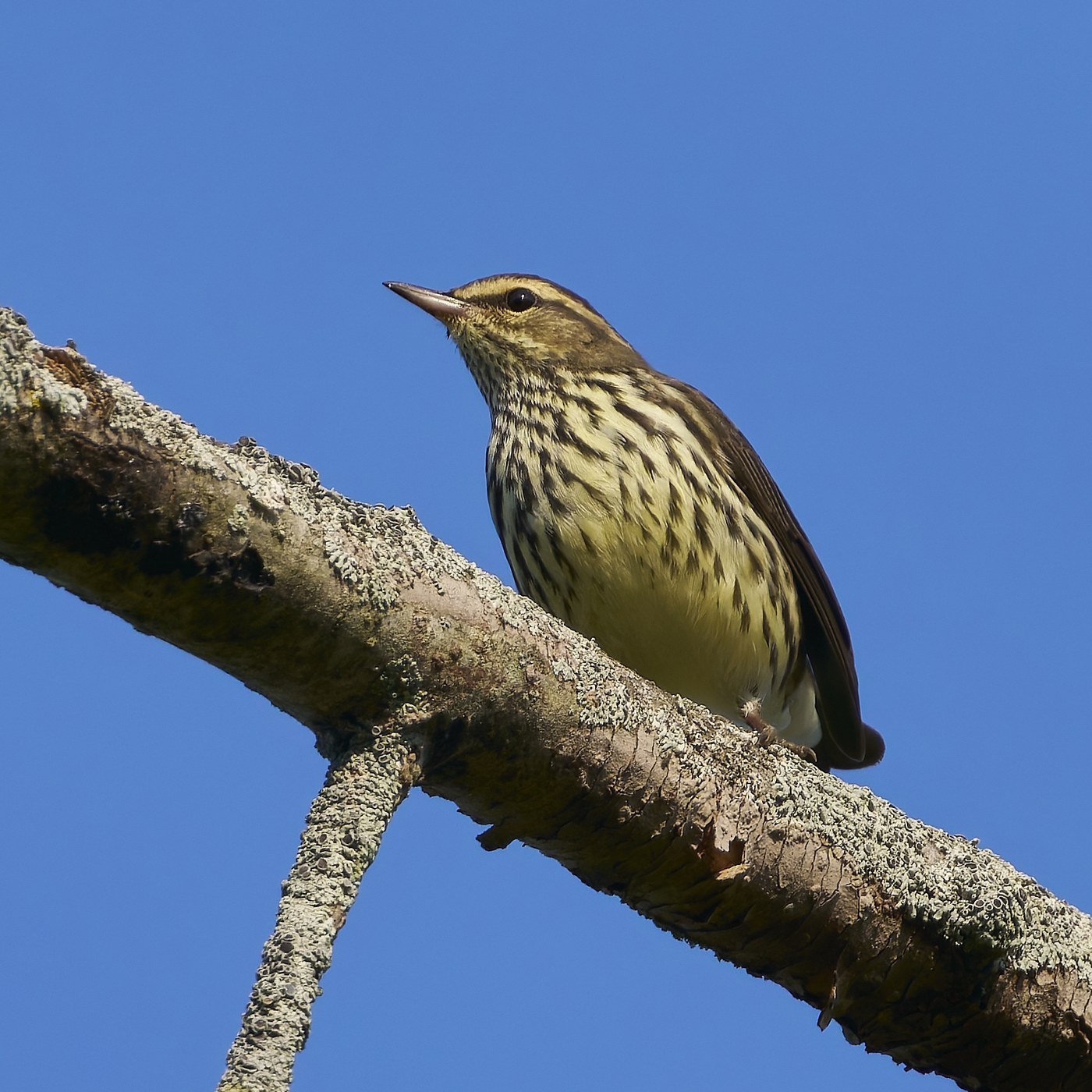
Key Field Marks
- Size & shape: A chunky, ground-walking warbler (about 15 cm / 6 in) with a fairly long bill and pink-brown legs, more thrush-like in build and behavior than a typical warbler.
- Upperparts: Plain olive-brown to dark brown, unstreaked.
- Underparts: Whitish to pale yellow, heavily and finely streaked (not spotted) with dark brown from throat to belly.
- Face: A supercilium (eyebrow stripe) that is often buffy or dull whitish, typically narrowing and less bold behind the eye.
- Behavior: Constantly bobs and teeters its rear end/tail while walking along the ground or mud, much like a Spotted Sandpiper.
Separating It From Similar Species
- Louisiana Waterthrush: The classic confusion species. Louisiana has a bigger bill, a bold white supercilium that flares wider behind the eye, an unstreaked white throat (versus Northern's streaked throat), bubblegum-pink legs, and a buffy wash restricted to the flanks. Louisiana also favors fast-moving streams with rocky beds, while Northern prefers still or slow-moving water.
- Ovenbird: Also walks on the forest floor and is streaked below, but has a bold orange crown stripe bordered by black and a bold white eyering, and does not bob its tail in the same swinging fashion.
Where & When to Look
- Habitat: Wooded swamps, bogs, and the edges of ponds, slow streams, and other still or slow-moving water with plenty of leaf litter and downed wood — unlike Louisiana Waterthrush's preference for fast, rocky streams.
- Range: Breeds across the boreal forest of Canada and the northern U.S.; migrates through virtually all of the eastern and central U.S.; winters in Central America, the Caribbean, and northern South America, often in mangroves.
- Season: An early fall migrant among wood-warblers, frequently on the move by late July and August; spring migration is comparatively later than Louisiana Waterthrush's.
Voice
- Song is a loud, ringing series of notes that starts with clear, sharp phrases and accelerates or drops in pitch toward the end — "sweet sweet sweet, chew chew chew, chew-chew-chew-chew."
- Call note is a sharp, hard "chink" or "chip," useful for locating a bird skulking near water.
Frequently asked questions
What is the best way to tell Northern Waterthrush from Louisiana Waterthrush?
Check the throat: Northern Waterthrush has fine streaking through the throat, while Louisiana's throat is clean white and unstreaked. Louisiana also has a bolder, flaring white eyebrow, bubblegum-pink legs, and prefers fast rocky streams, while Northern favors still or slow water.
Why does the Northern Waterthrush bob its tail?
It constantly teeters its rear end and tail while walking, a habitual behavior thought to help it blend motion with the flickering light and water at the forest floor, similar to a Spotted Sandpiper.
Is the Northern Waterthrush really a thrush?
No — despite its name and thrush-like ground-walking behavior, it is a wood-warbler in the family Parulidae, not a true thrush.
Where does the Northern Waterthrush spend the winter?
It winters in Central America, the Caribbean, and northern South America, frequently in coastal mangrove forests as well as inland wetlands.