
Northern Shoveler Identification Guide
A dabbling duck instantly recognizable by its oversized, spoon-shaped bill, which it uses to filter-feed while swimming low with its head down.
Read the full Northern Shoveler encyclopedia entry →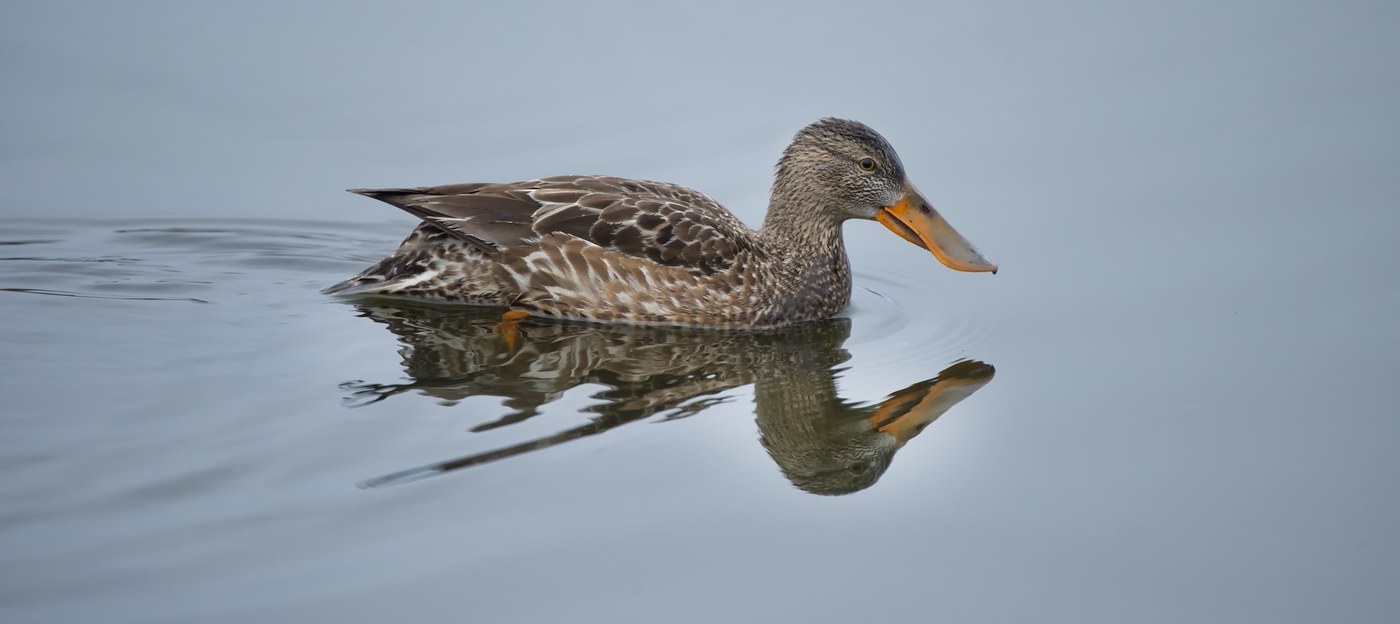
Key Field Marks
- Bill: The defining feature — a large, spatulate (spoon-shaped) bill, noticeably wider at the tip than the base, on both sexes.
- Breeding male: Iridescent green head, white breast, rich chestnut flanks and belly, black rear end, and a bright yellow eye.
- Female/eclipse male: Mottled brown overall, similar to a female Mallard, but told apart by the oversized bill and typically an orange-tinged bill with dark markings on top.
- Posture: Swims low in the water with the bill often angled down, giving a distinctive front-heavy silhouette.
- In flight: Pale blue forewing patch (like other dabbling ducks) with a green speculum bordered by white, and the bill remains obviously oversized even in flight.
Separating It From Similar Species
- Female Mallard: Similar mottled brown plumage but has a normal-proportioned bill (orange with dark saddle) and lacks the spatulate shape; Mallards also lack the shoveler's low, head-down swimming posture.
- Blue-winged Teal: Much smaller with a proportionally smaller bill; breeding male has a bold white facial crescent that shovelers lack.
- Gadwall: Female Gadwall has a smaller, more contrastingly orange-edged bill and shows a white speculum patch, not the shoveler's oversized bill.
Behavior & Feeding
- Feeds by swimming forward with its bill skimming the water surface, using comb-like lamellae along the bill edges to filter out small invertebrates, seeds, and plankton — a technique distinct from the tip-up dabbling of most other surface-feeding ducks.
- Often seen swimming in tight circles with other shovelers to stir up food from the water column.
Where & When to Look
- Habitat: Shallow, productive wetlands — marshes, flooded fields, sewage ponds, and shallow lake edges — favoring water with abundant plankton and invertebrates over deeper open water.
- Range: Breeds across the prairie pothole region of the northern U.S. and Canada; winters through much of the southern and coastal U.S., Mexico, and Central America.
- Season: A common migrant and winterer across much of North America, often arriving early in fall and lingering late in spring wherever shallow water persists.
Voice
- Generally quiet; males give a low, nasal, repeated "took-took" or "thook-thook," while females give a Mallard-like but softer, weaker quack.
Frequently asked questions
What is the easiest way to identify a Northern Shoveler?
Look for the oversized, spoon-shaped bill on both sexes, combined with a low, head-down swimming posture — no other common dabbling duck has such a disproportionately large bill.
How can I tell a female Northern Shoveler from a female Mallard?
Both are mottled brown, but the shoveler's bill is much larger and spatulate compared to the Mallard's slimmer, evenly proportioned bill, and shovelers typically swim lower with the bill angled toward the water.
How does a Northern Shoveler feed?
It swims forward skimming its wide bill just under the water's surface, filtering out tiny invertebrates and seeds using comb-like structures along the bill edge, rather than diving or tipping up like many other ducks.
Where can I find Northern Shovelers in winter?
Look in shallow, nutrient-rich wetlands such as marshes, flooded agricultural fields, and sewage treatment ponds across the southern and coastal United States, Mexico, and Central America.