
Northern Saw-whet Owl Identification Guide
One of North America's smallest and most secretive owls, identified by its round earless head, streaked rusty underparts, and monotonous tooting call given mainly at night.
Read the full Northern Saw-whet Owl encyclopedia entry →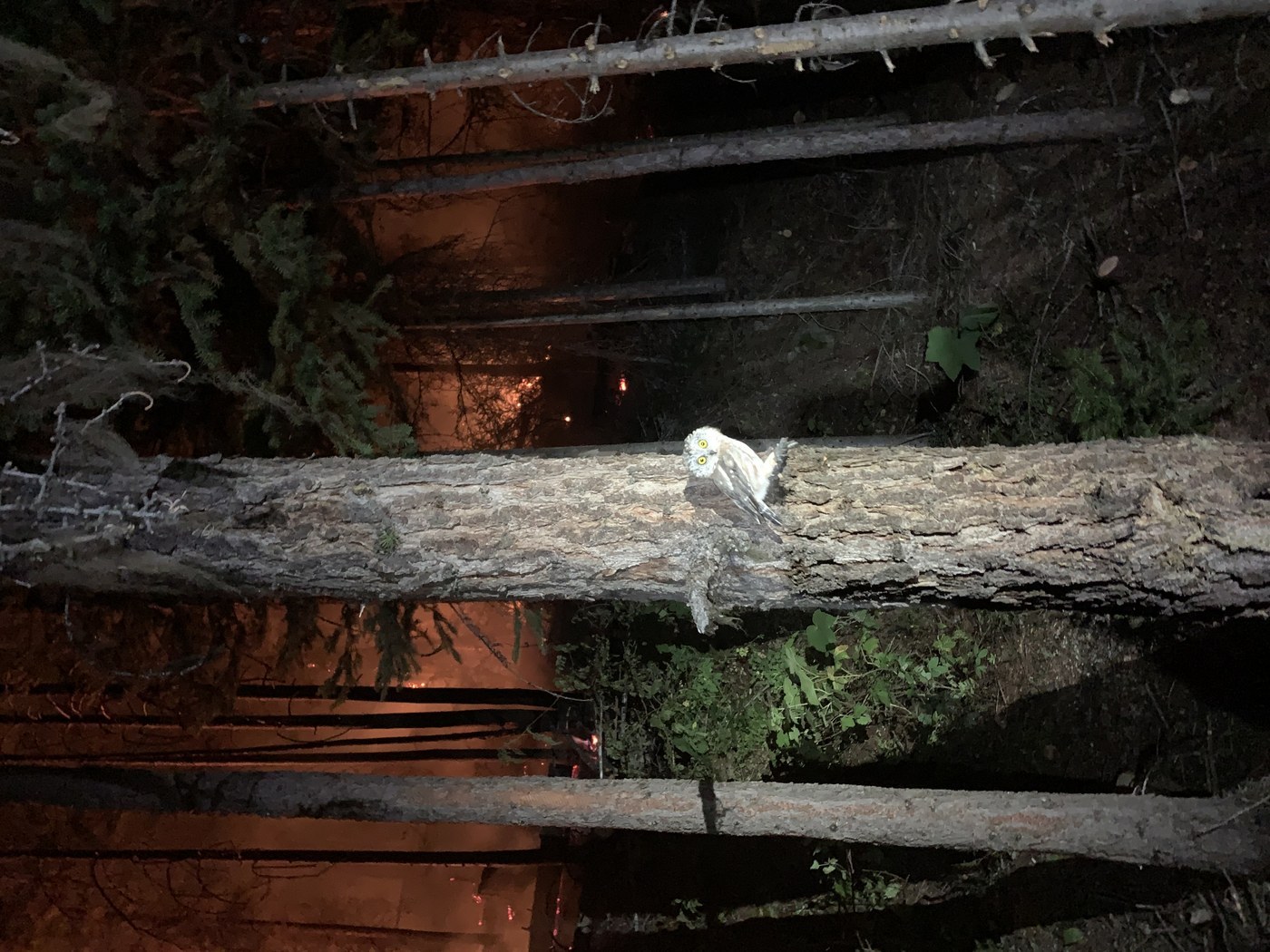
Key Field Marks
- Size & shape: Tiny (about 18–21 cm / 7–8 in), roughly the size of a robin, with a large rounded head, no ear tufts, and a short tail.
- Face: Pale facial disc with a faint darker border, framing large yellow eyes and a dark bill.
- Underparts: White to buffy background heavily streaked with rusty-brown, giving a soft, streaky (not barred) appearance.
- Upperparts: Brown with white spotting on the crown and scapulars (shoulder area).
- Juveniles: Distinctly different — rich chocolate-brown overall with a bold white "X" or triangle between the eyes, often confusing new birders.
Separating It From Similar Species
- Boreal Owl: Larger, with a more strongly black-bordered ("framed") facial disc, a yellowish (not blackish) bill, and a spotted rather than streaked crown; voice is a fast, accelerating series rather than steady monotone toots.
- Northern Pygmy-Owl: Active by day, has a longer cocked tail, and shows false eyespots on the nape that Saw-whets lack; Saw-whets are almost entirely nocturnal.
- Eastern/Western Screech-Owl: Both have visible ear tufts (though sometimes flattened) and much more intricately patterned, mottled/barred plumage rather than simple streaking.
Where & When to Look
- Habitat: Dense coniferous and mixed forests with thick understory for daytime roosting, including spruce, fir, and cedar thickets; also found in mixed woodlots during migration.
- Range: Breeds across southern Canada, the northern U.S., and south through western mountain forests into Mexico; northern and high-elevation populations migrate south or downslope in fall.
- Season: Migration peaks in October–November in much of North America, when banding stations regularly capture birds; roosting individuals can turn up in unexpected small thickets, even in urban parks, during this period.
Voice
- Territorial song is a monotonous, evenly spaced series of single whistled toots on one pitch — "toot-toot-toot-toot..." — often likened to a truck backing up, given mainly at night in late winter and early spring.
- Roosting daytime birds are silent and rely on camouflage and stillness, often allowing very close approach, tucked tight against a tree trunk.
Frequently asked questions
How do you tell a Northern Saw-whet Owl from a Boreal Owl?
Boreal Owl is larger with a strongly black-bordered facial disc and a yellowish bill, while Saw-whet Owl is smaller with a faintly bordered face and a blackish bill; their calls also differ, with Boreal giving a fast accelerating series versus the Saw-whet's steady monotone toots.
Why are Northern Saw-whet Owls so hard to see?
They roost quietly by day in dense thickets, usually low and tucked against the trunk, relying on camouflage and stillness rather than flight to avoid detection, so they are mostly found by chance or by following mobbing chickadees.
What does a juvenile Northern Saw-whet Owl look like?
Juveniles are rich chocolate-brown overall with an unstreaked breast and a bold white 'X' or triangle marking between and above the eyes, looking quite different from the streaky-breasted adult plumage.
When is the best time to hear a Northern Saw-whet Owl calling?
Late winter through early spring (roughly February–April in much of its range), at night, when males give their steady tooting territorial song.