
Northern Pygmy-Owl Identification Guide
A tiny, fierce, day-active owl of western mountain forests, best known for the false "eyespots" on the back of its head and its evenly spaced tooting call.
Read the full Northern Pygmy-Owl encyclopedia entry →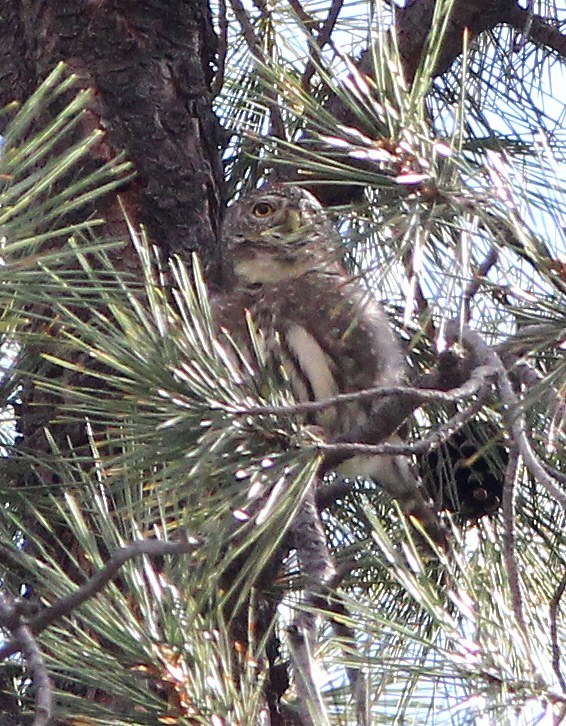
Key Field Marks
- Size & shape: Very small (about 17 cm / 6.5 in), roughly sparrow- to robin-sized, with a proportionally long tail often held cocked at an angle.
- Head: Round head with no ear tufts, yellow eyes, and a finely spotted crown.
- The giveaway mark: A pair of black-and-white false "eyespots" on the nape (back of the head), thought to deter mobbing songbirds by mimicking a watching face.
- Underparts: Whitish background with bold brown streaking down the belly and flanks; upperparts brown, gray, or rufous depending on morph.
- Bill & legs: Small hooked yellowish bill; legs feathered, feet yellow.
Separating It From Similar Species
- Northern Saw-whet Owl: Strictly nocturnal, lacks nape eyespots, shorter tail, and shows a plainer reddish-streaked breast. Pygmy-Owls are active by day and often perch in the open.
- Ferruginous Pygmy-Owl: Range mostly separate (desert Southwest/Mexico); has a streaked (not spotted) crown, and prefers lower, drier scrub habitat.
- Elf Owl: Smaller, short-tailed, strictly nocturnal, and lacks the cocked long tail and nape eyespots.
- Small size and daytime activity alone often tip birders off before plumage details are even checked.
Behavior Clues
- Frequently hunts by day (crepuscular to fully diurnal), perching in the open on snags or wires.
- Often mobbed by chickadees, nuthatches, and other songbirds that have located it — a noisy mob of small birds is a classic way to find one.
- Habitually pumps and flicks its tail while perched.
Where & When to Look
- Habitat: Mixed and coniferous forest edges, open woodlands, and mountain canyons from lowlands up into subalpine forest.
- Range: Resident from southeast Alaska and western Canada south through the mountains of the western U.S. into Mexico and parts of Central America.
- Season: Present year-round in most of its range; some higher-elevation birds shift downslope in winter.
Voice
- Song is a series of low, mellow, evenly spaced single whistled toots — "toot... toot... toot..." — repeated at a steady pace for long stretches, most vocal at dawn and dusk but also heard by day.
- Also gives a rapid double-note "took-took" territorial call.
Frequently asked questions
How can I tell a Northern Pygmy-Owl from a Northern Saw-whet Owl?
Pygmy-Owls are active during the day, have a longer tail often cocked upward, and show false eyespots on the nape; Saw-whet Owls are strictly nocturnal, shorter-tailed, and lack nape eyespots.
Why does the Northern Pygmy-Owl have spots on the back of its head?
The paired black-and-white nape markings mimic a second face, which is thought to discourage predators and mobbing songbirds from attacking from behind.
Is the Northern Pygmy-Owl nocturnal?
No — unlike most owls, it is largely diurnal and crepuscular, frequently hunting and calling in daylight, especially around dawn and dusk.
What is the easiest way to find a Northern Pygmy-Owl in the field?
Listen for a mobbing flock of chickadees, nuthatches, or kinglets scolding loudly at a fixed point, and for the owl's own evenly spaced single-note tooting song.