
Northern Pintail Identification Guide
An elegant, slender dabbling duck with a long, pointed tail and a slim neck, recognized by its graceful silhouette on open water and marshes across North America.
Read the full Northern Pintail encyclopedia entry →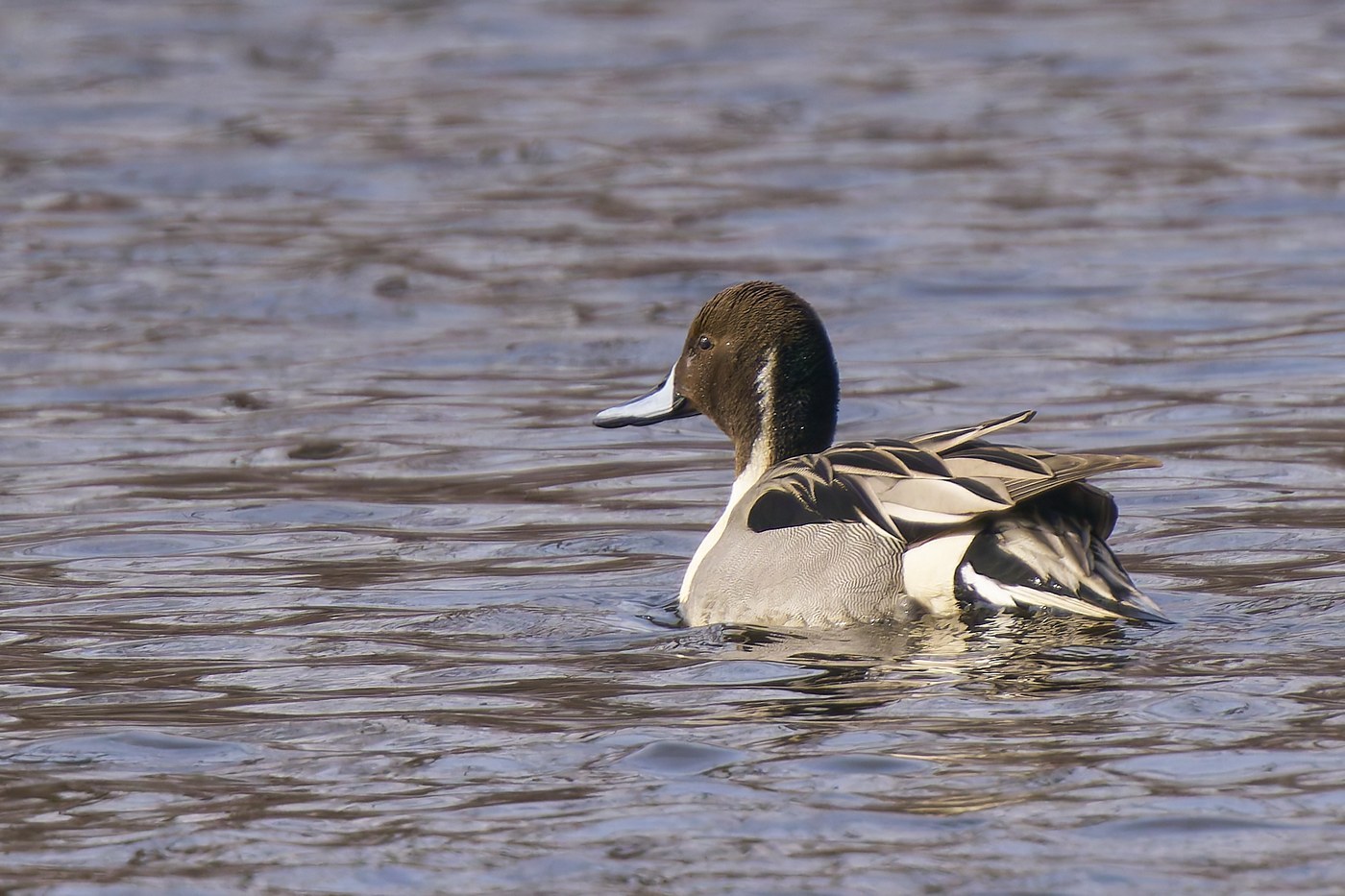
Overview
The Northern Pintail (Anas acuta) is a widespread, elegant dabbling duck found on marshes, wetlands, and open water across much of the Northern Hemisphere. Its slender build and, in males, extravagantly long pointed tail feathers make it one of the most graceful and readily identifiable ducks in flight or on the water.
Key Field Marks
- Size & shape: A slim, long-necked, long-bodied duck; males measure up to about 25–29 inches including their elongated central tail feathers, while females are shorter (around 20–22 inches) and lack the tail extension.
- Male plumage: A chocolate-brown head with a clean white stripe running up the side of the neck from a white breast and belly, gray flanks and back, and a long, thin, pointed black tail (the source of the name) that projects noticeably beyond the wings at rest and in flight.
- Female plumage: Mottled brown overall, similar to other female dabbling ducks, but distinguished by the same slim, long-necked shape, a pointed (though shorter) tail, and a gray-blue bill.
- Bill: Gray-blue, with males showing a slightly darker culmen (ridge) and blacker tip.
- Behavior: A dabbling duck that tips forward ("tips up") to feed on submerged vegetation and grain in shallow water rather than diving; often forms large mixed flocks with other dabblers, and flies with fast, direct wingbeats showing a slender, pointed silhouette.
Similar Species
- Mallard and other dabbling ducks are bulkier and shorter-necked, and lack the pintail's elongated tail and slim profile.
- Female pintails can be confused with female Mallards or Gadwalls, but the pintail's slimmer neck, grayer overall tone, plainer head, and pointed tail (even without full-length tail feathers) help separate it.
- In flight, the pintail's long neck, pointed tail, and slim, dark wing with a bronze-green speculum bordered by white distinguish it from other dabblers at a distance.
Where & When to Find One
Northern Pintails breed across the prairie pothole region of the northern U.S. and Canada, as well as across much of northern Eurasia, favoring open wetlands, shallow lakes, and grassy marshes. They winter widely across the southern U.S., Mexico, and Central America, often in large flocks on flooded agricultural fields, coastal marshes, and shallow lakes. They are among the earliest ducks to arrive on both spring and fall migration, so look for them in open wetland habitat especially in early fall and again in very early spring.
Voice
Males give a soft, wheezy, whistled "proop-proop" or a short, mellow flute-like whistle, especially during courtship; females give a lower, hoarse, descending quack more subdued than a Mallard's.
Frequently asked questions
What is the most distinctive feature of a male Northern Pintail?
Its long, thin, pointed tail feathers extending well past the wings, combined with a chocolate-brown head and a clean white stripe running up the neck, make the male instantly recognizable.
How can I identify a female Northern Pintail?
Look for an overall slim, long-necked, grayish-brown mottled duck with a plain head, a gray-blue bill, and a pointed (though shorter than the male's) tail — a slimmer silhouette than a female Mallard.
Is the Northern Pintail a diving duck?
No, it is a dabbling duck that tips forward to feed on submerged vegetation in shallow water rather than diving underwater like the diving ducks (e.g., scaup or Redhead).
Where do Northern Pintails spend the winter?
They winter widely across the southern U.S., Mexico, and Central America, often gathering in large flocks on flooded fields, coastal marshes, and shallow wetlands.
When is the best time to see Northern Pintails on migration?
They are among the earliest migrating ducks, so look for large flocks in open wetlands in early fall and again in very early spring.