
Northern Parula Identification Guide
A tiny, compact wood warbler with a bicolored bill and a rising, buzzy trilled song, often found foraging high in tree canopy or hanging Spanish moss.
Read the full Northern Parula encyclopedia entry →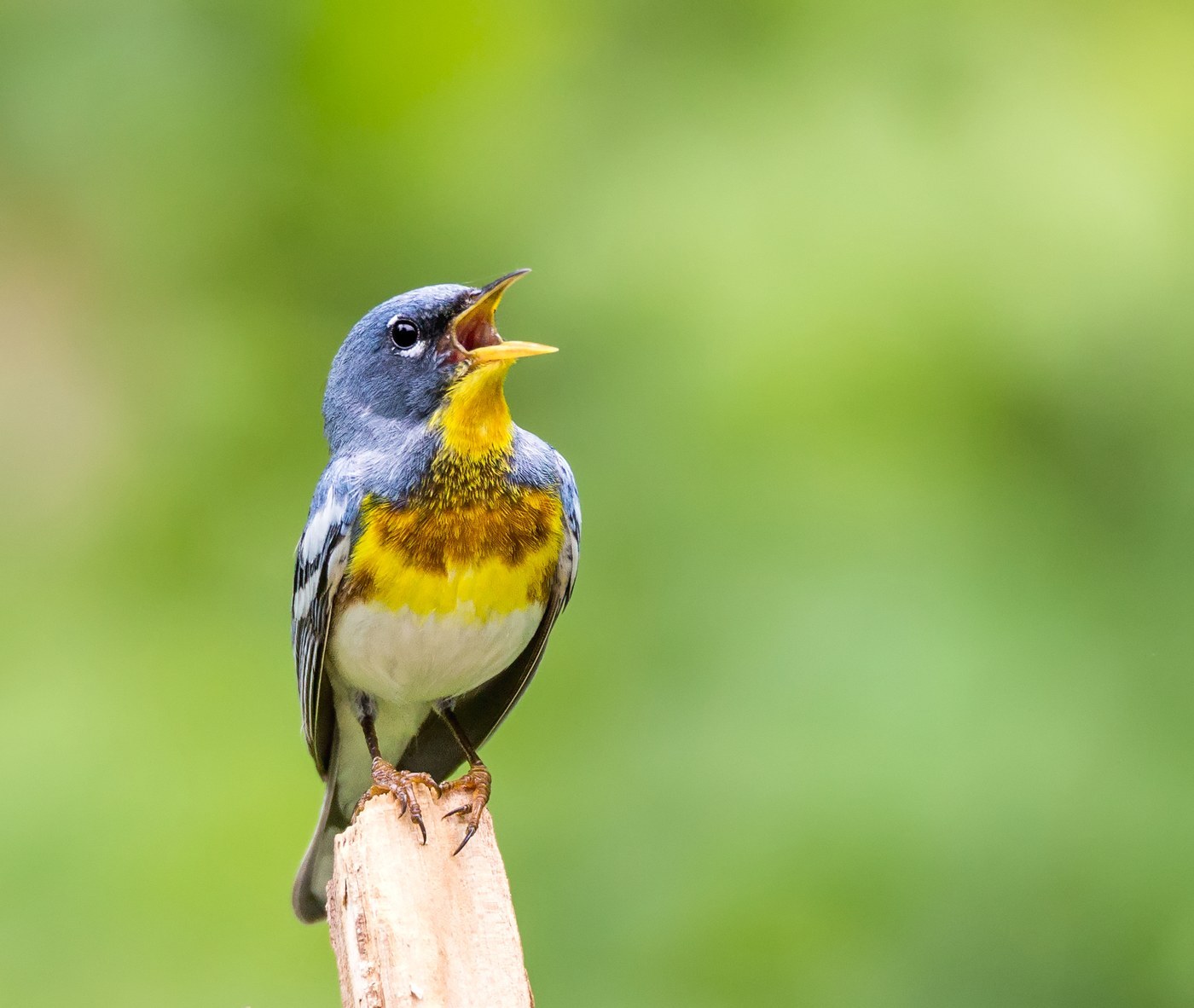
Overview
The Northern Parula (Setophaga americana) is one of the smallest North American wood warblers, breeding in forests across the eastern U.S. and Canada. Its bicolored bill and preference for hanging moss or lichen for nesting make it a distinctive and locally common spring and summer warbler.
Key Field Marks
- Size & shape: A very small, compact, short-tailed warbler about 4.5 inches long, with a relatively short tail and a fairly short, pointed bill.
- Bill color: Diagnostic bicolored bill — dark bluish-gray above and yellow-orange below — visible at close range and a key identification feature.
- Male plumage: Blue-gray upperparts with a yellowish-green patch on the back, a bright yellow throat and breast crossed by a dark rufous-and-black breast band, white belly, and white eye crescents (broken eye-ring).
- Female plumage: Similar but duller, with a paler, less defined or absent breast band and less contrast overall.
- Wing pattern: Two bold white wing bars stand out against the blue-gray wings.
- Behavior: Forages actively and often high in the forest canopy or out along thin outer branches, gleaning insects; in the Southeast, frequently nests within hanging clumps of Spanish moss, and in the North within Usnea (old man's beard) lichen.
Similar Species
- Tropical Parula (South Texas) looks very similar but lacks the white eye crescents (instead has a solid dark face) and typically lacks the distinct black band within the rufous breast band.
- Other blue-and-yellow warblers such as Cerulean Warbler lack the parula's bicolored bill, greenish back patch, and breast band, and show different overall plumage patterns.
- The combination of small size, greenish back patch, and bicolored bill is unique to the parula among regularly occurring eastern warblers.
Where & When to Find One
Northern Parulas breed in mature forests across much of the eastern U.S. and southeastern Canada, with a particular affinity for stands festooned with Spanish moss in the South or old man's beard lichen in the North, both used as nesting material. They winter in Mexico, Central America, and the Caribbean, and are common spring and fall migrants throughout the eastern U.S., often detected in mixed-species foraging flocks moving through tree canopy. Listen for the rising buzzy trill in spring woodlands from April through July on the breeding grounds.
Voice
The song is a distinctive rising, buzzy trill that accelerates and often snaps upward sharply in pitch at the end, frequently transcribed as a rapid "zzzzzzzzzip" — quite different in cadence from most other warbler songs and a reliable identifier even when the bird is hidden in dense canopy.
Frequently asked questions
What is the best field mark for identifying a Northern Parula?
Its bicolored bill — dark bluish-gray above and yellow-orange below — combined with small size, blue-gray upperparts, a greenish back patch, and a yellow throat/breast make it distinctive among eastern warblers.
How do you tell Northern Parula from Tropical Parula?
Northern Parula has white eye crescents (a broken white eye-ring) on an otherwise blue-gray face, while Tropical Parula lacks these crescents and shows a more solidly dark face; ranges also differ, with Tropical Parula largely restricted to South Texas.
Why is the Northern Parula associated with Spanish moss?
In the southeastern U.S., it frequently builds its nest inside hanging clumps of Spanish moss, while northern populations use a similar hanging lichen called old man's beard (Usnea) for the same purpose.
What does a Northern Parula's song sound like?
A distinctive rising, buzzy trill that accelerates and snaps upward in pitch at the end, often described as a rapid ascending 'zzzzzzzzzip.'
Where does the Northern Parula spend the winter?
It migrates to Mexico, Central America, and parts of the Caribbean for the winter, returning to eastern North American forests to breed each spring.