
Northern Hawk Owl Identification Guide
A boldly patterned, falcon-shaped owl of boreal forest that hunts by day from exposed treetop perches, with a long tail and fast, low flight unlike any other North American owl.
Read the full Northern Hawk Owl encyclopedia entry →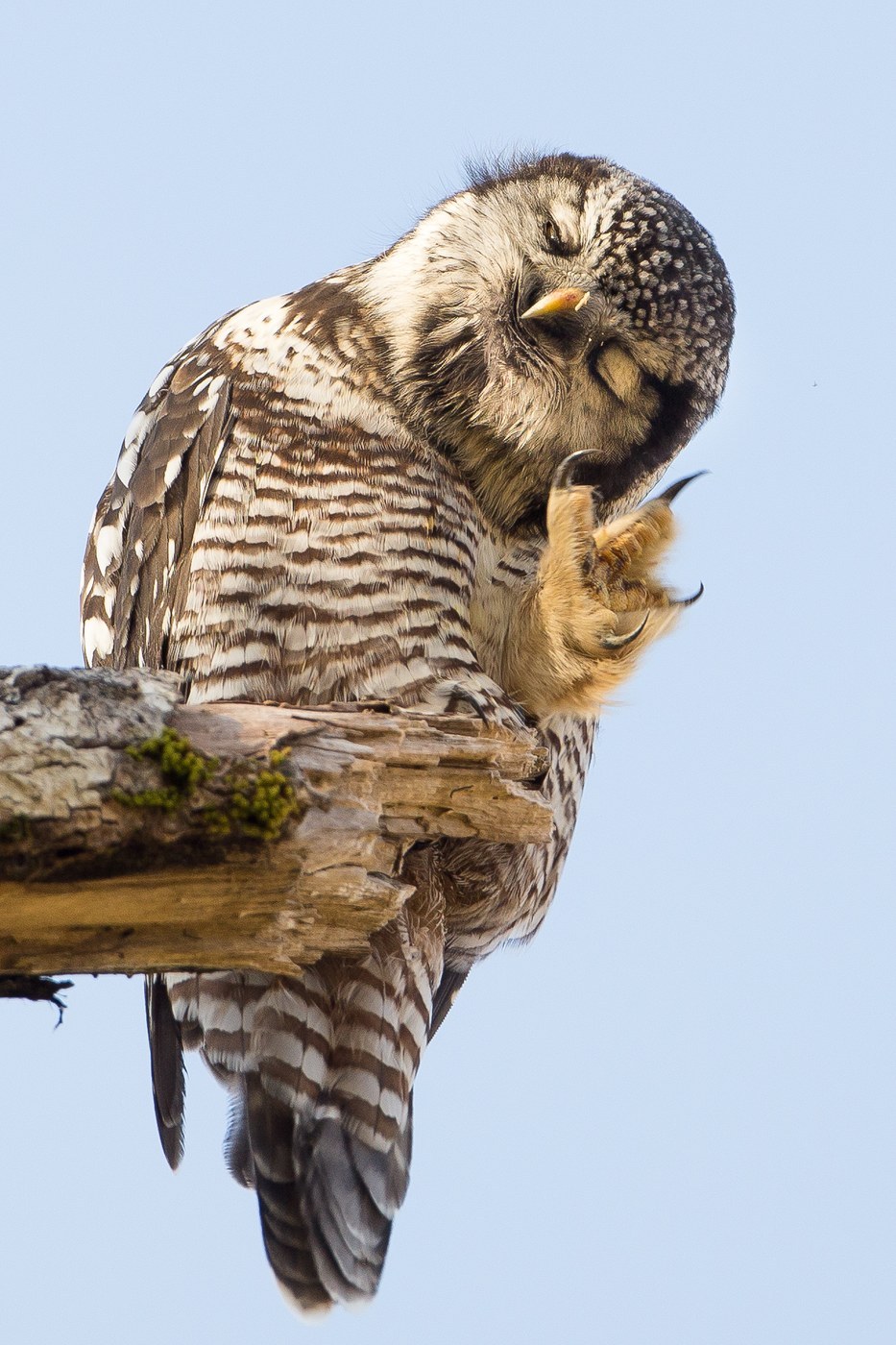
Overview
The Northern Hawk Owl (Surnia ulula) is a mid-sized owl of the northern boreal forest that behaves and even looks more like a falcon than a typical owl. It is strictly diurnal, hunting in daylight from prominent perches, and its irruptions southward in some winters make it an exciting find for birders outside its core range.
Key Field Marks
- Size & shape: A medium-sized owl, about 14–17 inches long, with a notably long tail and a small, rounded head lacking ear tufts — an overall streamlined, falcon-like silhouette unlike the stocky shape of most owls.
- Facial disc: A pale grayish-white facial disc bordered by a bold black border along the sides, giving a distinctive framed-face look.
- Plumage: Dark brown to blackish-brown above with white spotting, and densely barred brownish underparts (unlike the streaking seen in many other owls).
- Eyes: Bright yellow eyes set in the pale face, adding to the intense, alert expression.
- Behavior: Almost entirely diurnal (day-active), often perching bolt upright at the very top of a spruce or dead snag, bobbing and flicking its long tail like a shrike or kestrel; flies fast and low with quick wingbeats and glides, again recalling a falcon or accipiter more than a typical owl.
Similar Species
- Northern Pygmy-Owl is much smaller, lacks the hawk owl's long tail and framed facial pattern, and has dark false "eyespots" on the back of the head.
- Short-eared Owl hunts by day over open ground with buoyant, moth-like flight, but is larger-headed, round-faced without the black facial border, and lacks the long tail.
- Silhouette alone — long tail, small rounded head, upright treetop perching posture — usually separates the hawk owl from every other North American owl at a glance.
Where & When to Find One
Northern Hawk Owls are resident across the boreal forest of Canada and Alaska, inhabiting open coniferous woodland, burned areas, and forest edges near clearings or bogs. They are non-migratory but irrupt irregularly farther south into the northern U.S. (Minnesota, Wisconsin, Michigan, New England) in some winters when prey (mainly voles) crashes in the north. Winter is the best season to find one south of the core range, scanning treetops and utility poles along open habitat edges in daylight.
Voice
Mostly silent outside the breeding season. On territory, males give a long, rolling, whistled trill used in advertising and courtship, and both sexes give a sharp, chattering "ki-ki-ki-ki" alarm call when a nest or perch is approached.
Frequently asked questions
Why is the Northern Hawk Owl often mistaken for a falcon?
It has an atypical owl shape with a long tail, small rounded head without ear tufts, and fast, low, direct flight, plus a habit of hunting by day from exposed perches — all traits more typical of falcons than owls.
Is the Northern Hawk Owl active at night like most owls?
No, it is almost entirely diurnal, hunting in daylight, which is unusual among North American owls and makes daytime treetop sightings possible.
Where can I see a Northern Hawk Owl in the United States?
It breeds in Canada's and Alaska's boreal forest, but in some winters it irrupts south into the northern U.S. (e.g., Minnesota, Wisconsin, New England), where it can be found perched atop trees along open habitat edges.
What does a Northern Hawk Owl's face look like?
A pale grayish-white facial disc with a bold black border along the sides and bright yellow eyes, giving it a distinctively 'framed' facial pattern.
What food source drives Northern Hawk Owl winter irruptions?
Population crashes of voles and other small rodents in the boreal forest push hawk owls to move farther south in search of food during some winters.