
Northern Harrier Identification Guide
A slim, long-winged raptor of open marshes and grasslands that hunts by coursing low over the ground in a distinctive tilting, owl-faced flight, identified at any distance by its white rump patch.
Read the full Northern Harrier encyclopedia entry →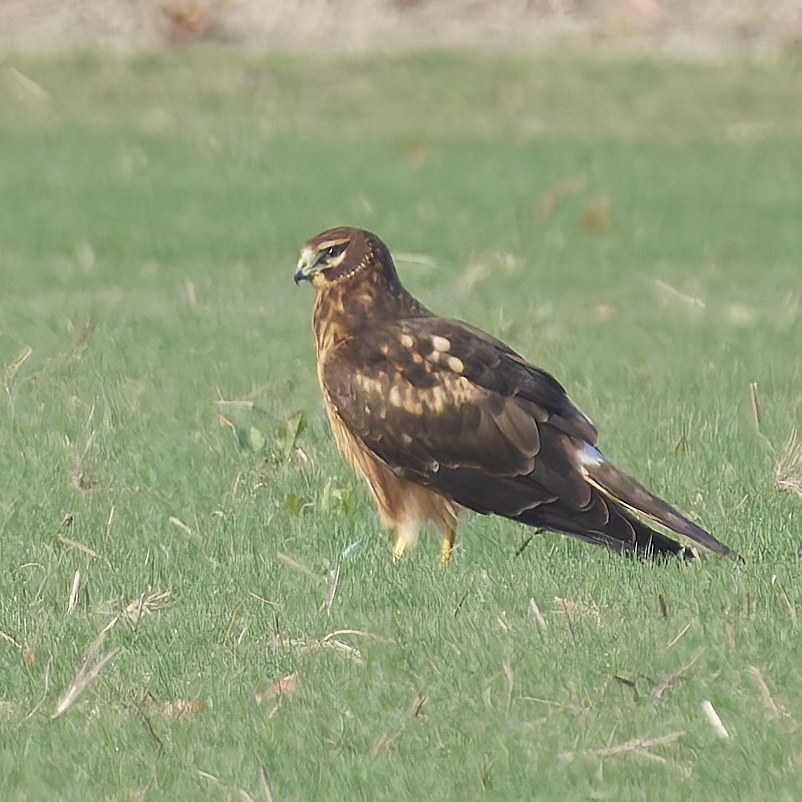
Overview
The Northern Harrier (Circus hudsonius) is a slender, long-tailed hawk of open country — marshes, grasslands, and agricultural fields — found across North America. Its low, buoyant hunting flight and owl-like facial disc (used to hear prey, much like an owl) set it apart from every other North American raptor.
Key Field Marks
- Size & shape: A slim, long-winged, long-tailed raptor, 18–20 inches long with a wingspan around 3.5–4 feet; wings are held in a shallow V (dihedral) in flight, similar to a Turkey Vulture but with a much more buoyant, tilting flight style.
- White rump: A bold white patch at the base of the tail is visible on all ages and both sexes and is the single best field mark, obvious even at a distance or in poor light.
- Facial disc: An owl-like ruff of stiff feathers around the face helps funnel sound to the ears, aiding this species' unusual reliance on hearing to locate prey in dense grass.
- Male plumage: Pale gray above and white below with black wingtips, earning the nickname "gray ghost."
- Female plumage: Larger than the male, brown above and heavily streaked buffy-brown below.
- Juvenile plumage: Similar to female but with an unstreaked, warm rufous-orange breast and belly.
- Behavior: Hunts by flying low and slow over open fields and marshes, tilting side to side on raised wings, then dropping suddenly onto prey detected by sound or sight; often roosts communally on the ground in winter.
Similar Species
- Turkey Vulture also flies with wings in a dihedral and rocks side to side, but is much larger, entirely blackish with silvery flight feathers, has a small bare red head, and lacks the harrier's white rump.
- Rough-legged Hawk and other buteos have broader wings, soar higher, and lack the harrier's low coursing flight and facial disc.
- Short-eared Owl, which shares open-country habitat and low flapping flight, especially at dusk, lacks the white rump and has rounder wings and a more moth-like wingbeat.
Where & When to Find One
Northern Harriers breed in open marshes, prairies, and grasslands across most of Canada and the northern U.S., wintering more broadly across the southern and central U.S. south to Mexico and Central America. They favor treeless, open habitats — coastal marshes, hay fields, prairie, and airport grasslands are especially reliable. Look for them cruising low over such open ground at any time of day, though activity often peaks in early morning and late afternoon.
Voice
Generally quiet away from the nest; near the breeding territory gives a sharp, repeated, nasal "kek-kek-kek-kek" alarm call, and a shrill whistled "pee-ee" during food exchanges between mates.
Frequently asked questions
What is the single best field mark for a Northern Harrier?
A bold white patch at the base of the tail (rump), visible on males, females, and juveniles alike, is the quickest and most reliable way to identify a Northern Harrier in flight.
How does a Northern Harrier hunt differently from other hawks?
It flies low and slow over open ground with wings held in a shallow V, using an owl-like facial disc to help locate prey by sound before dropping down to catch it, rather than soaring high or hunting from a perch.
How can I tell a male from a female Northern Harrier?
Males are pale gray above with black wingtips (nicknamed the 'gray ghost'), while females are larger and brown above with heavy streaking below; juveniles resemble females but have an unstreaked rufous-orange breast.
What habitat should I search for Northern Harriers?
Open, treeless habitats such as marshes, prairies, hay fields, and coastal grasslands, where they course low over the vegetation while hunting.
Is the Northern Harrier related to owls?
No, it is a true hawk (family Accipitridae), but it has independently evolved an owl-like facial disc that helps it hunt by sound in dense grass, a rare trait among diurnal raptors.