
Northern Goshawk Identification Guide
A powerful, secretive forest hawk with a fierce red eye and bold white eyebrow, the largest and most formidable of the North American accipiters.
Read the full Northern Goshawk encyclopedia entry →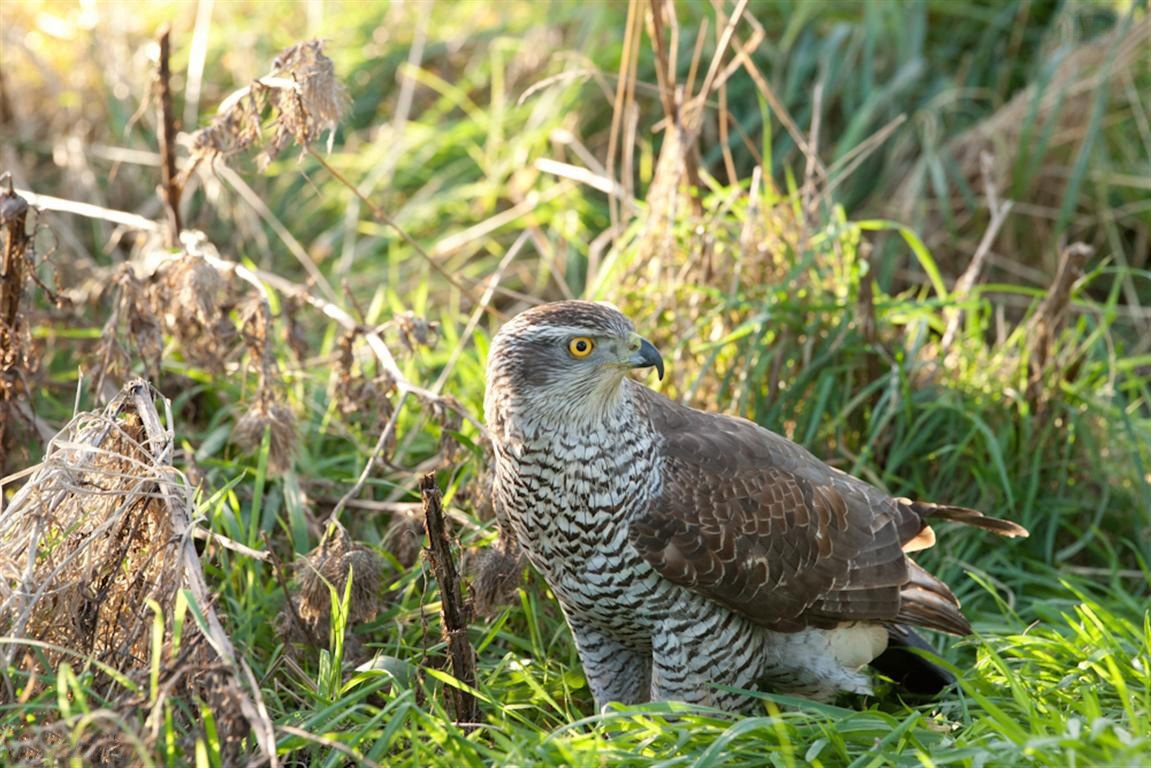
Overview
The Northern Goshawk (Accipiter gentilis) is a large, powerful raptor of mature coniferous and mixed forests across the northern U.S., Canada, and Eurasia. It is famously elusive and aggressive, known for fiercely defending its nest against intruders including humans, but is otherwise rarely seen due to its preference for dense forest interiors.
Key Field Marks
- Size & shape: The largest North American accipiter, 20–26 inches long with a wingspan up to 46 inches; broad-chested and bulky with fairly broad, rounded wings and a long tail compared to falcons.
- Adult plumage: Slate-gray to blue-gray upperparts and finely barred pale gray underparts, with a dark cap and a bold white eyebrow (supercilium) stripe that gives an intense, fierce expression.
- Eye color: Adults have a striking red to orange-red eye, deepening with age; juveniles have pale yellow eyes.
- Juvenile plumage: Brown above with heavy dark streaking (not barring) below and a buffy background color, along with a less distinct pale eyebrow than adults; can resemble a large juvenile Cooper's Hawk.
- Behavior: Flies with quick, powerful wingbeats and short glides, often low and fast through forest gaps; extremely aggressive near the nest, sometimes striking intruders on the head.
Similar Species
- Cooper's Hawk and Sharp-shinned Hawk are both notably smaller and slimmer, lack the goshawk's bulky chest and bold white eyebrow, and adults show reddish-barred (not fine gray-barred) underparts.
- Size is the best clue in mixed accipiter flight views: a goshawk looks like a Cooper's Hawk "on steroids," with broader wings, a bulkier body, and a more powerful, direct flight.
- Red-tailed Hawk and other buteos are much bulkier still with broader wings and shorter tails, and soar frequently, unlike the goshawk's forest-adapted flap-and-glide flight.
Where & When to Find One
Northern Goshawks favor large tracts of mature coniferous, deciduous, or mixed forest across Canada, Alaska, the northern U.S., and higher-elevation forests farther south in the Rockies and Appalachians. They are non-migratory to partially migratory, with northern populations sometimes irrupting south in winters of prey scarcity. Because they hunt and nest deep within forest cover, they are best located by learning their alarm call near a nest site (spring through summer) or by watching forest edges and clearings during irruption winters.
Voice
Generally silent away from the nest, but near an active nest gives a loud, harsh, repeated "kak-kak-kak-kak" alarm call when disturbed, along with a softer wailing "kee-a" begging call from females and young.
Frequently asked questions
What is the easiest way to identify a Northern Goshawk?
Look for a large, bulky accipiter with slate-gray upperparts, finely barred pale underparts, a bold white eyebrow stripe, and a red eye — noticeably larger and heavier-bodied than a Cooper's Hawk.
How do you tell a Northern Goshawk from a Cooper's Hawk?
The goshawk is considerably larger and bulkier with broader wings, a bolder white eyebrow, and fine gray barring below versus the Cooper's Hawk's smaller size, slimmer build, and warmer reddish barring.
Why are Northern Goshawks hard to see?
They live and hunt within dense mature forest interiors and are naturally wary and secretive except when defending an active nest, making chance sightings uncommon outside of forest gaps or irruption years.
Do Northern Goshawks migrate?
Most populations are largely resident, but northern birds may irrupt southward in some winters when prey such as grouse and hares become scarce.
Is it true Northern Goshawks attack people near their nests?
Yes, goshawks are known for fiercely defending nest sites and will dive at and sometimes strike intruders, including humans, that come too close during the breeding season.