
Northern Fulmar Identification Guide
A stocky, gull-like seabird of cold northern oceans that glides on stiff, straight wings low over the waves, distinguished from gulls by its thick neck and tube-nosed bill.
Read the full Northern Fulmar encyclopedia entry →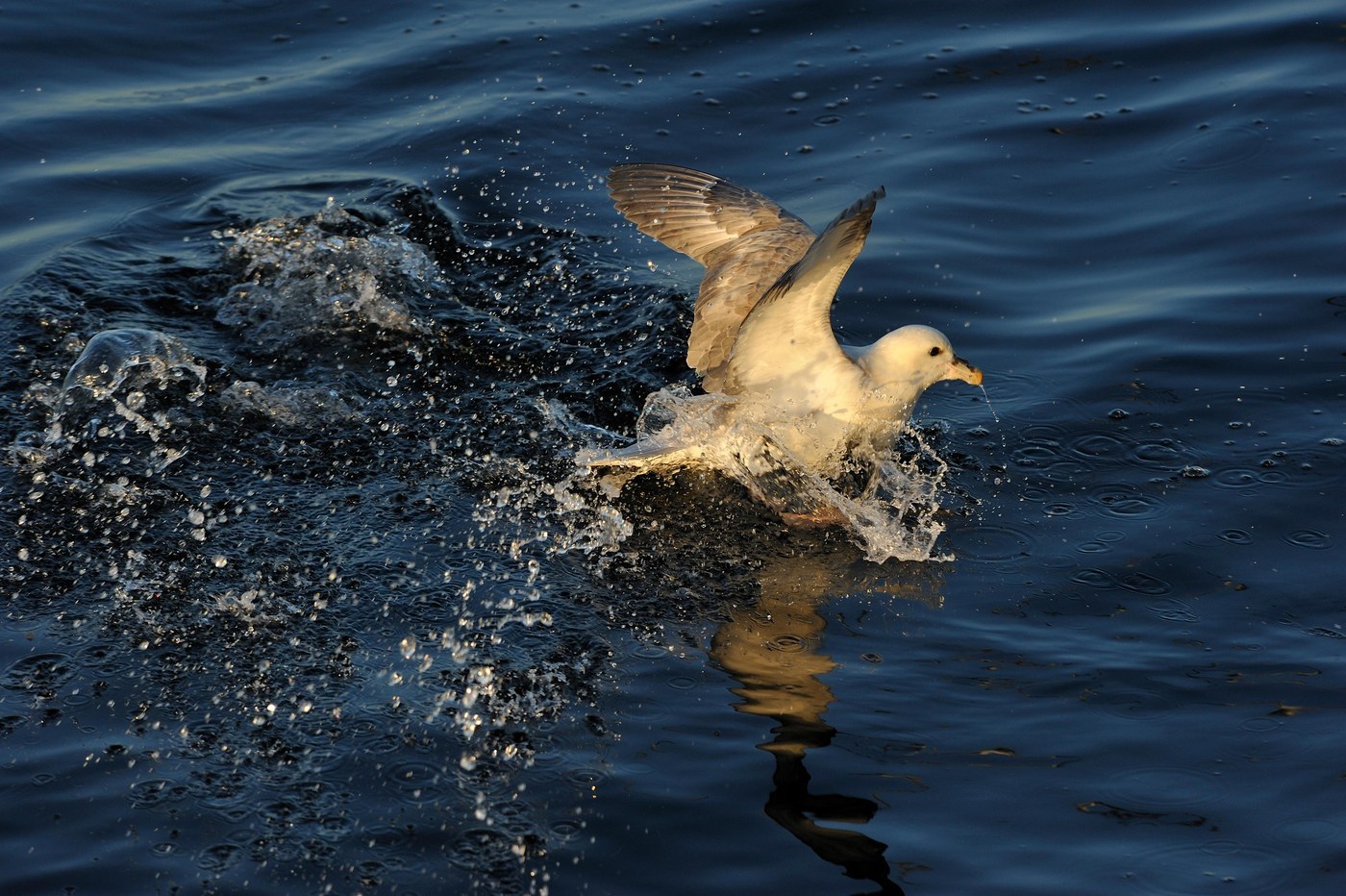
Overview
The Northern Fulmar (Fulmarus glacialis) is a tubenose seabird — a relative of albatrosses and shearwaters — that breeds on sea cliffs of the North Atlantic and North Pacific and spends most of its life far offshore. It is frequently mistaken for a gull at a distance but has a very different flight style and structure.
Key Field Marks
- Size & shape: A stocky, gull-sized seabird, about 18–20 inches long, with a thick neck, large rounded head, and a short, thick tail; overall bull-necked and barrel-chested compared to gulls.
- Bill: A stubby, strongly hooked bill with visible tubular nostrils on top (the "tubenose" feature shared by petrels and albatrosses), often yellowish with a bluish-gray base.
- Color morphs: Occurs in a light morph (pale gray back, white head and underparts) and a dark morph (uniform sooty gray-brown throughout), with intermediates; Pacific birds are more frequently dark morph, Atlantic birds more frequently light morph.
- Flight style: Flies on stiff, straight, unbending wings held flat, alternating rapid shallow wingbeats with long low glides just above the wave tops — quite unlike the more flexible, bowed-wing flight of gulls.
- Behavior: Highly pelagic, following fishing boats and feeding at the surface on fish, squid, and offal; on breeding cliffs, sits upright on narrow ledges in loose colonies.
Similar Species
- Gulls (e.g., Herring Gull) have longer, more flexible wings, a more buoyant flapping flight with wingbeats above and below the body plane, a slimmer bill without tube nostrils, and lack the fulmar's thick-necked, barrel-chested shape.
- Shearwaters are slimmer-bodied, longer-winged, and lack the fulmar's thick neck and stubby hooked bill; they also tilt and arc more dramatically in flight.
- Dark-morph fulmars can suggest a jaeger or dark shearwater, but the stiff-winged glide and tubenose bill are diagnostic.
Where & When to Find One
Northern Fulmars breed colonially on sea cliffs and rocky coasts of the high Arctic and sub-Arctic North Atlantic and North Pacific, including Iceland, Greenland, Newfoundland, the British Isles, and Alaska. Outside the breeding season they disperse widely over open ocean, and can be seen from pelagic birding trips or coastal seawatches off the U.S. Atlantic and Pacific coasts mainly in winter. They are rarely seen from shore except during storms that push them closer to land.
Voice
Largely silent at sea, but on breeding colonies fulmars give a range of harsh, cackling and grunting notes, often described as a guttural "ag-ag-ag-ag" or cackling chatter exchanged between paired birds at the nest ledge.
Frequently asked questions
How do you tell a Northern Fulmar from a gull?
Fulmars have a thicker neck, stockier barrel-chested body, a stubby hook-tipped bill with tube nostrils, and fly with stiff, straight wings and rapid shallow beats alternating with long glides, unlike a gull's more flexible, flapping flight.
What are the two color forms of Northern Fulmar?
A light morph with a pale gray back and white head/underparts, and a dark morph that is uniformly sooty gray-brown; both occur in the Atlantic and Pacific, though dark morphs are more common in the Pacific.
Where can I see a Northern Fulmar from land?
They are mostly pelagic, so land sightings are rare except during strong onshore storms; the best views come from dedicated pelagic boat trips off the North Atlantic or North Pacific coasts.
Is the Northern Fulmar related to albatrosses?
Yes, it belongs to the tubenose order Procellariiformes along with albatrosses, shearwaters, and petrels, sharing their tubular nostrils used for salt excretion and sense of smell.
What does a Northern Fulmar sound like?
It is mostly silent at sea but gives harsh, guttural cackling and grunting calls at breeding colonies when interacting with its mate or defending its ledge.