
Northern Flicker Identification Guide
A large, brown, spotted woodpecker that often feeds on the ground for ants, revealing a bold white rump and flashing yellow or salmon-red wing linings in flight.
Read the full Northern Flicker encyclopedia entry →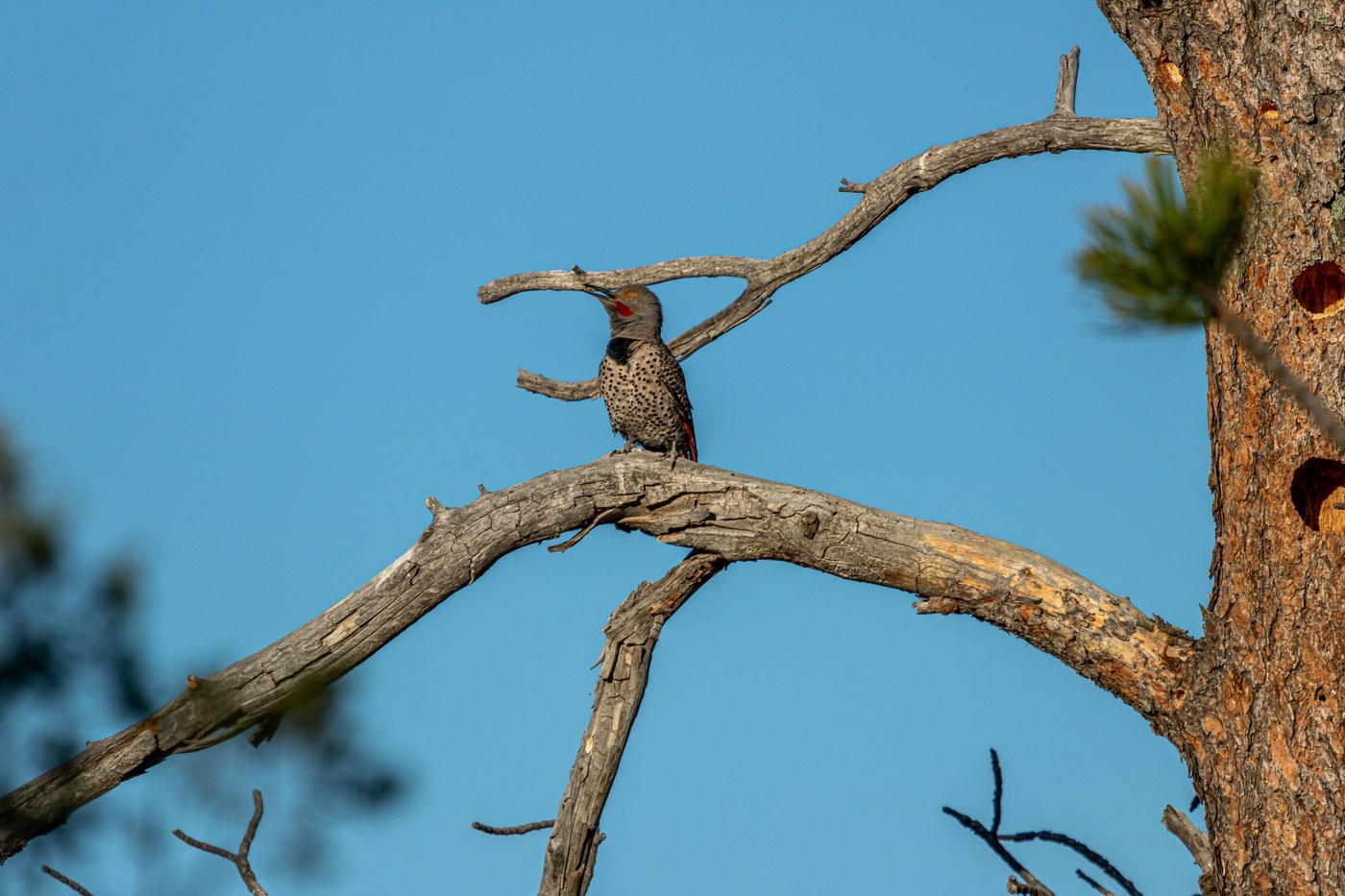
Overview
The Northern Flicker (Colaptes auratus) is a large, distinctive woodpecker found across nearly all of North America. Unlike most woodpeckers, it frequently forages on lawns and open ground rather than tree trunks, making it a common and often surprising backyard sighting.
Key Field Marks
- Size & shape: A large woodpecker, roughly 11–12 inches long, with a slim rounded head, long slightly downcurved bill, and long tail.
- Plumage: Brownish-gray overall with black barring on the back and wings, a black crescent bib on the upper breast, and bold black spotting across the belly.
- Rump patch: A conspicuous white rump patch flashes clearly in flight, one of the best field marks at any distance.
- Wing/tail color: Two distinct color forms occur — "Yellow-shafted" flickers (eastern/northern) show bright yellow wing and tail linings and a red crescent on the nape; "Red-shafted" flickers (western) show salmon-red wing and tail linings and a gray face with no nape crescent, but a red mustache stripe on males.
- Face pattern: Yellow-shafted males have a black mustache stripe and gray crown with a tan face; Red-shafted males have a red mustache stripe and a brown crown and face.
- Behavior: Often seen hopping on lawns and bare ground probing for ants with its long, barbed tongue; undulating flight typical of woodpeckers, with the white rump flashing on takeoff.
Similar Species
- Red-headed Woodpecker and other Melanerpes woodpeckers lack the flicker's brown, heavily barred back and ground-foraging habit.
- Gilded Flicker (Sonoran Desert) closely resembles the Red-shafted form but is paler and found in saguaro cactus habitat; range and habitat are the best separators.
- No other common woodpecker shows the combination of a brown spotted body, black breast crescent, and bright white rump patch in flight.
Where & When to Find One
Flickers occur in open woodlands, forest edges, parks, and suburban yards continent-wide, and are the only woodpecker regularly seen feeding on open ground. Yellow-shafted birds breed across the eastern half of North America and Canada; Red-shafted birds occupy the western half; the two forms intergrade in a broad zone through the Great Plains. Many northern populations migrate south for winter, while southern populations are year-round residents. Listen and look for them in open habitats with scattered trees, especially where ants are abundant in lawns and clearings.
Voice
A loud, sustained "wick-wick-wick-wick-wick" territorial call carries far and is given especially in spring; flickers also give a single loud "klee-yer" call and a soft "wickawicka" during interactions, plus a drumming roll on resonant surfaces like dead limbs or metal gutters.
Frequently asked questions
Why is a Northern Flicker often seen on the ground?
Flickers specialize in eating ants and beetle larvae, so unlike most woodpeckers they spend much of their foraging time hopping on lawns and bare ground rather than climbing tree trunks.
What's the difference between Yellow-shafted and Red-shafted flickers?
Yellow-shafted flickers (eastern) show yellow underwing/tail color, a red nape crescent, and a black mustache on males; Red-shafted flickers (western) show salmon-red underwing/tail color, no nape crescent, and a red mustache on males.
What field mark is easiest to spot on a flying flicker?
The bold white rump patch, clearly visible as the bird flies away, is the quickest way to confirm a Northern Flicker at a distance.
Do Northern Flickers migrate?
Northern populations, especially Yellow-shafted birds in Canada and the northern U.S., migrate south in winter, while southern and western populations are largely year-round residents.
What does a Northern Flicker sound like?
A loud, repeated 'wick-wick-wick-wick' call in spring, along with a single sharp 'klee-yer' note and drumming on resonant surfaces.