
Northern Bobwhite Identification Guide
A chunky, round-bodied quail of grasslands and brushy fields, best known for the whistled "bob-WHITE" call that rings across open country in spring and summer.
Read the full Northern Bobwhite encyclopedia entry →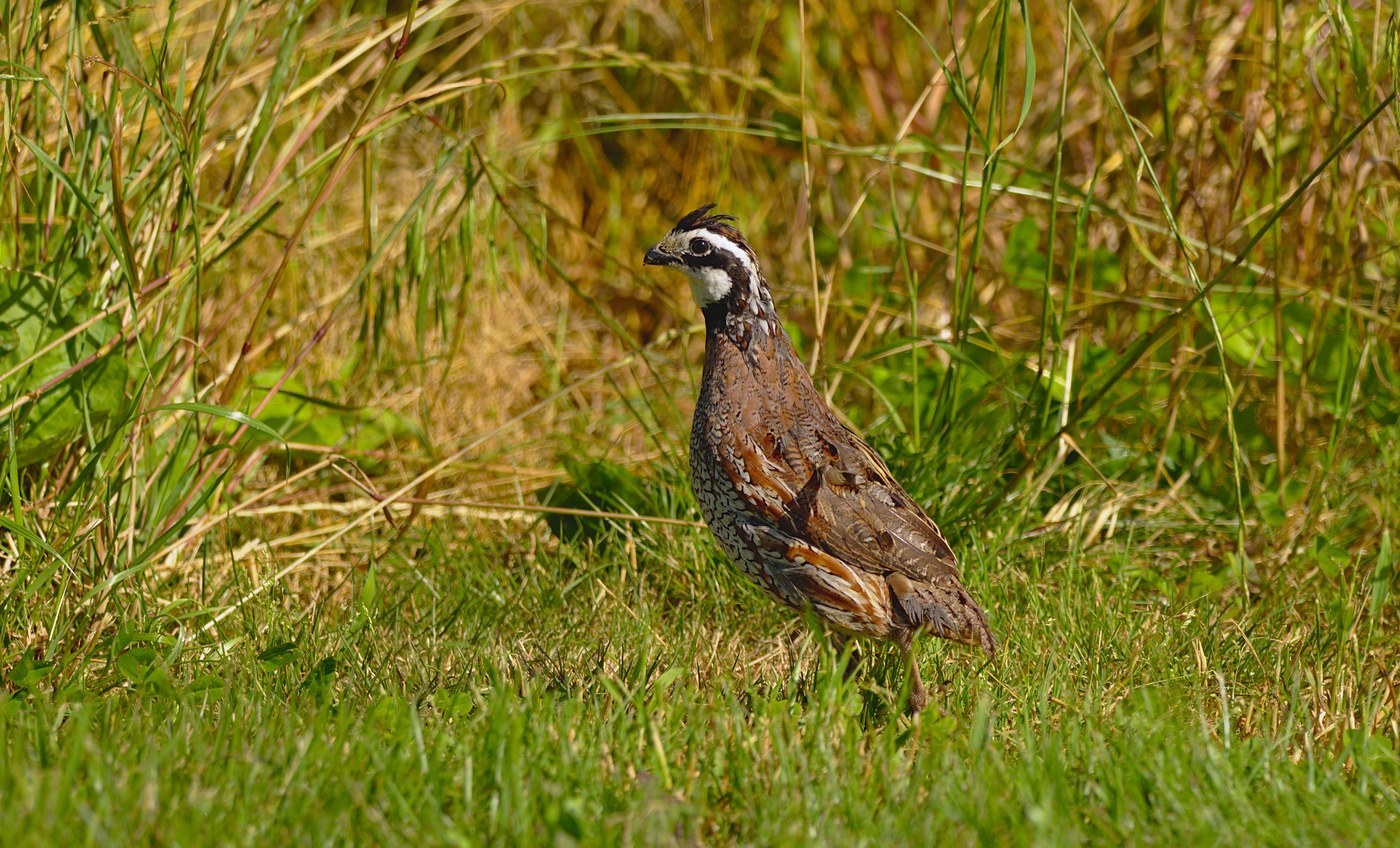
Overview
The Northern Bobwhite (Colinus virginianus) is a small, plump, ground-dwelling quail native to open grasslands, old fields, and brushy edges of the eastern and central United States, extending into Mexico. It is one of the most heard-before-seen birds in its range, more often located by its explosive whistled call than by sight.
Key Field Marks
- Size & shape: A small, rotund gamebird about 9.5–11 inches long, with a short neck, short rounded tail, and a distinctly small, curved bill.
- Plumage: Mottled reddish-brown, chestnut, and buff overall with intricate black-and-white barring and scalloping on the flanks and underparts, giving a dead-leaf camouflage pattern.
- Head pattern: Males show a bold white throat and white eyebrow stripe bordered by black; females and juveniles have the same pattern in buffy tan instead of white.
- Legs: Short, sturdy, unfeathered legs suited to walking and scratching through leaf litter and grass.
- Behavior: Spends nearly all its time on the ground in coveys (family groups) outside the breeding season; explodes into fast, whirring flight only when flushed at close range, then glides low and lands quickly to run for cover.
Similar Species
- Scaled Quail and Gambel's Quail (arid Southwest) have obvious head plumes and scaly-patterned underparts, unlike the bobwhite's streaky brown plumage and lack of a crest.
- Ruffed Grouse is larger, found in forested habitat rather than open fields, and has a fan-shaped tail with a dark terminal band.
- Juvenile bobwhites can look nondescript but always retain the basic head-stripe pattern and covey behavior that separate them from sparrows or other small brown birds.
Where & When to Find One
Look for bobwhites in weedy field edges, fallow agricultural land, pine savanna, and brushy fencerows across the southeastern and south-central U.S., with a shrinking range in the Midwest and Northeast due to habitat loss. They are non-migratory, so birds present in an area in summer are typically present year-round, moving in tight coveys of a dozen or more birds outside the nesting season (roughly fall through early spring). Early morning and late afternoon are best, when coveys forage and call along field edges and dirt roads.
Voice
The classic advertising call is a clear, rising two- or three-note whistle rendered as "bob-WHITE" or "poor-bob-WHITE," given by males from an elevated perch such as a fence post or low branch through spring and summer. Coveys also give soft contact whistles and a scattered "koi-lee" assembly call used to regroup after being flushed.
Frequently asked questions
What does a Northern Bobwhite look like?
A small, plump, short-tailed quail with intricately mottled brown, chestnut, and white plumage, and a bold white (male) or buffy (female) throat and eyebrow stripe bordered in black.
How can I tell a Northern Bobwhite from other quail?
Unlike Scaled or Gambel's Quail, bobwhites lack a head plume or crest and instead show a clean-cut striped head pattern; they're also found in grassy/brushy eastern and central habitats rather than arid Southwest scrub.
Why is the Northern Bobwhite hard to see?
It spends almost all its time walking and foraging on the ground under dense grass and brush, relying on cryptic mottled plumage to stay hidden, and only flies in short explosive bursts when nearly stepped on.
What time of year is best to hear a Northern Bobwhite calling?
Males whistle their namesake 'bob-WHITE' call most persistently from spring through summer during the breeding season, often from a fence post or shrub.
Are Northern Bobwhites social birds?
Yes, outside the breeding season they live in tight family groups called coveys, often roosting together in a tail-to-tail circle on the ground for warmth and predator vigilance.