
Northern Bald Ibis Identification Guide
A critically endangered, glossy black ibis with a bare red face and head, a shaggy neck ruff, and a long curved red bill, now surviving mainly in a small wild colony in Morocco plus reintroduced populations.
Read the full Northern Bald Ibis encyclopedia entry →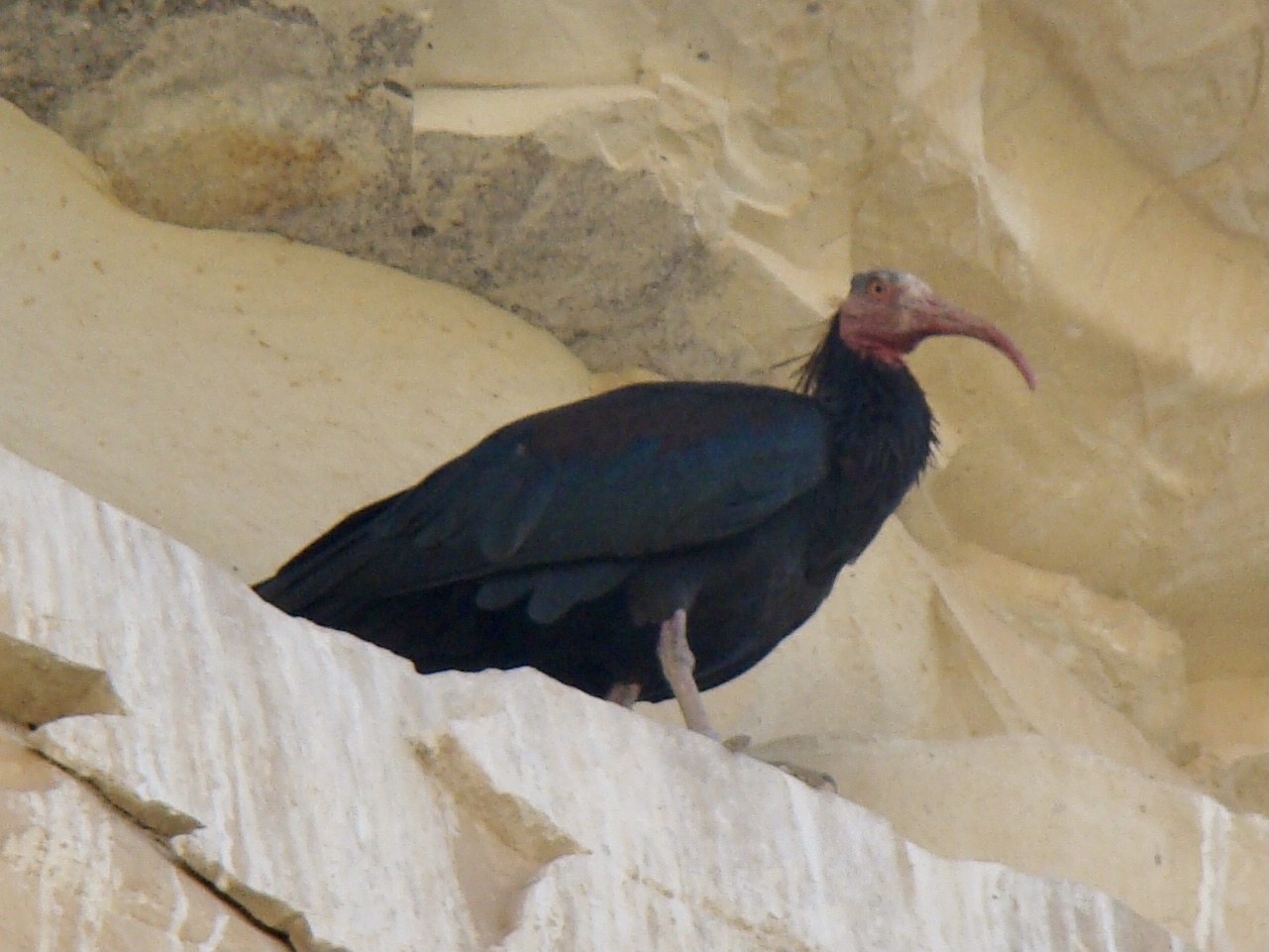
Overview
The Northern Bald Ibis (Geronticus eremita) is one of the rarest and most distinctive birds in the world, historically found across the Middle East, North Africa, and parts of southern Europe but now reduced to a small natural wild population, primarily in Morocco, supplemented by reintroduction projects in Spain, Austria, Germany, and Italy.
Key Field Marks
- Size & shape: Large, stocky ibis about 70–80 cm long, with a heavy body, long legs, and a long, thin, strongly downcurved bill.
- Head: Distinctive bare, wrinkled red skin covering the entire face and crown, lacking feathers — the source of its "bald" common name.
- Neck plumes: A shaggy ruff of elongated, wispy black feathers extending from the back of the head and neck, often loose and unkempt-looking, especially in breeding condition.
- Plumage: Overall glossy black body with strong iridescent green, bronze, and purple sheen visible in good light, especially on the wings.
- Bill and legs: Long, thin, curved dull red bill; reddish-pink legs.
- Flight: Flies with neck and legs extended, showing broad, rounded black wings; often travels and forages in small flocks.
Similar Species
- Glossy Ibis: Smaller, with a fully feathered head (no bare red skin) and a more uniformly chestnut-and-green iridescent plumage rather than solid black with a bare red face; ranges overlap little given the Northern Bald Ibis's extreme rarity and restricted range.
- Hermit Ibis (an older name sometimes used for the same species): Not a separate species — same bird, alternate common name.
Habitat & Range
Historically bred across North Africa, the Middle East, and parts of the Alps in Europe, but the only self-sustaining wild population today is on the Atlantic coast of Morocco (notably around Souss-Massa National Park), with additional reintroduced, human-assisted migratory and resident colonies established in Spain (Andalusia), and central Europe (Austria, Germany, Italy) through intensive conservation breeding and release programs. Uses semi-arid steppe, coastal cliffs, and rocky terrain for nesting, foraging in adjacent open grassland, farmland, and semi-desert for food.
Season
The Moroccan population is largely resident year-round. Reintroduced European populations established through conservation projects (such as the Waldrappteam project) are migratory, and birds have been taught human-led migration routes between breeding grounds in Austria/Germany and wintering areas in Italy, since the historical migratory tradition had been lost with the species' near-extinction.
Behavior
Forages on the ground by probing with its long curved bill for invertebrates, small reptiles, and other small animal prey in open, sparsely vegetated terrain. Nests colonially on cliff ledges or, in some reintroduction sites, on artificial structures, with birds returning to the same colonies in successive years. Highly social, typically seen in small flocks.
Voice
Gives a range of low, guttural, croaking and grunting calls at breeding colonies, generally quieter and less vocal away from nesting sites; calls are harsh and unmusical compared to many other ibis and heron relatives.
Frequently asked questions
Where can the Northern Bald Ibis still be seen in the wild?
The main self-sustaining wild population is along the Atlantic coast of Morocco, particularly near Souss-Massa National Park, with smaller reintroduced populations now established in parts of Spain, Austria, Germany, and Italy.
How is the Northern Bald Ibis different from the Glossy Ibis?
The Northern Bald Ibis has bare red skin covering its entire head and face plus a shaggy neck ruff, while the Glossy Ibis has a fully feathered head with no bare skin and a more chestnut-toned iridescent body.
Why do some Northern Bald Ibis populations follow ultralight aircraft?
Because the species' historic migratory knowledge was lost through near-extinction in Europe, conservationists in projects like the Waldrappteam have hand-reared young birds and used microlight aircraft to teach captive-bred, reintroduced flocks a safe migration route.
Is the Northern Bald Ibis endangered?
Yes, it is classified as critically endangered, having declined drastically from a historical range spanning North Africa, the Middle East, and parts of Europe to just a few hundred individuals in the wild today, though numbers have slowly increased thanks to conservation efforts.