
Noisy Pitta Identification Guide
A vividly multicolored, plump ground-dwelling bird of Australian rainforests, more often heard giving its loud "walk-to-work" call than seen among the dense leaf litter it forages in.
Read the full Noisy Pitta encyclopedia entry →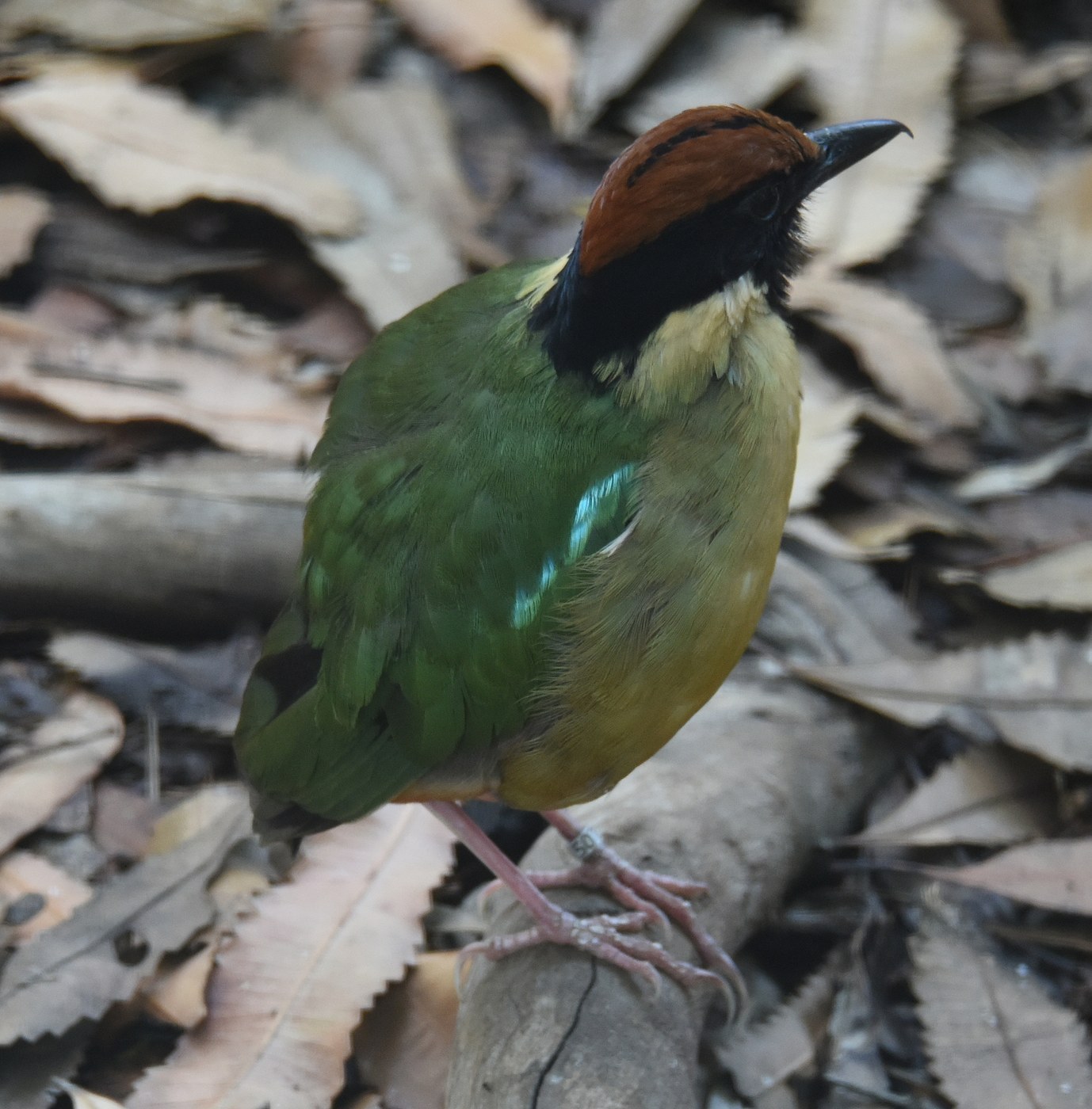
Overview
The Noisy Pitta (Pitta versicolor) is one of Australia's most colorful birds, but its brilliant plumage is often surprisingly hard to spot against the dappled light of the rainforest floor, making its loud, distinctive call the most reliable way to detect it.
Key Field Marks
- Size & shape: Plump, short-tailed, round-bodied bird about 17–20 cm, with a fairly large head, strong legs, and an almost tailless appearance typical of pittas.
- Head pattern: Black crown and broad black eye-stripe/mask contrasting with a rich chestnut-brown nape and a pale buffy throat.
- Body: Bright green back and wings, a black belly patch, and a vivid scarlet-red patch on the lower belly and undertail — this combination of green upperparts, black belly, and red vent is diagnostic.
- Wings: Shows a small pale blue shoulder patch and blue-black flight feathers in flight.
- Legs: Long, sturdy pinkish legs adapted for hopping on the forest floor.
- Behavior: Forages by hopping on the ground, flicking leaf litter aside; extremely shy and quick to freeze or dash for cover, making visual observation difficult despite its bright colors.
Similar Species
No other Australian bird shares the pitta's combination of shape and color pattern; within its range it is essentially unmistakable if seen well. Confusion is more likely by voice, but its loud, distinctive call has no close match among rainforest birds in its range.
Habitat & Range
Found along the eastern coast of Australia from Cape York Peninsula in far north Queensland south through coastal New South Wales, inhabiting rainforest, dense wet eucalypt forest, and vine scrub, generally in the shaded, leaf-littered understorey. Also occurs in New Guinea.
Season
Mostly resident in the north of its range; southern (New South Wales) populations are largely migratory or partially migratory, arriving to breed in spring and departing north for the winter, making it more predictably present in southern rainforest during the warmer months.
Behavior
Forages alone on the forest floor for snails, insects, and other invertebrates, using favored rocks or "anvils" to smash open snail shells, leaving telltale piles of broken shells as a sign of its presence even when the bird itself is unseen. Notoriously secretive and difficult to see despite bright plumage, often detected only by voice or by these shell middens.
Voice
A very loud, far-carrying two- or three-note whistled call, often rendered as "walk-to-work" or "want-a-watch," delivered from a low perch or the ground, especially at dawn and dusk; this call is usually the first and often only clue to the bird's presence.
Frequently asked questions
Why is the Noisy Pitta so hard to see despite bright colors?
Its green back blends into rainforest foliage and shadow while it forages quietly and quickly in dense leaf litter, and it is quick to freeze or flee, so most encounters are auditory rather than visual.
What does the Noisy Pitta's call sound like?
A loud, distinctive whistled phrase often described as sounding like "walk-to-work," carrying well through dense rainforest.
How can I find evidence of a Noisy Pitta without seeing one?
Look for its feeding "anvils" — favored rocks or exposed roots scattered with broken snail shells the bird has smashed open to extract the snail.
Are Noisy Pittas migratory?
Northern Queensland populations tend to be resident, while southern New South Wales populations are largely migratory, arriving to breed in spring and moving north for winter.