
Noisy Miner Identification Guide
A grey, colonial Australian honeyeater with a bare yellow eye-patch and bill, notorious for its constant chattering and aggressive group mobbing of other birds from its territory.
Read the full Noisy Miner encyclopedia entry →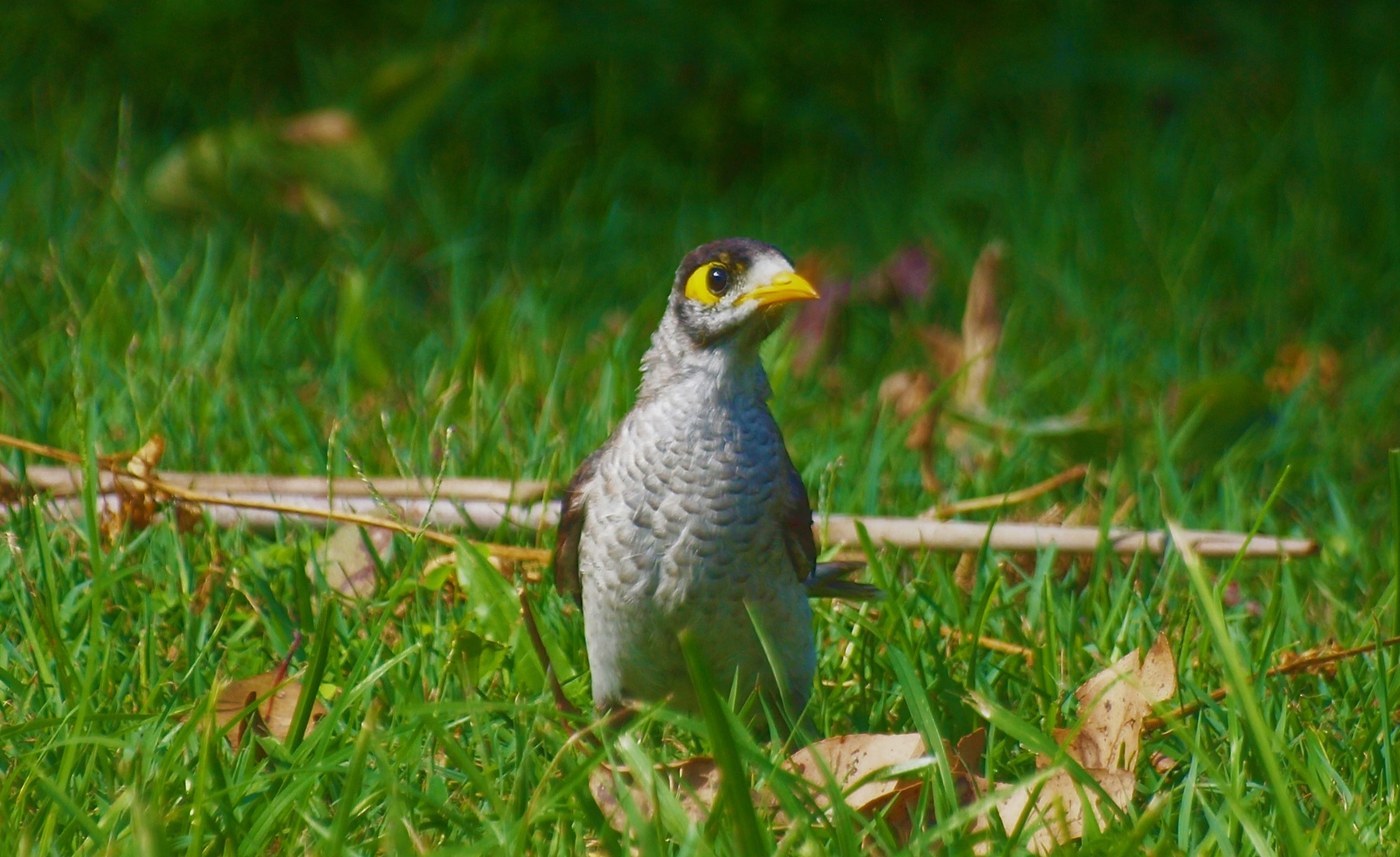
Overview
The Noisy Miner (Manorina melanocephala) is a common, highly social, and often dominant honeyeater across eastern and southeastern Australia, well known both for its loud, incessant calling and for aggressively excluding other bird species from its colonial territories.
Key Field Marks
- Size & shape: Medium-sized honeyeater, about 24–28 cm, with a fairly stocky build, a longish tail, and an upright, alert posture, often perching prominently in the open.
- Plumage: Predominantly grey overall, with a darker grey to blackish crown and forehead, pale grey underparts finely scalloped with darker markings, and olive-yellow wash on the wing edges.
- Bare parts: Distinctive bright yellow bill and a bare yellow patch of skin behind and around the eye, contrasting with the grey head — a key diagnostic feature.
- Tail: Grey tail tipped with white, visible in flight.
- Behavior: Almost always seen in noisy, active groups rather than alone, perching conspicuously and calling frequently.
Similar Species
- Yellow-throated Miner: Paler grey overall with a whitish rump (versus the Noisy Miner's grey rump) and a yellow-tinged throat; ranges mostly replace each other with limited overlap in parts of inland eastern Australia.
- Bell Miner: Smaller, more uniformly olive-green rather than grey, with a shorter bill and a different, bell-like "tink" call; found in denser eucalypt forest colonies ("bell miner associated dieback" areas).
Habitat & Range
Widespread and common across eastern and southeastern Australia from Queensland through New South Wales, Victoria, and into southeastern South Australia and Tasmania. Favors open eucalypt woodland, forest edges, parks, golf courses, and gardens, and has become especially abundant in fragmented and disturbed landscapes with abundant edge habitat, sometimes to the detriment of small woodland birds it aggressively excludes.
Season
Resident year-round; a highly sedentary, colonial species that maintains permanent group territories.
Behavior
Lives in complex, cooperative colonies with coordinated group defense, communal feeding, and cooperative breeding where multiple birds help feed young at a single nest. Extremely aggressive toward other bird species, especially smaller woodland birds, actively mobbing and chasing intruders from colony territory — a behavior of significant conservation concern where Noisy Miner colonies dominate fragmented woodland remnants. Feeds on nectar, fruit, and insects, foraging both in the canopy and on the ground.
Voice
Extremely vocal, with a wide repertoire including a sharp, repeated "pwit-pwit" or "chick-chick" alarm call given in unison during mobbing, plus various chattering, piping, and scolding notes almost constantly through the day, making colonies easy to detect by ear well before birds are seen.
Frequently asked questions
How can I tell a Noisy Miner from a Yellow-throated Miner?
The Noisy Miner has a grey rump and darker grey crown, while the Yellow-throated Miner has a paler, whitish rump and a yellow-washed throat; their ranges mostly complement rather than overlap.
Why are Noisy Miners considered a conservation concern?
They form aggressive colonies that mob and exclude smaller native woodland birds from otherwise suitable habitat, contributing to declines of small bush birds in fragmented eucalypt woodland across eastern Australia.
What is the easiest way to identify a Noisy Miner?
Look for the bright yellow bill and bare yellow eye-patch set against grey plumage, combined with loud, near-constant chattering calls from a social group.
Are Noisy Miners the same as Bell Miners?
No, they are related but distinct species; Bell Miners are smaller, more olive-green, and give a distinctive tinkling bell-like call, while Noisy Miners are larger, greyer, and much louder and more varied in their calls.