
New Zealand Robin Identification Guide
A confiding, upright forest bird of New Zealand with dark plumage and a pale belly, known for boldly perching close to the ground and cocking its head to watch for disturbed insects.
Read the full New Zealand Robin encyclopedia entry →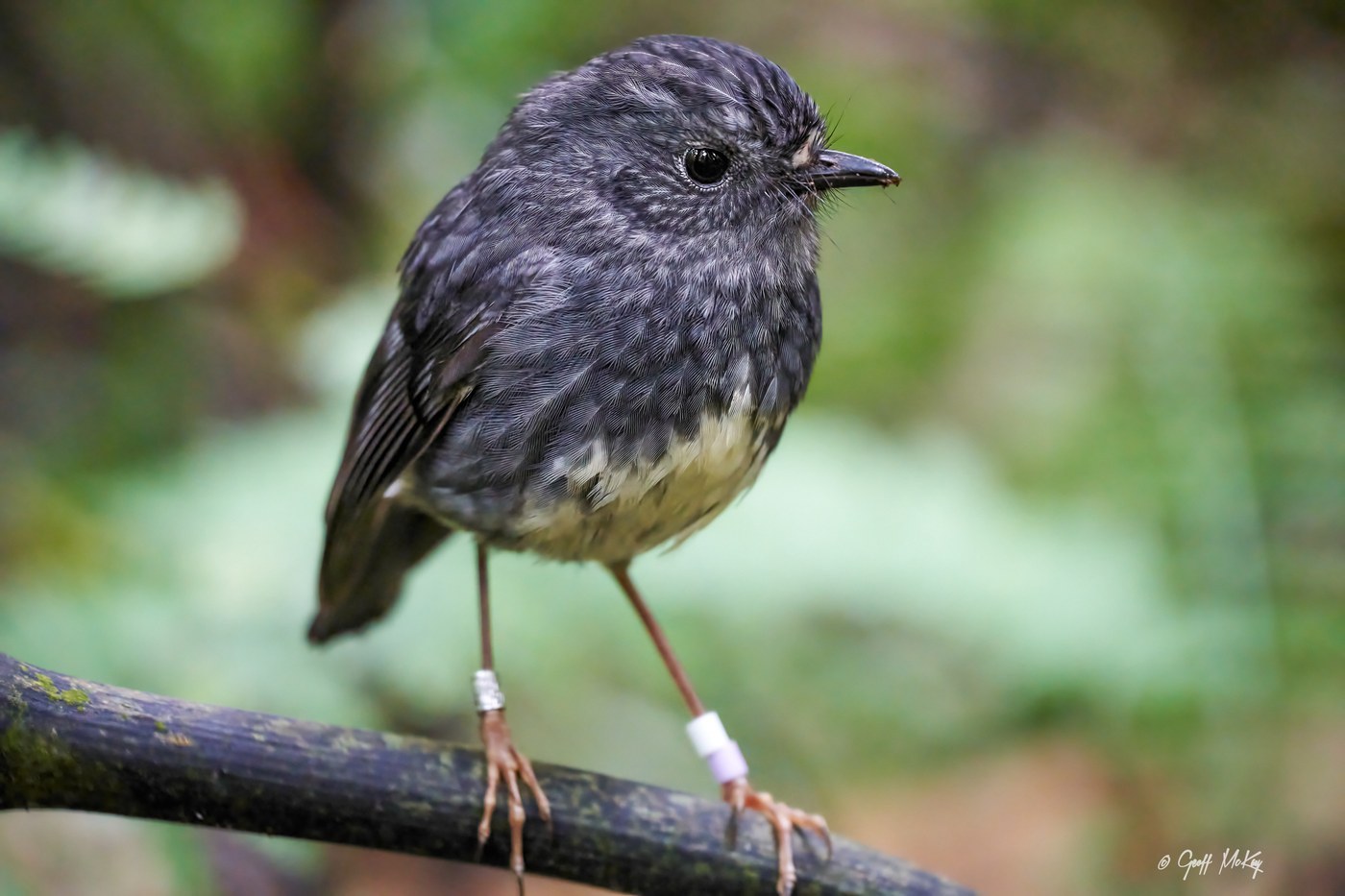
Overview
The New Zealand Robin (Petroica longipes in the North Island, Petroica australis in the South Island, both commonly called toutouwai) is a small, tame native forest passerine unrelated to the European Robin but sharing a similarly confiding, curious nature.
Key Field Marks
- Size & shape: Small, upright-postured songbird about 18 cm long, with relatively long legs, an alert, vertical stance, and a habit of perching low, often near or on the ground.
- Plumage: North Island birds are dark slaty-grey to blackish above with a variably pale, off-white to pale grey breast and belly, sometimes with a faint pale spot above the bill. South Island birds tend to be darker and more uniformly sooty, with more restricted pale underparts, and males and females differ subtly, with males generally darker than females.
- Bill and legs: Fine black bill; longish blackish legs suited to hopping and foraging on the forest floor and low perches.
- Behavior: Perches upright on low branches or on the ground, flicking wings, and often approaches walkers closely, sometimes landing within a meter of a stationary person.
Similar Species
- New Zealand Tomtit: Smaller, with a more contrasting black head/upperparts and bright white or yellow-washed underparts and a distinct white spot above the bill and white wing markings; robins are larger, plainer, longer-legged, and generally darker overall with less crisp contrast.
- New Zealand Fantail: Much smaller with a conspicuously fanned black-and-white tail and buff underparts, very different shape and behavior from the robin's upright, tail-still posture.
Habitat & Range
Endemic to New Zealand, found in native forest on the North Island (North Island Robin) and South Island and Stewart Island (South Island Robin), with strongholds in predator-controlled reserves and offshore/mainland sanctuaries such as Zealandia, Tiritiri Matangi, Kapiti Island, and various South Island beech forest reserves, since it is highly vulnerable to introduced mammalian predators.
Season
Resident and non-migratory year-round; pairs typically defend permanent territories in suitable forest.
Behavior
Forages mainly on the forest floor and low vegetation for invertebrates, often following larger animals or walkers to catch insects disturbed underfoot, similar in habit to the fantail but generally staying lower and perching more statically. Known for caching food items and for males feeding females during courtship. Extremely tame in predator-free areas, sometimes hopping to within arm's reach of quiet visitors.
Voice
A clear, melodious, warbling song, more musical and sustained than the fantail's simple chips; also gives sharp "chip" contact and alarm calls.
Frequently asked questions
Is the New Zealand Robin related to the European Robin?
No, despite the shared common name and similarly tame behavior, the New Zealand Robin belongs to the Australasian robin family (Petroicidae) and is not closely related to the European Robin.
How do I tell a New Zealand Robin from a Tomtit?
The robin is larger, longer-legged, and more uniformly dark with a less sharply defined pale belly, while the Tomtit is smaller with crisper black-and-white or black-and-yellow contrast and a distinct white forehead spot.
Where are New Zealand Robins easiest to find?
Predator-free sanctuaries and well-managed native forest reserves, such as Zealandia, Kapiti Island, or Tiritiri Matangi, offer the best and most reliable close-up encounters.
Why are New Zealand Robins so tame?
Having evolved with few native mammalian predators, they show relatively little innate fear of large animals or people, especially in areas with active predator control, and often approach walkers looking for disturbed insects.