
New Zealand Pigeon Identification Guide
A large, iridescent native pigeon with a bright white belly and heavy, noisy wingbeats, easily spotted gorging on fruit in the forest canopy across New Zealand.
Read the full New Zealand Pigeon encyclopedia entry →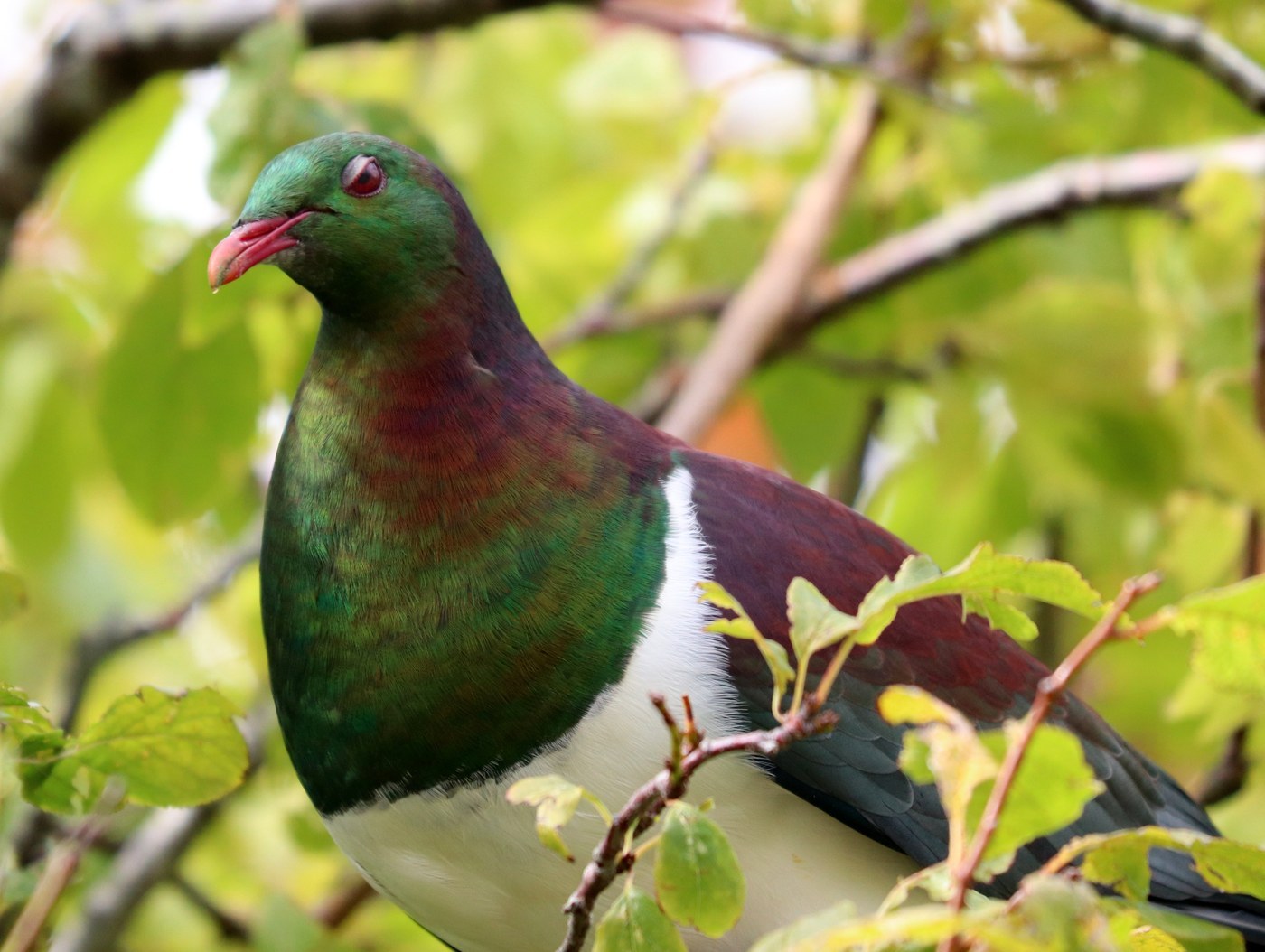
Overview
The New Zealand Pigeon, or kererū (Hemiphaga novaeseelandiae), is a large, striking native pigeon and an important seed disperser for many native New Zealand trees, being one of the only birds large enough to swallow big native fruits whole.
Key Field Marks
- Size & shape: Large, bulky pigeon, about 51 cm long, noticeably bigger and heavier-bodied than an introduced feral pigeon.
- Plumage: Glossy, iridescent green and bronze-purple head, neck, and upper breast contrasting sharply with a clean, pure white belly and undertail — the white belly against the dark iridescent chest is diagnostic and visible even in flight or silhouette.
- Bill and legs: Short, stout reddish bill with a pale tip, and red legs and feet.
- Flight: Loud, whooshing wingbeats produced by its broad wings are often heard before the bird is seen; flight is strong and direct, sometimes including diving, swooping display flights during breeding season.
- Posture: Often perches heavily and visibly at the top of fruiting trees, sometimes appearing precarious as it stretches to reach fruit or leaves.
Similar Species
Within New Zealand it is essentially unmistakable — no other native bird combines its large size, white belly, and glossy dark chest. Introduced feral pigeons (rock doves) are smaller, lack the sharp white-belly/dark-chest contrast, and show much more plumage variation (grays, checkering, white patches in irregular patterns).
Habitat & Range
Endemic to New Zealand, occurring throughout native forest on the North and South Islands, Stewart Island, and the Chatham Islands (where a distinct subspecies, the Chatham Island Pigeon or parea, occurs). Found in native broadleaf and podocarp forest, forest edges, and increasingly in well-vegetated suburban areas and parks with fruiting trees such as kōwhai, tree lucerne (tagasaste), and puriri.
Season
Resident and largely non-migratory, though birds may move locally to track fruiting and flowering events, sometimes concentrating heavily at abundant food sources such as flowering kōwhai in spring or fruiting trees in autumn.
Behavior
Feeds mainly on fruit, leaves, buds, and flowers, and is uniquely important ecologically as one of the few remaining native birds large enough to disperse the big seeds of trees like tawa and karaka whole. Can appear almost drunk after gorging on fermenting fruit. Performs dramatic display flights in breeding season involving steep dives and swooping climbs, accompanied by loud wing-noise.
Voice
Generally quiet; gives a soft, low "coo" call, but is far more often detected by the loud, distinctive whooshing sound of its wingbeats in flight than by vocalizations.
Frequently asked questions
How do I tell a New Zealand Pigeon from a feral pigeon?
The kererū is larger and heavier, with a sharply contrasting glossy green-bronze chest and pure white belly, whereas feral pigeons are smaller and show variable gray, checkered, or patchy plumage without that clean two-tone pattern.
Why do kererū sometimes look clumsy in trees?
Their large size makes fine branches hard to balance on, and after gorging on fermenting fruit they can appear unsteady, occasionally even falling from branches.
What sound identifies a kererū before you see it?
Its heavy, whooshing wingbeats are very distinctive and often heard well before the bird itself comes into view.
Why is the kererū ecologically important?
It is one of the few native birds with a bill and throat large enough to swallow the big fruits and seeds of trees like tawa, karaka, and puriri whole, making it a critical seed disperser for New Zealand forests.