
New Holland Honeyeater Identification Guide
A common, active black-and-white honeyeater of southern Australian gardens and heathland, best known for its white eye, bold yellow wing panel, and constant flitting between flowering shrubs.
Read the full New Holland Honeyeater encyclopedia entry →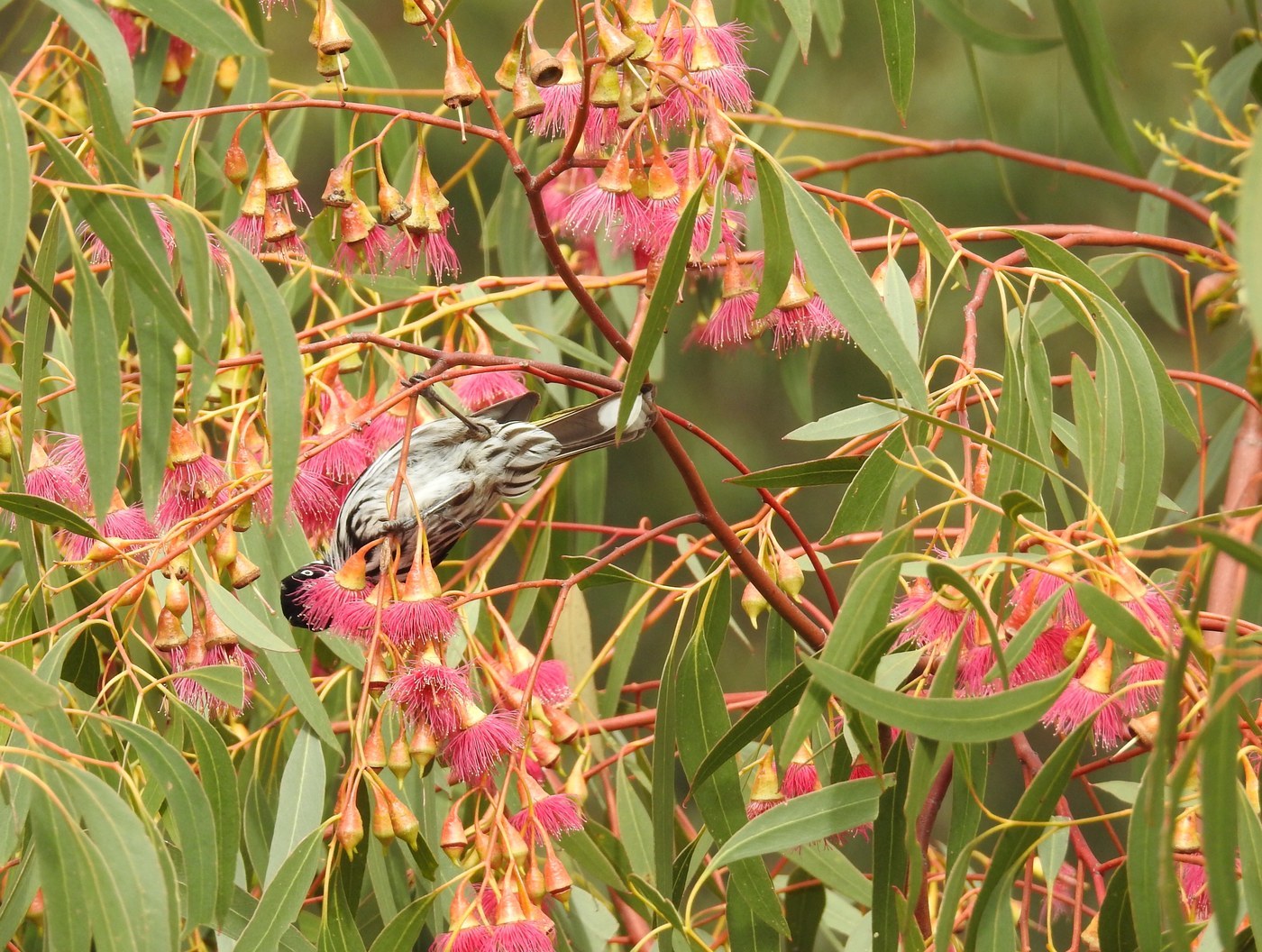
Overview
The New Holland Honeyeater (Phylidonyris novaehollandiae) is one of the most familiar and widespread honeyeaters across southern Australia, thriving in gardens, parks, heathland, and banksia woodland wherever nectar-rich flowers are available.
Key Field Marks
- Size & shape: Small, slender honeyeater about 16–18 cm long, with a slightly downcurved, fine bill suited to probing flowers.
- Plumage pattern: Bold black-and-white streaked plumage overall — black head and upperparts with white streaking on the breast and back, giving a busy, contrasty look.
- Eye: Striking pale white to cream iris that stands out clearly against the black face, a signature feature.
- Wings & tail: Bright yellow panel along the folded wing (edges of the flight feathers) and yellow edges on the tail, flashing conspicuously in flight.
- Bill: Fine, slightly downcurved black bill for nectar feeding.
- Behavior in flight: Fast, direct, often low over shrubs, frequently chasing other honeyeaters.
Similar Species
- White-cheeked Honeyeater: Very similar black-and-white streaked pattern but has a bold white cheek patch and dark (not white) eye; ranges overlap in parts of southern Australia and Western Australia, so check the eye color and cheek patch carefully.
- Tawny-crowned Honeyeater: Also found in heathland but has a warm tawny crown and lacks the strong yellow wing panel.
Habitat & Range
Widespread across southern Australia from southeastern Queensland through New South Wales, Victoria, Tasmania, South Australia, and into southwestern Western Australia. Favors heathland, coastal scrub, banksia and eucalypt woodland, and readily adapts to well-planted suburban gardens, parks, and botanic gardens with native flowering shrubs like grevillea, banksia, and bottlebrush.
Season
Resident year-round across most of its range, though some populations show local nomadic movements tracking flowering events, moving to wherever nectar is currently most abundant.
Behavior
Highly active and aggressive at flowering shrubs, frequently chasing off other honeyeaters, wattlebirds, and even small birds of other species from good nectar sources. Feeds on nectar, insects, and some fruit, often hovering briefly at flowers. Highly vocal and conspicuous, especially in spring when defending breeding territories.
Voice
A loud, harsh, chattering "chek-chek-chek" or scolding series of notes, often given while chasing rivals; also gives a sharper metallic contact call in flight.
Frequently asked questions
What is the easiest way to identify a New Holland Honeyeater?
Look for the combination of a pale white eye, black-and-white streaked body, and a bright yellow panel on the folded wing — no similar honeyeater combines all three so clearly.
How do I separate it from the White-cheeked Honeyeater?
Check the eye and cheek: New Holland has a white/cream eye and no obvious white cheek patch, while White-cheeked Honeyeater has a dark eye and a bold white cheek patch.
Will New Holland Honeyeaters visit garden feeders?
They are drawn more to nectar-rich native flowering plants like grevillea, banksia, and bottlebrush than to artificial feeders, and are common visitors to well-planted gardens.
Are New Holland Honeyeaters migratory?
They are mostly sedentary but can be locally nomadic, moving to track seasonal flowering of favored nectar plants.