
Neotropic Cormorant Identification Guide
A slim, small-bodied cormorant of the Americas told from the larger Double-crested Cormorant by its thinner bill, longer tail, and a pointed white border to the yellow-orange facial skin.
Read the full Neotropic Cormorant encyclopedia entry →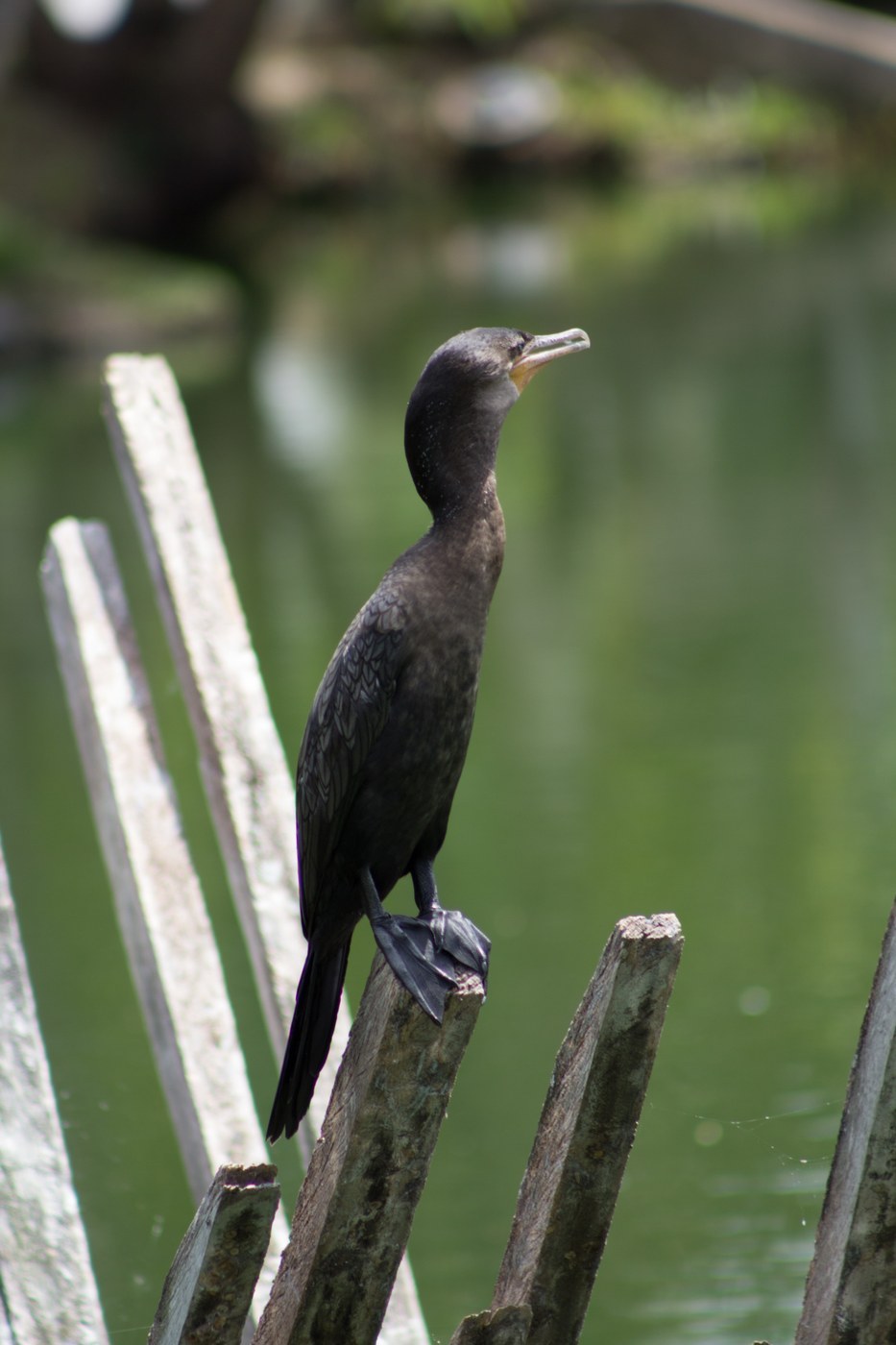
Overview
The Neotropic Cormorant (Nannopterum brasilianum) is the smallest and most widespread cormorant in the Americas, ranging from the southern United States through Central and South America. It is often found alongside the larger Double-crested Cormorant in the U.S., making careful comparison useful.
Key Field Marks
- Size & shape: Smaller and slimmer than Double-crested Cormorant, with a noticeably longer, thinner tail that often looks disproportionately long in flight and at rest.
- Bill: Thin, more delicate bill compared to the thicker bill of Double-crested Cormorant.
- Facial skin: Yellow to dull orange skin around the base of the bill and chin, bordered by a thin whitish line that comes to a point behind the gular pouch — this pale border is a key distinguishing feature from Double-crested Cormorant, which lacks the sharp pointed white edge.
- Plumage: Overall glossy black; breeding adults can show fine white plumes on the head and neck and a white stripe along the flanks.
- Juveniles: Browner overall, with a paler brown breast fading to darker belly, similar in pattern to young Double-crested but smaller and thinner-billed.
- In flight: Long tail and slim profile give a more streamlined, almost anhinga-like silhouette compared to the bulkier Double-crested.
Similar Species
- Double-crested Cormorant: Larger, thicker bill, shorter tail relative to body, and orange facial skin that forms a rounded (not pointed) border; the crests (when present) differ and Double-crested has a more hook-tipped, heavier bill.
- Anhinga: Much longer, thinner neck and dagger-like (not hooked) bill; swims with only head and neck above water rather than more of the body, and has a spread fan-shaped tail.
Habitat & Range
Found along the Gulf Coast, Texas, and increasingly across the southern and south-central United States, expanding its range northward in recent decades; core range spans Mexico, Central America, and South America to Chile and Argentina. Uses freshwater lakes, rivers, ponds, coastal lagoons, and estuaries, often perching on snags, wires, or pilings with wings spread to dry, exactly as other cormorants do.
Season
Resident year-round through most of its range, including in the southern U.S., though some northern populations show local seasonal movements or post-breeding dispersal.
Behavior
Dives from the surface to pursue fish underwater, propelled by its feet, then returns to a perch to hold wings open in a spread-wing drying posture. Often gathers in loose flocks with other cormorants and waterbirds, nesting colonially in trees, mangroves, or on cliffs and small islands.
Voice
Generally silent away from the breeding colony; near nests, gives low grunts, croaks, and pig-like grunting sounds typical of cormorants.
Frequently asked questions
How do I tell a Neotropic Cormorant from a Double-crested Cormorant?
Look for a smaller body, thinner bill, proportionally longer tail, and a pointed whitish border around the yellow-orange facial skin, versus the larger, thicker-billed Double-crested with a rounded orange facial patch.
Where in the U.S. can I find Neotropic Cormorants?
They are common along the Texas and Gulf Coast and have been steadily expanding north and east across the southern and south-central states in recent decades.
Do Neotropic Cormorants migrate?
Most populations, especially in the tropics, are year-round residents, though edge populations show some seasonal dispersal.
Why do cormorants spread their wings while perched?
Unlike most waterbirds, cormorant feathers are not fully waterproof, so they spread their wings after diving to dry them in the sun and wind.