
Nene Identification Guide
Hawaii's state bird is a medium-sized, mostly terrestrial goose with a black face, buff-furrowed neck, and distinctively reduced webbing on its feet for walking on lava rock.
Read the full Nene encyclopedia entry →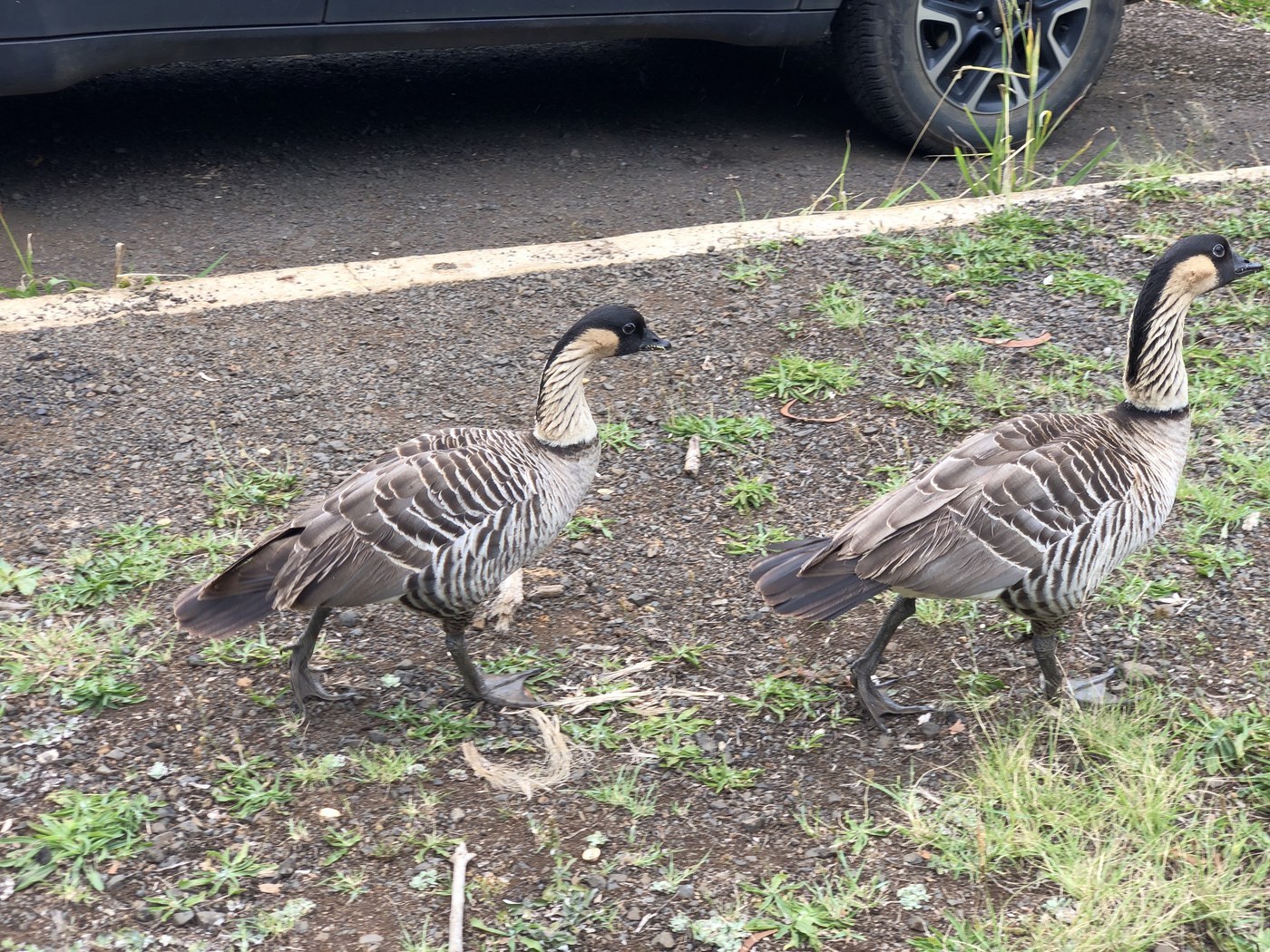
Overview
The Nene (Branta sandvicensis), also called the Hawaiian Goose, is the world's rarest goose and Hawaii's official state bird. It descended from Canada Goose ancestors that colonized the islands and evolved a more upright, terrestrial lifestyle suited to walking over lava fields rather than swimming.
Key Field Marks
- Size & shape: Medium goose, 22–26 inches long, with a slimmer body, longer neck, and more upright stance than a Canada Goose.
- Head & face: Black crown, face, and hindneck.
- Neck pattern: Buff-and-black diagonal furrows (deep grooves of cream-buff feathering separated by black) running down the sides and back of the neck — the single best field mark.
- Body: Grayish-brown back and flanks with pale feather edges giving a scaled look; underparts paler gray-brown.
- Bill and legs: Black bill; black legs and feet with notably reduced webbing between the toes, an adaptation for walking on rough lava terrain rather than swimming.
- Flight: Flies less readily than most geese; when it does fly, wingbeats look labored and the reduced webbing is not visible in flight, so rely on plumage pattern.
Similar Species
- Canada Goose: Larger, has a solid white chin-strap rather than buff neck furrows, fully webbed feet, and is far more aquatic. Canada Geese are not native to Hawaii, so any goose seen on the main Hawaiian Islands away from captivity is almost certainly a Nene.
- Domestic/hybrid geese: Occasionally seen near resorts; lack the precise black-and-buff neck furrowing and structural proportions of a true Nene.
Habitat & Range
Endemic to the Hawaiian Islands, with the largest wild populations on Hawai'i Island (especially Hawaii Volcanoes National Park and upcountry ranchland), Maui (Haleakalā National Park), and Kaua'i, plus reintroduced birds on Moloka'i and O'ahu. Found in a wide elevational range, from coastal grasslands and golf courses at sea level up to sparsely vegetated volcanic slopes and shrubland above 8,000 feet. Prefers open grassy areas, lava flows with scattered vegetation, and pastureland; it grazes on grasses, leaves, berries, and seeds rather than foraging in water.
Season
Resident year-round; not migratory. Breeding season runs roughly from October through March, timed opposite most Northern Hemisphere geese, coinciding with Hawaii's cooler, wetter winter months when forage is most abundant.
Behavior
Highly terrestrial — walks and grazes far more than it swims, and can often be seen strolling across roads, lawns, and golf courses, sometimes in family groups. Pairs mate for life and are frequently seen walking together with goslings. Less wary of humans than most wild geese due to decades of conservation management, though visitors are asked to keep distance and never feed them.
Voice
Gives a soft, moaning "nay-nay" or "ne-ne" call (the source of its name), quieter and more nasal than the loud honking of Canada Geese. Also makes low grunts and hisses when alarmed.
Frequently asked questions
What makes the Nene different from other geese?
It has reduced webbing on its feet, a more upright terrestrial posture, and distinctive buff-and-black furrowed neck markings, all adaptations for walking on lava terrain instead of swimming.
Where is the best place to see a Nene?
Hawaii Volcanoes National Park on Hawai'i Island and Haleakalā National Park on Maui host the largest, most reliable populations, especially in grassy pullouts and picnic areas.
Could a Canada Goose be mistaken for a Nene?
Canada Geese are not established in the wild in Hawaii, so a goose there is almost certainly a Nene; the Nene also lacks the white chin-strap and has buff neck furrows instead.
Is the Nene endangered?
Yes, it remains an endangered species; it was reduced to fewer than 30 birds by the 1950s and has recovered through intensive captive breeding and reintroduction, though it still depends on ongoing conservation management.
Do Nene migrate?
No, they are non-migratory residents of the Hawaiian Islands, though individuals do move seasonally between lowland and upland habitats to follow food and breeding conditions.