
Nazca Booby Identification Guide
A large white seabird of the eastern tropical Pacific and Galápagos, told from the similar Masked Booby by its orange-pink bill.
Read the full Nazca Booby encyclopedia entry →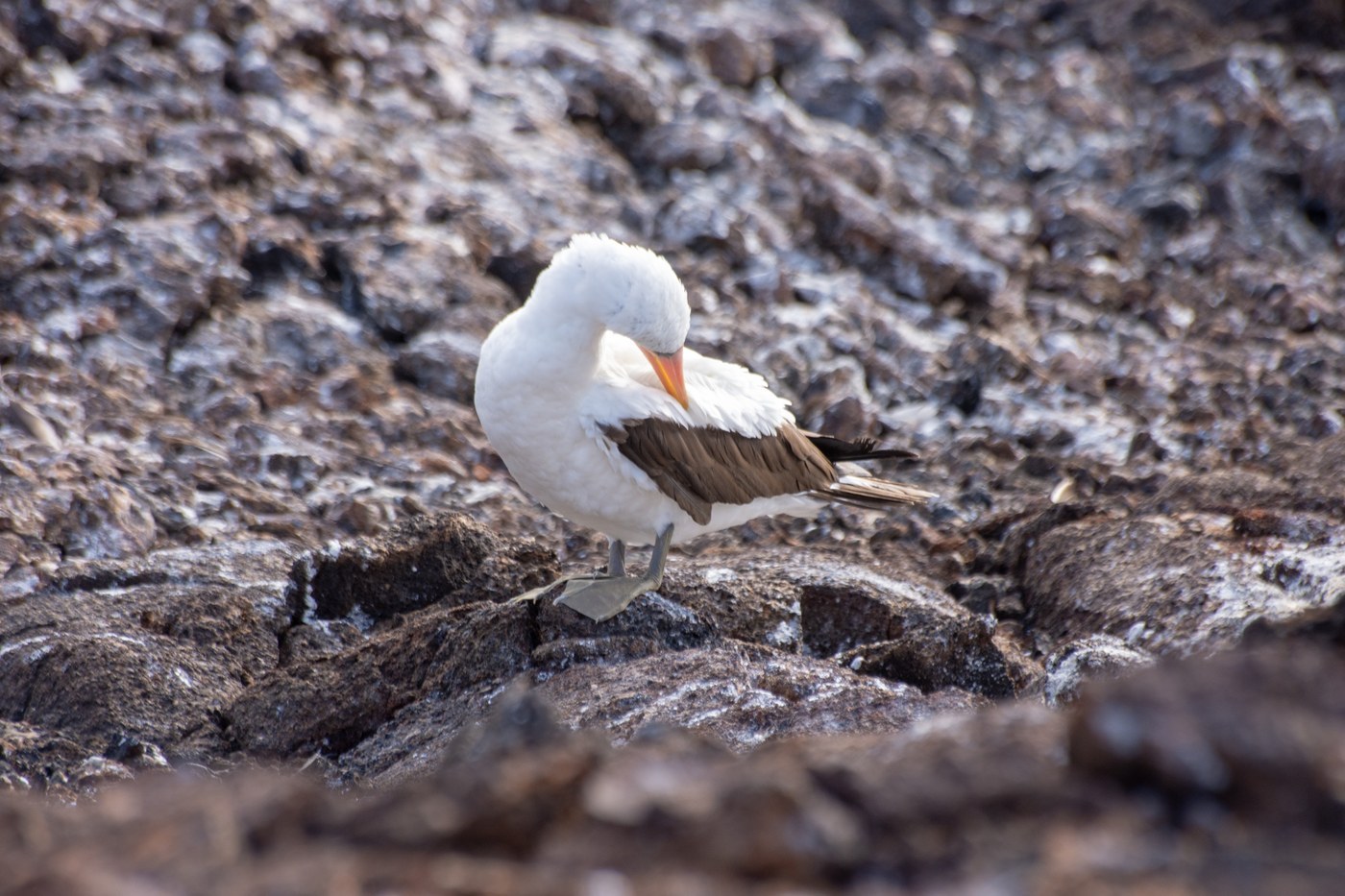
Key Field Marks
- Size & shape: A large, robust booby with long, pointed wings, a stout tapered bill, and a wedge-shaped tail, typical of the genus.
- Plumage: Predominantly white body with sharply contrasting black flight feathers (primaries and secondaries) and a black tail, visible both at rest and especially in flight.
- Bill color: Orange to pink-orange, the key mark separating it from the very similar Masked Booby, which has a yellow bill.
- Face: Bare blue-gray facial skin forming a mask around the eyes and bill base.
- Legs: Pale bluish-gray.
- Juveniles: Show a brownish head and mottled brown-and-white body, gradually acquiring adult plumage over a couple of years.
Separating It From Similar Species
- Masked Booby: Nearly identical in pattern but has a yellow (not orange-pink) bill; the two were formerly considered one species before being split based on bill color, vocal, and genetic differences, and their ranges are mostly separate (Masked Booby in the Atlantic and central/western Pacific, Nazca in the eastern tropical Pacific).
- Blue-footed Booby: Shares Galápagos range but shows brown (not black-and-white contrasting) upperparts, a streaked head, and bright blue legs and feet.
- Red-footed Booby: Smaller and more variable in plumage (including white and brown morphs), with red legs and a shorter, more pointed bill base color pattern.
Where and When to See It
Nazca Boobies breed colonially on rocky, largely bare islands in the eastern tropical Pacific, most famously in the Galápagos Islands, as well as other islands off the coasts of Mexico, Central America, and northern South America (including Malpelo and other Pacific islets). They nest on open ground in dense colonies and forage by plunge-diving from height into the ocean for fish and squid, often visible from tour boats around Galápagos cliffs and offshore waters.
Voice
Mostly silent at sea; at breeding colonies, males give thin whistling calls while females give a harsher, honking quack-like call, both used in courtship and territorial displays.
Frequently asked questions
How do you tell Nazca Booby from Masked Booby?
Bill color is the key difference: Nazca Booby has an orange to pink-orange bill, while Masked Booby has a yellow bill. The two species were once considered the same until being split.
Where is the best place to see Nazca Boobies?
The Galápagos Islands host large breeding colonies, along with other islands in the eastern tropical Pacific off Mexico, Central America, and northern South America.
What does a Nazca Booby eat?
It feeds mainly on fish and squid, captured by plunge-diving from considerable height into the ocean.
How can you tell an adult Nazca Booby from a juvenile?
Adults are white-bodied with black flight feathers and tail and an orange-pink bill, while juveniles are largely brown and mottled, gaining adult plumage over roughly two years.