
Narcissus Flycatcher Identification Guide
A small, brilliant yellow-and-black East Asian flycatcher of forests, males instantly recognizable by their vivid throat and eyebrow.
Read the full Narcissus Flycatcher encyclopedia entry →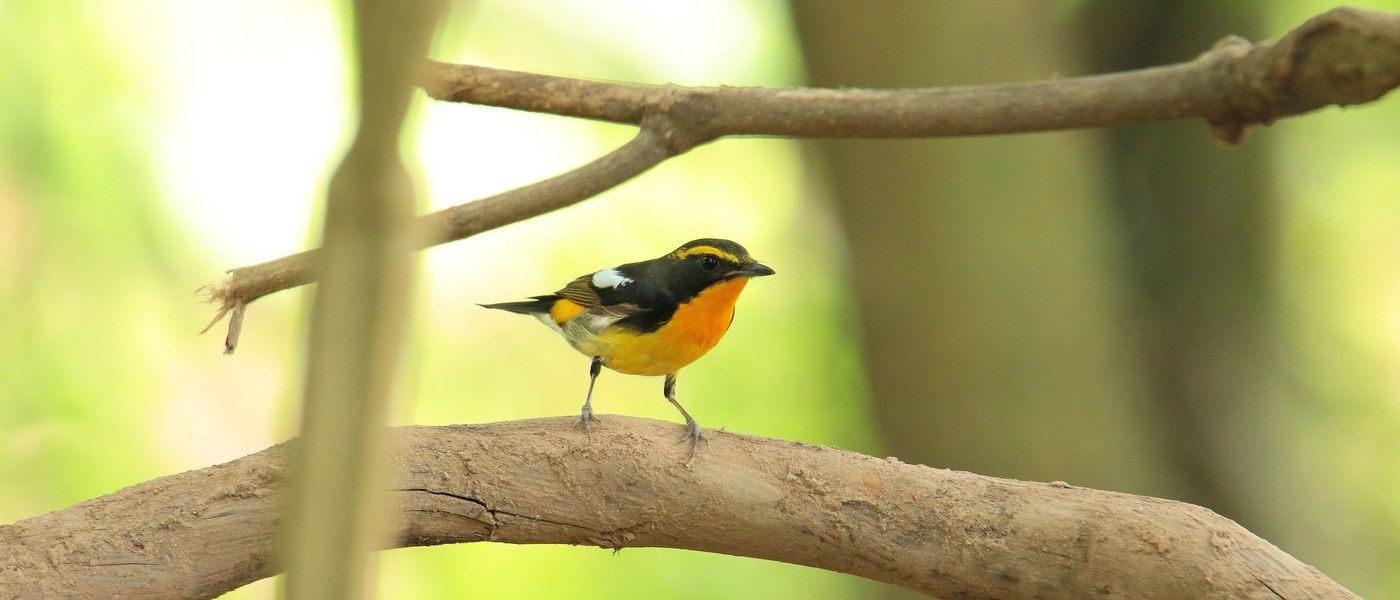
Key Field Marks
- Size & shape: A small, compact flycatcher with a short tail and an upright perching posture typical of the genus, often seen sallying from a perch to catch insects.
- Adult male: Bright golden-yellow underparts and supercilium (eyebrow stripe) contrasting sharply with glossy black upperparts, black face, and a bold white patch on the folded wing; yellow also extends onto the rump.
- Adult female: Much duller and cryptic, olive-brown above and buffy below, lacking the male's bold black-and-yellow pattern, making females much harder to identify with confidence.
- Bill: Small, thin, and dark, typical of an insect-catching flycatcher.
Separating It From Similar Species
- Yellow-rumped Flycatcher: Very similar and closely related; male Narcissus Flycatcher shows a more extensively yellow supercilium and generally a less contrasting white wing patch pattern, and ranges differ somewhat, so care and, where possible, voice or range context help separate the two.
- Mugimaki Flycatcher: Male shows orange rather than yellow underparts and a white supercilium stripe rather than yellow, along with a different wing pattern.
- Female-type birds: Best left unidentified to species unless seen well and in known range/season, given the overlap in dull female/immature flycatcher plumages.
Where and When to See It
Narcissus Flycatchers breed in forested habitats — including deciduous and mixed woodland — in Japan, the Korean Peninsula, and parts of far eastern Russia and northeastern China. They are long-distance migrants, wintering in Southeast Asia (parts of the Philippines, Indonesia, and the Malay Peninsula), and pass through eastern China and other stopover areas on migration. Look for them in forest understory and mid-canopy during spring and fall passage, and on breeding territories in wooded hills during the breeding season.
Voice
The song is a sweet, clear series of whistled phrases, delivered from a high perch on the breeding grounds; calls include short, sharp "tak" or "pit" notes given in alarm or contact.
Frequently asked questions
What makes a male Narcissus Flycatcher easy to identify?
Its combination of bright golden-yellow underparts and supercilium against glossy black upperparts with a white wing patch is distinctive among East Asian flycatchers.
Are female Narcissus Flycatchers easy to identify?
No, females are dull olive-brown and buffy, lacking bold markings, and are difficult to separate from other female flycatchers without care and context.
Where does the Narcissus Flycatcher breed?
In forested habitats in Japan, the Korean Peninsula, and parts of far eastern Russia and northeastern China.
Where does the Narcissus Flycatcher spend the winter?
It migrates to Southeast Asia, including parts of the Philippines, Indonesia, and the Malay Peninsula.