Mourning Dove Identification Guide
A slim, tan-brown dove with a long pointed tail and mournful cooing call, common at feeders and open country across North America.
Read the full Mourning Dove encyclopedia entry →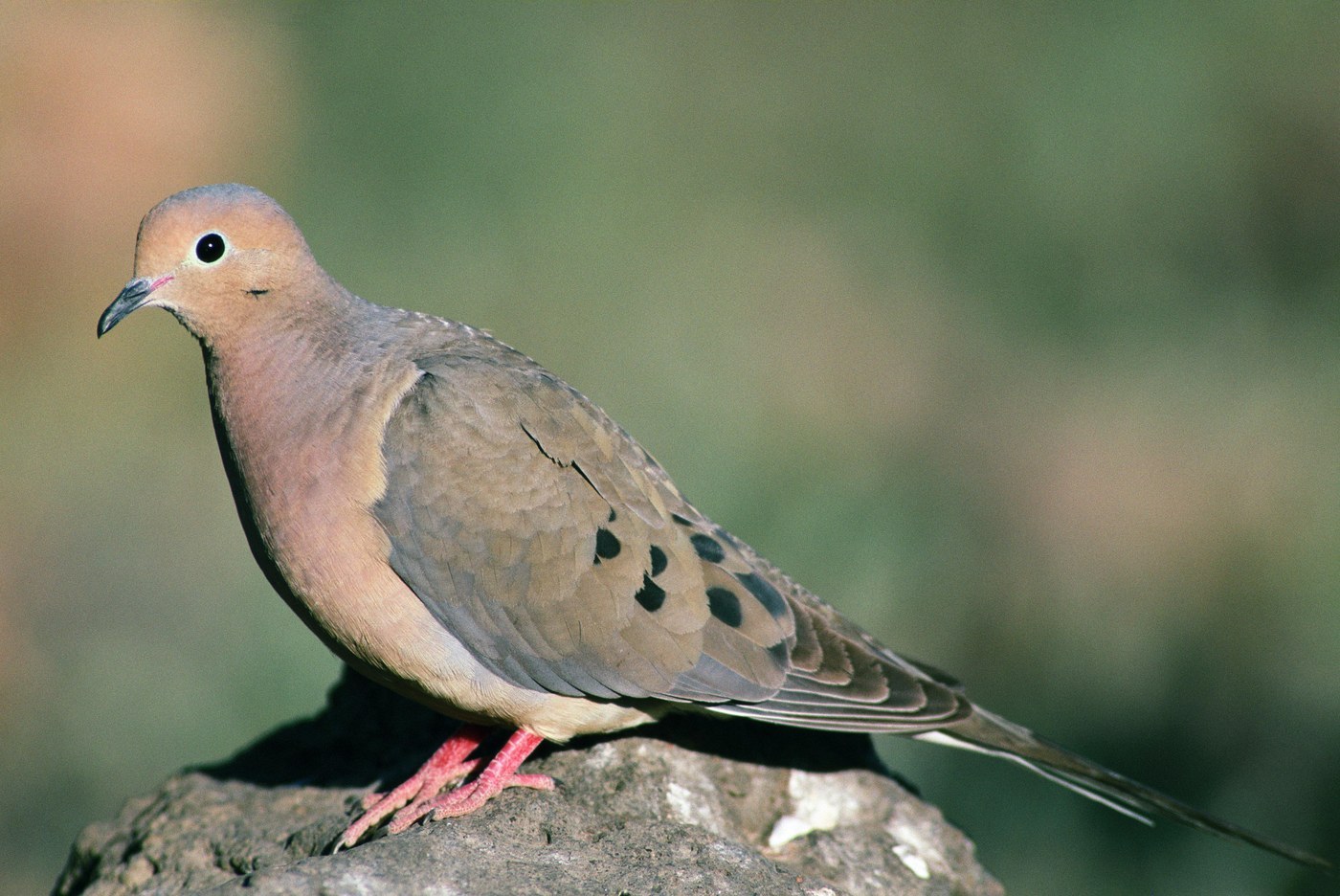
Key Field Marks
- Size & shape: A slender, medium-sized dove roughly the size of a small pigeon but much slimmer, with a small round head, a plump body, and a notably long, tapered, pointed tail edged in white.
- Plumage: Overall soft grayish-tan to buffy brown, paler and pinkish on the breast, with scattered black spots on the folded wing.
- Face: A small black bill, a black spot below the eye, and a patch of iridescent pink and green on the side of the neck visible in good light.
- Eye ring: Pale blue skin around the eye.
- Flight: Fast and direct on pointed wings; the wings produce a sharp whistling flutter on takeoff.
Separating It From Similar Species
- Eurasian Collared-Dove: Larger and paler gray-buff overall, with a black half-collar on the back of the neck and a square (not pointed) tail with a broad white tip.
- White-winged Dove: Shows a bold white stripe along the folded wing and a rounded, white-cornered tail; found mainly in the southern US and Southwest.
- Rock Pigeon: Much stockier and shorter-tailed, with highly variable plumage and a distinctive low, chuckling coo rather than the Mourning Dove's mournful call.
Where and When to See It
Mourning Doves are one of the most widespread and abundant birds in North America, found year-round across nearly the entire continental US and southern Canada in open woodlands, farmland, grasslands, suburban yards, and at bird feeders. Northern populations shift south in winter, but many areas host Mourning Doves throughout the year. They perch on wires and dead branches and feed on the ground on seeds and grain.
Voice
The familiar call is a soft, mournful "coo-OO-oo-oo-oo," often mistaken for an owl by newcomers. It is frequently heard at dawn and dusk from a perch, and the whistling wing sound on takeoff is a useful secondary clue even before the bird is seen.
Frequently asked questions
How can you tell a Mourning Dove from a pigeon?
Mourning Doves are noticeably slimmer with a long, pointed, white-edged tail, while Rock Pigeons are stockier with a short, squared tail and much more variable plumage.
What does a Mourning Dove sound like?
A soft, mournful five-note coo, 'coo-OO-oo-oo-oo,' often mistaken for an owl.
Why do Mourning Dove wings make noise when they fly?
Their wing feathers produce a sharp whistling flutter on takeoff, a useful way to detect them even before you see the bird.
Is the Mourning Dove the same as the Eurasian Collared-Dove?
No — Collared-Doves are larger and paler with a black neck collar and a square white-tipped tail, while Mourning Doves are smaller, spotted-winged, and have a pointed tail.
Mourning Dove identified by the community
Recent Mourning Dove sightings identified with Bird Identifier.