
Montezuma Quail Identification Guide
A secretive, dumpy quail of Southwestern oak-grassland with a bold black-and-white clown-faced male and a plain, well-camouflaged female, notorious for sitting tight until flushed at close range.
Read the full Montezuma Quail encyclopedia entry →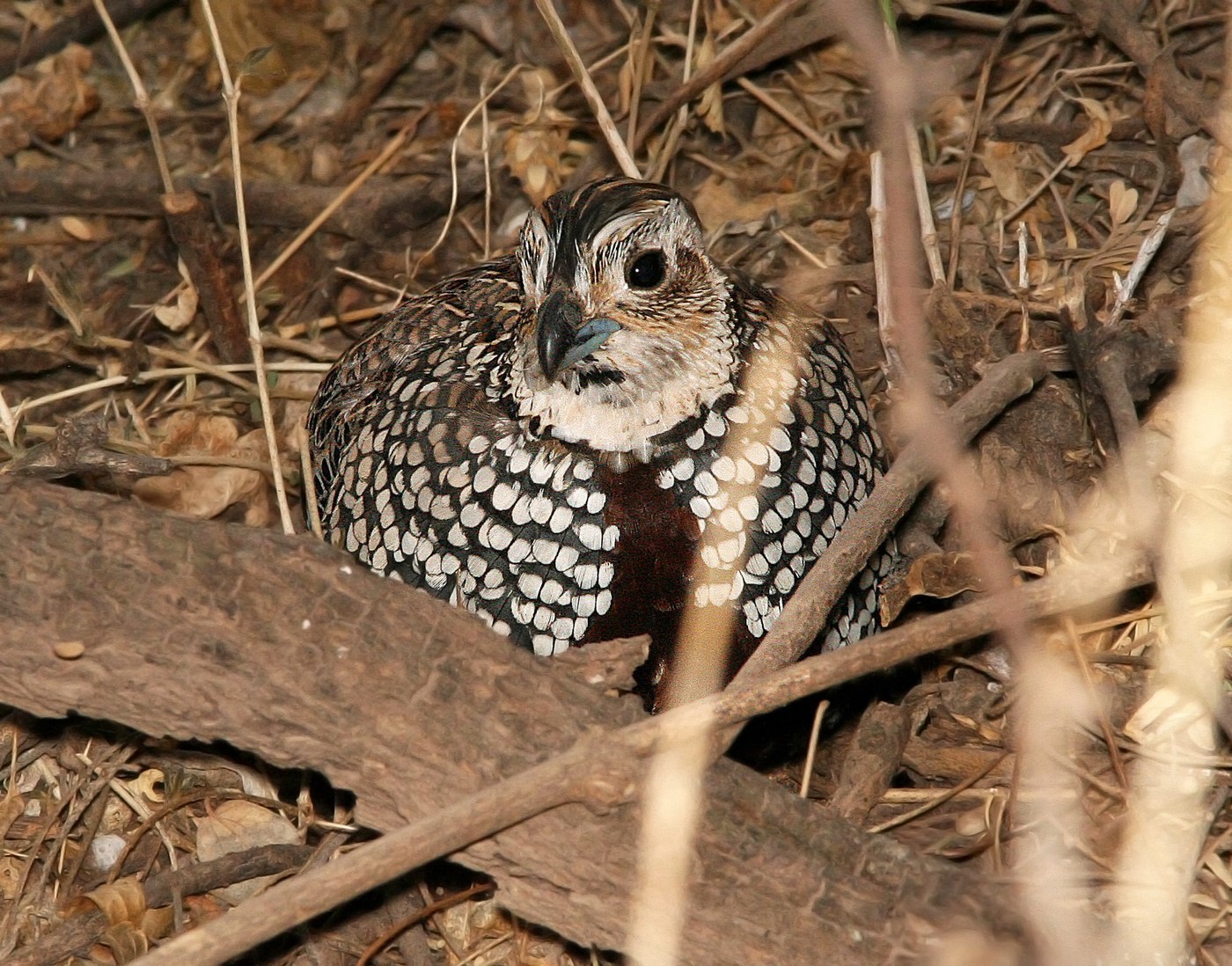
Key Field Marks
- Small, chunky, round-bodied quail with a distinctly bushy, crested nape giving it a large-headed silhouette.
- Male: striking bold black-and-white "harlequin" facial pattern with bold stripes, black throat, cinnamon-chestnut underparts heavily spotted with black and white on the flanks, and a blue-gray back streaked with black and buff.
- Female: much plainer mottled buffy-brown overall, cryptic and sparrow-like at a glance, but retains the same dumpy, crested body shape that helps separate it from other quail species.
Separating It From Similar Species
Scaled Quail and Gambel's/California Quail
- All lack the male Montezuma Quail's bold black-and-white face pattern and heavily spotted flanks; female Montezuma Quail is best told from these by its rounder, dumpier shape and bushy (not pointed) crest.
Behavior & Voice
- Extremely secretive; relies on camouflage and freezing in place rather than flushing, often allowing very close approach before exploding into flight with a whirring burst of wingbeats.
- Feeds by digging for bulbs and tubers, especially wood-sorrel (Oxalis), leaving small conical diggings in the soil — a useful sign of presence even when birds are not seen.
- Found in pairs during the breeding season and small coveys at other times.
- Voice is a descending, quavering, whinny-like call, often described as ventriloquial and easy to overlook.
Habitat, Range & Season
- Inhabits oak-pine woodland and grassland with a tall bunchgrass understory, particularly in the "Sky Island" mountain ranges of southeastern Arizona, southwestern New Mexico, and west Texas, extending south through the highlands of Mexico.
- Largely resident, with local movements tied to grass cover and food availability; best detected in late summer and fall when grass cover has grown tall after monsoon rains.
Frequently asked questions
Why is the Montezuma Quail so hard to see?
It relies on camouflage and freezing motionless rather than flushing, often staying hidden until an observer is nearly on top of it, then bursting away suddenly.
What is the best field mark for a male Montezuma Quail?
Its bold black-and-white harlequin facial pattern combined with heavily spotted chestnut flanks is unmistakable and unlike any other quail in its range.
Where is the best place to look for Montezuma Quail?
Oak-pine woodland and grassland with tall bunchgrass in the Sky Island ranges of southeastern Arizona, southwestern New Mexico, and west Texas, extending into Mexico's highlands.
How can I tell a Montezuma Quail was present without seeing the bird?
Look for small conical diggings in the soil where the birds have excavated bulbs and tubers, particularly wood-sorrel.