
Mistle Thrush Identification Guide
Europe's largest thrush, a bold gray-brown bird with rounded blackish spots below, known for defending berry trees and singing loudly from treetops even in stormy weather.
Read the full Mistle Thrush encyclopedia entry →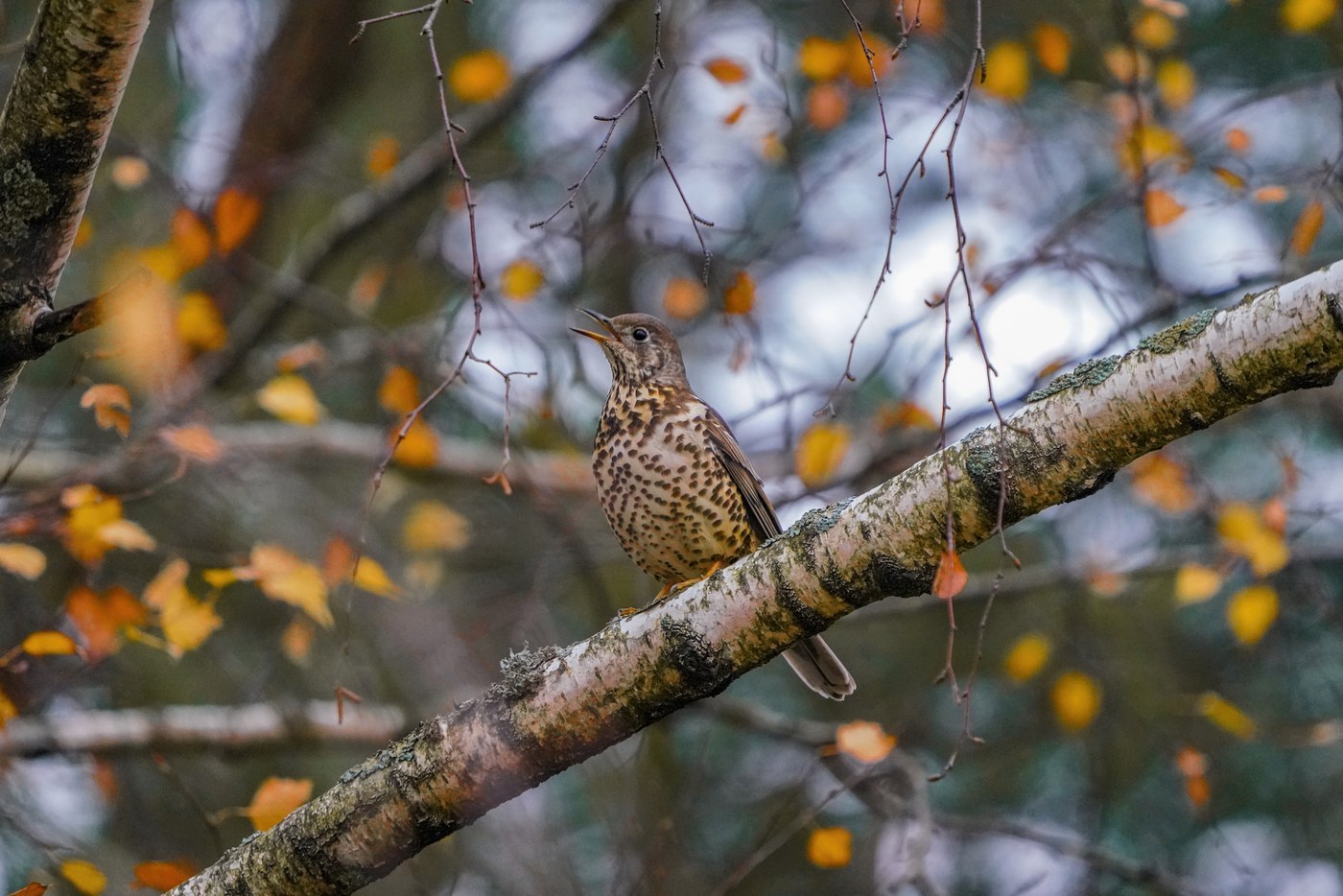
Key Field Marks
- Largest European thrush, about 27 cm (10.5 in), noticeably bigger and bulkier than a Song Thrush, with a long tail and upright, confident stance.
- Upperparts are cold grayish-brown; underparts whitish to pale cream, densely covered in bold, rounded blackish spots (more rounded and coarser than Song Thrush's smaller, arrow-shaped spots).
- White underwing linings flash in flight, along with pale tips to the outer tail feathers.
- Flight is strongly undulating, with bursts of wingbeats followed by closed-wing glides.
Separating It From Similar Species
Song Thrush
- Smaller and warmer brown above, with smaller, more triangular/arrow-shaped spots packed more densely on a buffier breast; underwing is buffy-orange rather than white. Song Thrush is also more retiring and less bold than Mistle Thrush.
Fieldfare
- Has a gray head and rump contrasting with a chestnut back — a completely different pattern — and is highly gregarious in winter flocks, unlike the more solitary or pair-based Mistle Thrush.
Behavior & Voice
- Famously bold and aggressive, vigorously defending berry-laden trees (especially mistletoe, holly, and hawthorn) from other birds in winter — the source of its name.
- Often perches high and exposed at the very top of a tall tree to sing, including during wind and rain, earning the old nickname "storm cock."
- Song is loud, far-carrying, and fluty, made up of short repeated phrases, somewhat like a Blackbird's but more monotonous and wilder-sounding.
- Call is a distinctive dry, rattling chatter, often compared to a football rattle or ratchet — very different from any other common European thrush call.
Habitat, Range & Season
- Found in open woodland, parkland, farmland with hedgerows and scattered trees, and large gardens across most of Europe, western Asia, and North Africa.
- Largely resident in milder areas, with northern and eastern populations moving south and west in winter.
- Sings from very early in the year, sometimes as early as midwinter, well before most other resident songbirds.
Frequently asked questions
How do I separate a Mistle Thrush from a Song Thrush?
Mistle Thrush is larger and colder gray-brown with bold, rounded spots and a white underwing, while Song Thrush is smaller, warmer brown, with smaller triangular spots and a buffy underwing.
Why is the Mistle Thrush called the 'storm cock'?
Because it often sings loudly from an exposed treetop perch even during windy, stormy weather, when most other birds stay quiet.
What does the Mistle Thrush's call sound like?
A dry, rattling chatter, often likened to the sound of a football rattle or ratchet, quite distinct from other thrush calls.
Why does the Mistle Thrush defend certain trees in winter?
It aggressively guards individual berry-rich trees, such as those with mistletoe or holly, as a private winter food supply, chasing off other birds that try to feed there.