
Mississippi Kite Identification Guide
A slim, buoyant gray raptor of the southern Great Plains and Southeast that hawks insects on the wing with falcon-like grace.
Read the full Mississippi Kite encyclopedia entry →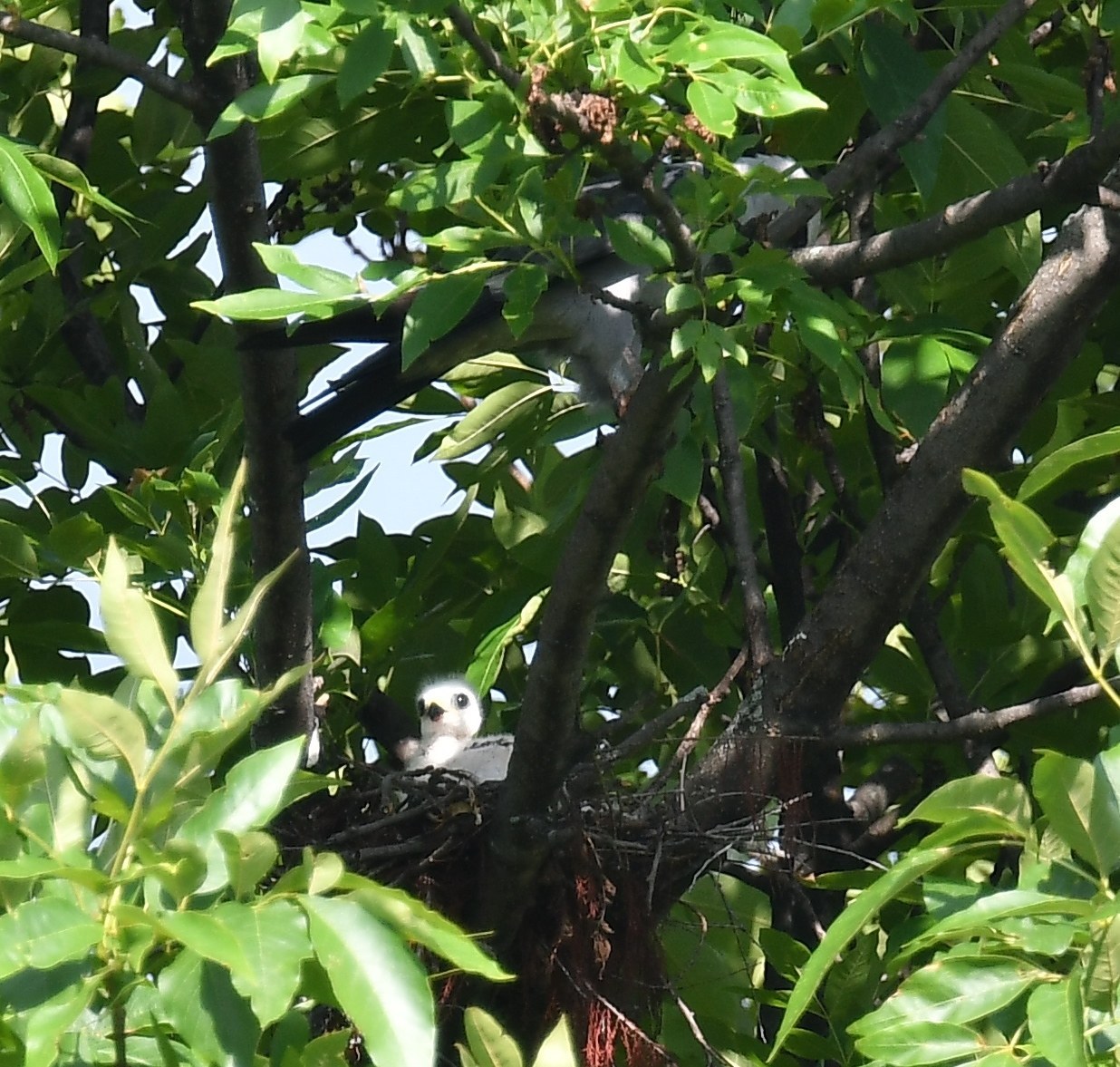
Key Field Marks
- Small, slender raptor, about 35 cm (14 in) long with long, pointed wings and a wingspan near 80 cm.
- Adult: pale gray head contrasting with darker slate-gray body; blackish tail and outer primaries against paler secondaries create a subtle two-toned wing pattern in flight.
- Red eye visible at close range on adults.
- Juvenile: heavily streaked brown below with a banded tail, taking a couple of years to reach full adult plumage.
- Flight silhouette is falcon-like: pointed wingtips, buoyant, agile flight, often soaring on flat or slightly drooped wings.
Separating It From Similar Species
Swallow-tailed Kite
- Unmistakable: bold black-and-white plumage with a deeply forked tail, quite unlike the plain gray, square-tailed Mississippi Kite.
Peregrine Falcon
- Bulkier-bodied with a banded tail and heavier chest markings; Mississippi Kite is far slimmer and lighter in flight.
Merlin
- Smaller, stockier, with a strongly banded tail and different, more direct flight; lacks the kite's pale head and buoyant soaring.
Behavior & Voice
- Frequently catches large flying insects — dragonflies, cicadas, grasshoppers — directly out of the air, often eating prey on the wing.
- Soars and glides for long periods with minimal flapping, sometimes in loose flocks, especially during migration.
- Call is a thin, high-pitched two-note whistle, often rendered "phee-phew" or "klee-eek."
Habitat, Range & Season
- Breeds across the southern Great Plains and southeastern United States, favoring open woodlands, shelterbelts, riparian corridors, and increasingly urban parks and golf courses.
- Long-distance migrant that winters mainly in southern South America, including Argentina and Paraguay.
- Migrates in flocks, sometimes traveling alongside Swainson's Hawks and Broad-winged Hawks; look for it in the U.S. from April through September.
Frequently asked questions
What time of year can I see Mississippi Kites in the U.S.?
They are present as breeders roughly from April through September, then migrate to winter in South America.
How does a Mississippi Kite hunt?
It typically catches large flying insects such as dragonflies and cicadas directly in the air, often consuming prey while still flying.
How do I tell adult from juvenile Mississippi Kites?
Adults are clean pale gray on the head with a darker gray body and red eye; juveniles are heavily streaked brown below with a banded tail.
Are Mississippi Kites found in cities?
Yes, they have adapted well to urban and suburban settings with mature trees, including parks, golf courses, and residential neighborhoods within their breeding range.