
Military Macaw Identification Guide
A large, mostly olive-green macaw with a red forehead patch and bare white facial skin, found in scattered forest and canyon populations from Mexico to Argentina.
Read the full Military Macaw encyclopedia entry →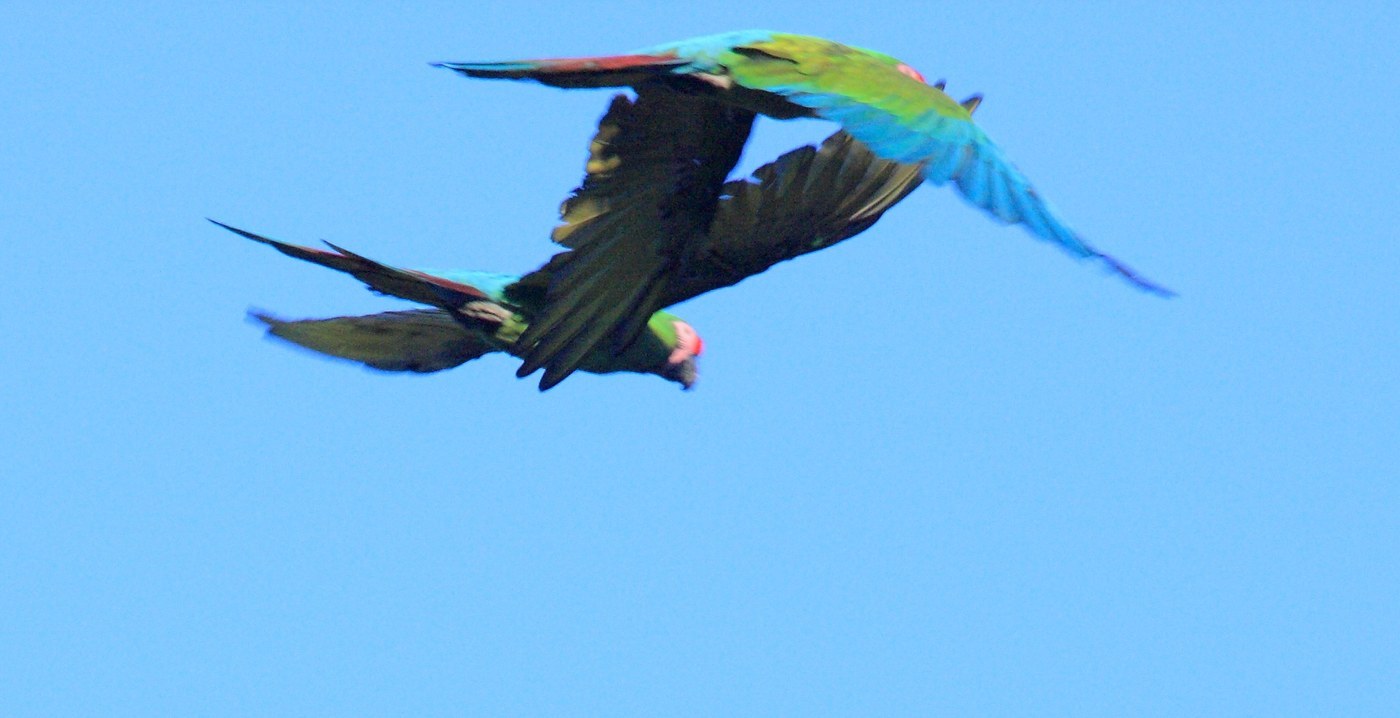
Key Field Marks
- Large macaw, about 70 cm (28 in) long including a long, pointed tail, with a wingspan approaching 1 m.
- Overall plumage is a rich olive to dull green (not bright emerald), darker and duller than the closely related Great Green Macaw.
- Bright red forehead patch just above the base of the bill — the clearest close-range field mark.
- Bare, whitish facial skin patch around the eye is marked with fine lines of tiny blackish feathers, giving a subtly striped appearance up close.
- Flight feathers show blue-green tones; tail is brownish-red at the base with a blue tip, showing red in flight from below.
- Bill is pale horn-gray on the upper mandible with a blackish lower mandible.
Separating It From Similar Species
Great Green Macaw (Buffon's Macaw)
- Larger and noticeably paler, brighter yellowish-green overall, with an orange-tinged tail base; found in wetter Central American and Chocó lowland forest, generally not overlapping with core Military Macaw range.
Scarlet and Green-winged Macaws
- Both are predominantly red, not green, so are easily eliminated by overall body color.
Blue-and-yellow Macaw
- Blue upperparts and yellow underparts rule this species out immediately.
Behavior & Voice
- Travels in pairs or small, noisy flocks, with slow, deep, deliberate wingbeats typical of large macaws.
- Gives loud, raucous, far-carrying screeches and croaking calls, especially in flight and at communal roosts.
- Many populations roost and nest on cliff faces and in limestone canyons, sometimes gathering in large numbers at traditional roost sites at dusk and dawn.
Habitat, Range & Season
- Occurs in disjunct populations from western Mexico south through parts of Colombia, Venezuela, Ecuador, Peru, Bolivia, and into northern Argentina.
- Favors semi-humid to arid pine-oak forest, tropical deciduous forest, and rugged limestone canyon country, generally at middle elevations.
- Non-migratory but locally nomadic, moving between foraging areas and traditional cliff roosts throughout the year.
Frequently asked questions
How can I tell a Military Macaw from a Great Green Macaw?
Military Macaw is duller olive-green and smaller with a less extensive facial skin pattern, while Great Green Macaw is larger, brighter yellowish-green, and has an orange wash at the tail base.
Where is the best place to see Military Macaws?
Look near limestone canyons and cliff faces in arid to semi-humid forest, from western Mexico through the Andean foothills of South America, especially around traditional dusk roost sites.
What does the red patch on a Military Macaw indicate?
It's simply a fixed plumage feature — the red forehead patch appears in both sexes and at all ages once feathered, and is not a display or breeding-only marking.
Are Military Macaws social birds?
Yes, they are typically seen in pairs or small flocks and often gather communally at cliff roosts, calling loudly as they arrive and depart.