
Middle Spotted Woodpecker Identification Guide
A medium-sized European woodpecker told from its larger relative by a dull red (not black) crown, streaked flanks, and a much quieter, gleaning lifestyle in old-growth oak woodland.
Read the full Middle Spotted Woodpecker encyclopedia entry →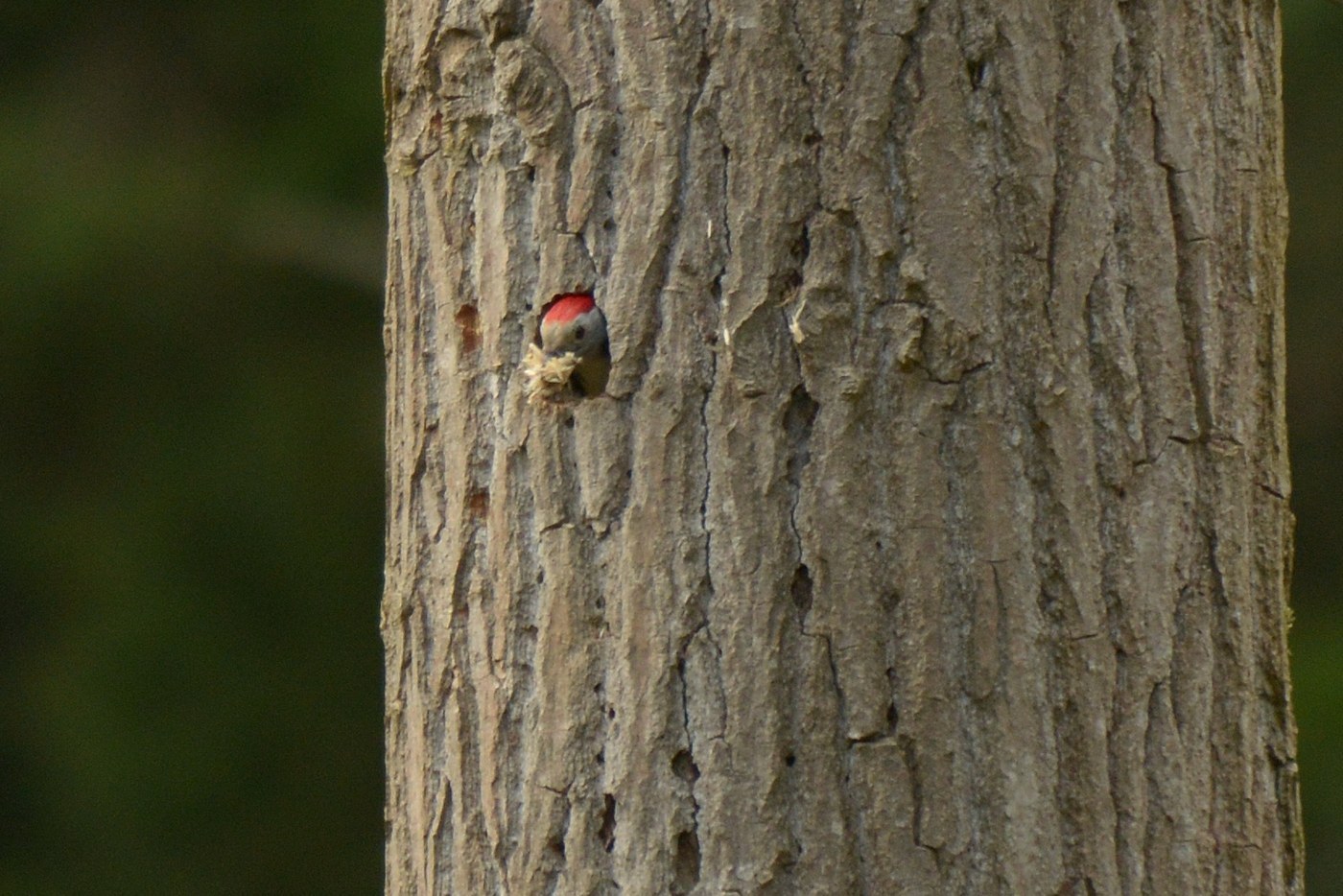
Key Field Marks
- Medium-sized woodpecker, roughly 20 cm (8 in), noticeably smaller and slimmer than a Great Spotted Woodpecker but bigger than a Lesser Spotted.
- Crown color is the giveaway: both sexes show a dull, pale pinkish-red crown (not glossy black), unlike the black-capped Great Spotted male or female.
- White face and cheeks with only faint, broken dark whisker marks that do not form a solid black moustache stripe reaching the bill or nape.
- Underparts are whitish with distinct blackish streaking down the flanks, rather than the plain white belly of Great Spotted.
- Vent (undertail) is pale pink, less vivid than the bright red vent patch of Great Spotted.
- Bill is noticeably thinner, shorter, and less chisel-like — built for gleaning bark rather than heavy excavation.
Separating It From Similar Species
Great Spotted Woodpecker
- Great Spotted has a solid glossy black crown (male) or black crown (female), a bold black moustache stripe connecting to a black band down the neck, plain white underparts, and a bright red vent bordered by black.
- Middle Spotted lacks that solid black facial "harness," has streaked flanks, and a duller red crown in both sexes.
Lesser Spotted Woodpecker
- Much smaller (sparrow-sized), with extensive black-and-white barring across the back and wings and no red vent at all — easily eliminated by size and barred back alone.
Syrian Woodpecker
- Very similar to Great Spotted but lacks the black bar separating the red vent from the black upperparts; ranges mostly do not overlap with Middle Spotted in the core of its range.
Behavior & Voice
- Forages by gleaning and hopping along small branches and twigs high in the canopy rather than hammering trunks — drums only rarely and softly, using calls instead of loud drumming to advertise territory.
- Calls include a nasal, single "kik" and a distinctive rattling, whinnying territorial call, "kek-kek-kek-kek," delivered in a fast series.
Habitat, Range & Season
- Closely tied to mature, structurally complex deciduous woodland — especially old oak forest, floodplain forest, and orchards with plenty of standing dead wood.
- Resident (non-migratory) across central, southern, and eastern Europe into Anatolia and the Caucasus; notably absent from Britain, Ireland, and most of Scandinavia and Iberia.
- Present year-round wherever found; look and listen for it especially in late winter and early spring when calling activity peaks before nesting.
Frequently asked questions
How do I tell a Middle Spotted Woodpecker from a Great Spotted Woodpecker?
Check the crown and face: Middle Spotted has a dull pinkish-red crown (in both sexes) and no solid black moustache stripe, while Great Spotted has a glossy black cap (male) and a bold black stripe running from the bill down the neck.
Does the Middle Spotted Woodpecker drum like other woodpeckers?
Rarely and only briefly. It relies mainly on vocal calls, especially a whinnying rattle, rather than loud territorial drumming.
What habitat should I search for this species?
Old, structurally rich deciduous woodland with mature oaks and abundant dead wood; it is largely absent from young or heavily managed forest.
Is the Middle Spotted Woodpecker found in the UK?
No, it does not occur in Britain or Ireland; its range is centered on central, southern, and eastern continental Europe.
Are males and females different in this species?
Only slightly — both sexes show the dull red crown, but males typically show a bit more red extending further back on the crown than females.