
Meyer's Parrot Identification Guide
A stocky, mostly brownish-grey African parrot with contrasting yellow shoulder patches and a variable yellow crown patch, common in savanna woodland across much of sub-Saharan Africa.
Read the full Meyer's Parrot encyclopedia entry →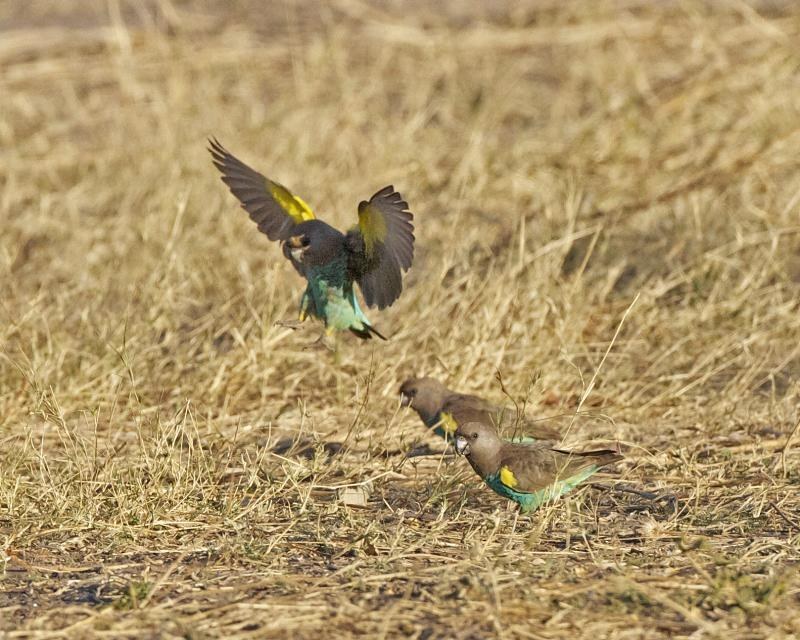
Key Field Marks
- Size & shape: A medium-small, compact parrot about 21–23 cm (8–9 in) long, with a short square tail and the stocky build typical of the genus Poicephalus.
- Body: Mostly brownish-grey to olive-brown body plumage, with a contrasting bright green to turquoise lower belly and rump and yellow patches on the shoulder (bend of the wing/carpal area) — the most reliable field mark for the species.
- Head: Variable amount of yellow on the forecrown, ranging from a small patch to none at all depending on subspecies and individual, with the rest of the head brownish-grey like the body.
- Bill: Blackish-grey, stout, strongly hooked bill typical of Poicephalus parrots.
- Flight: Fast, direct flight on quick wingbeats; the yellow shoulder patches and greenish rump/belly can flash conspicuously as the bird banks in flight.
- Behavior: Usually encountered in pairs or small flocks, often quiet and easily overlooked while perched motionless in canopy foliage; more conspicuous in flight or when calling.
Similar Species
- Brown-headed Parrot (Poicephalus cryptoxanthus): Similar brownish-grey head and body, but Brown-headed Parrot typically shows a paler, more uniformly buffy-brown head without significant yellow, and yellow underwing coverts rather than shoulder patches as the key wing mark.
- Rüppell's Parrot (Poicephalus rueppellii): Range mostly separate (drier southwestern Africa, Angola/Namibia); males show blue on the belly rather than green, and females can show more yellow on the crown, but ranges rarely overlap with Meyer's Parrot.
- Senegal Parrot (Poicephalus senegalus): West African, with a bright yellow underside/belly (much brighter yellow-orange breast) and a green (not grey-brown) head, occurring well outside Meyer's Parrot's more eastern/southern African range.
Where & When to See It
- Range: Widespread across sub-Saharan Africa, from Ethiopia and South Sudan south through East Africa (Kenya, Tanzania) to Zambia, Zimbabwe, Botswana, and northern/eastern South Africa, and west into parts of Angola.
- Habitat: Savanna woodland, especially miombo and acacia woodland, riverine forest, and adjacent cultivated areas with large trees; frequently found near baobabs and other large trees used for roosting and nesting cavities.
- Season: Non-migratory resident year-round throughout its range; most easily located at dawn and dusk when pairs fly noisily between roost and feeding trees.
Voice
- Calls include sharp, shrill whistled and screeching notes given in flight, generally higher-pitched and less harsh than the calls of larger African parrots like African Grey Parrot.
- Often first detected by voice as a pair flies rapidly overhead between feeding trees.
Frequently asked questions
What is the best field mark for Meyer's Parrot?
Bright yellow patches at the bend of the wing (shoulder), combined with an otherwise brownish-grey body and a contrasting green-turquoise lower belly and rump.
How do I tell Meyer's Parrot from Brown-headed Parrot?
Meyer's Parrot shows yellow shoulder patches as its main wing feature, while Brown-headed Parrot instead shows yellow underwing coverts and typically a plainer, more uniform buffy-brown head lacking significant yellow.
Does every Meyer's Parrot have a yellow crown?
No, the amount of yellow on the forecrown is variable by subspecies and individual, ranging from a distinct patch to almost none, so it should not be relied on alone for identification.
What habitat should I search for Meyer's Parrot?
Savanna and miombo/acacia woodland across sub-Saharan Africa, especially areas with large trees such as baobabs used for roosting and nesting.