
Mexican Whip-poor-will Identification Guide
A cryptically patterned nightjar of southwestern mountain forests, virtually identical in appearance to Eastern Whip-poor-will but separable by range, habitat, and its slower, more measured nocturnal song.
Read the full Mexican Whip-poor-will encyclopedia entry →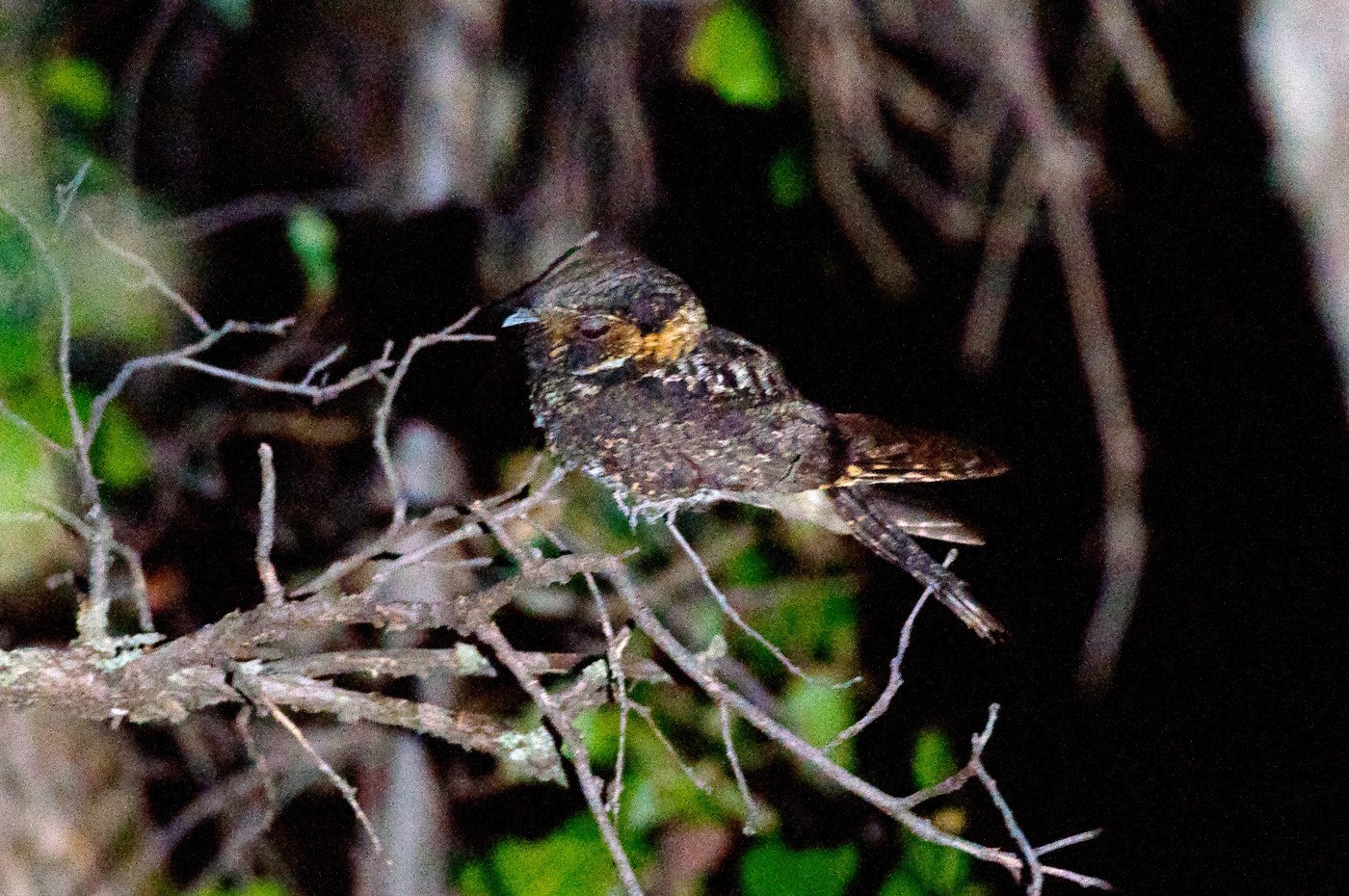
Key Field Marks
- Size & shape: A medium-sized nightjar about 22–26 cm (8.5–10 in) long with a large flat head, tiny bill, huge dark eyes, and long rounded wings and tail typical of the whip-poor-will group.
- Plumage: Intricately patterned, cryptic mottled grey-brown, black, and buff plumage that provides excellent camouflage against leaf litter and bark, virtually indistinguishable in the field from Eastern Whip-poor-will by plumage alone.
- Throat: Male shows a white throat patch/lower border and white outer tail corners visible in flight; females show buffier, less contrasting tail corners.
- Behavior: Almost entirely nocturnal and crepuscular; spends the day motionless on the ground or a horizontal branch, relying on camouflage, and becomes active at dusk to hunt flying insects in low, fluttery flight.
- Best identification approach: Because this species is essentially identical in appearance to Eastern Whip-poor-will, voice and range/habitat are the primary identification tools, not plumage.
Similar Species
- Eastern Whip-poor-will (Antrostomus vociferus): Nearly identical in plumage; the two were considered one species until a 1997 split. Eastern Whip-poor-will occurs in eastern North American deciduous/mixed forest at lower elevations, while Mexican Whip-poor-will occupies southwestern montane pine-oak forest — ranges barely overlap, and song is the most reliable way to separate them where ambiguity exists.
- Common Poorwill (Phalaenoptilus nuttallii): Smaller and shorter-tailed, with a squarer tail shape and a distinctly different, shorter "poor-will" song (versus the longer "whip-poor-will" phrase), and tends to favor drier, more open scrub/desert habitat.
- Common Nighthawk (Chordeiles minor): Longer, more pointed wings with a bold white wing bar, and an active, erratic aerial foraging style at dusk, quite different from the whip-poor-wills' low fluttering sallies from the ground.
Where & When to See It
- Range: Mountains of the southwestern United States (southeastern Arizona, southwestern New Mexico, west Texas) south through the highlands of Mexico to Honduras/Nicaragua.
- Habitat: Pine-oak and montane pine forest, typically at higher elevation than Eastern Whip-poor-will's habitat, often in canyons and foothill woodland with open understory for ground roosting.
- Season: Breeds in the southwestern US spring through summer, generally arriving in April/May and departing by September/October for wintering areas in Mexico and Central America; almost entirely nocturnal, so most often detected by voice at dusk and after dark rather than seen.
Voice
- Song is a repeated, whistled "whip-poor-WEEL" (or similar) phrase, but delivered at a notably slower pace and lower pitch than Eastern Whip-poor-will's faster, more urgent-sounding song — the single best way to distinguish the two species where their ranges might otherwise create confusion.
- Calls are given persistently through the night, especially around dusk and dawn and on moonlit nights.
Frequently asked questions
How is Mexican Whip-poor-will different from Eastern Whip-poor-will?
The two species look virtually identical in plumage. They are best separated by range (Mexican Whip-poor-will is a southwestern montane species, Eastern occurs in eastern North American forests) and by song, with Mexican Whip-poor-will singing more slowly and at a lower pitch.
What habitat does Mexican Whip-poor-will prefer?
Pine-oak and montane pine forest at moderate to high elevation in the mountains of the southwestern US and Mexico.
Why is Mexican Whip-poor-will so hard to see?
It is nocturnal and spends daylight hours motionless on the ground or a horizontal branch, relying on cryptic plumage for camouflage; it is far more often heard than seen.
When were Mexican and Eastern Whip-poor-wills recognized as separate species?
They were split into two species in 1997, based primarily on differences in voice, since the two are nearly identical in appearance.